
AI-powered learning platform development combines a learning product with features such as adaptive practice, course recommendations, AI assistance, and instructor-reviewed content generation. Building one means defining the learning task, preparing reliable content and data, testing the AI against that task, and integrating it without losing control of learner records or course rules.
A platform can recommend another lesson without knowing whether the learner understood the last one. It can also produce a fluent explanation that teaches the wrong method. The product decision is therefore specific: which learning problem will this feature address, what evidence will it use, and who can correct it?
For a new product, start with the audience and course structure covered by our e-learning design and development work. For an existing product, an AI feature may fit inside its current LMS. Neither route requires replacing every course workflow or training a model from scratch.
For those who prefer to listen rather than read, this article is also available as a podcast on Spotify.
What Is an AI-Powered Learning Platform?
An AI-powered learning platform uses models to make recommendations, generate assistance, or estimate learner needs within an education product. Its course catalog, enrollment, permissions, assessments, and progress records still need ordinary software with explicit rules.
Consider a learner who repeatedly makes the same error in a practice exercise. The platform could offer an approved explanation, recommend a prerequisite lesson, or give the instructor a review request. Each action needs a different level of evidence. A failed attempt may reveal a knowledge gap, but it could also reflect a confusing question or an inaccessible interface.
Personalization does not always require machine learning. A rule that unlocks the next module after a passed test is deterministic course logic. Use it when it solves the problem. A learned model becomes worth evaluating when simple rules cannot adequately rank a large library, interpret open-ended questions, or recognize useful patterns in reliable data.
The distinction from LMS development is scope: an LMS manages learning operations; the AI layer supports particular decisions or interactions. An AI layer should not become the authority for access, certificates, or final grades simply because it can produce text.
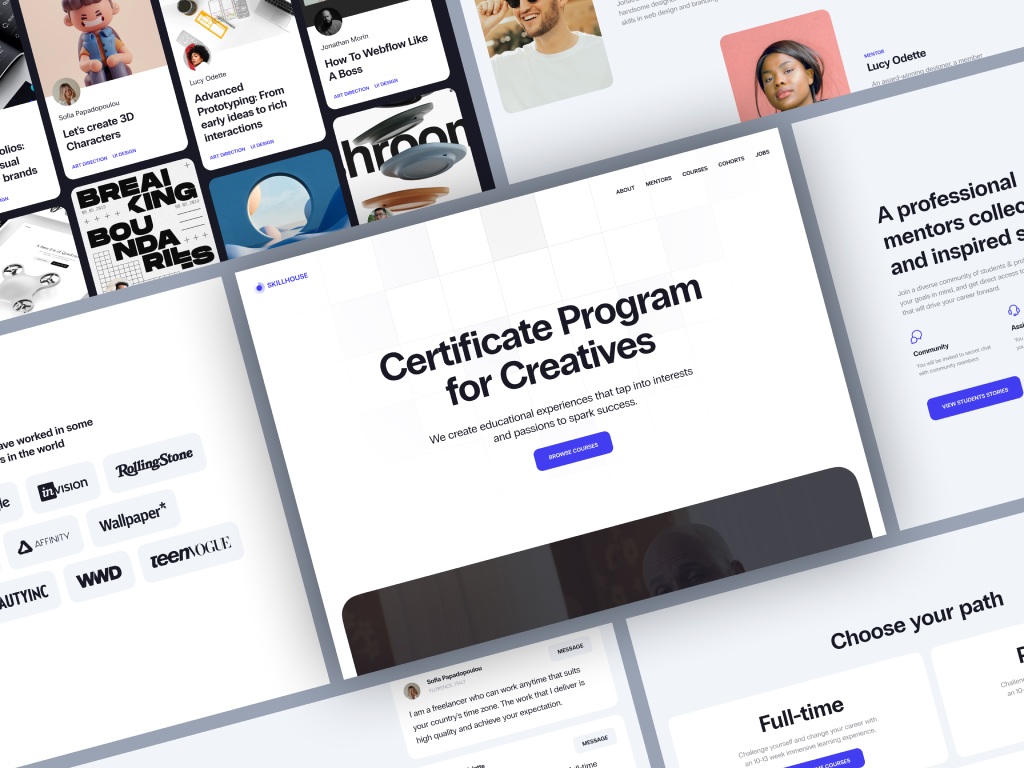
Skillhouse Elearning Platform by Shakuro
Types of AI learning systems
Choose the system by the decision it supports. Adaptive practice, conversational help, content discovery, and assessment assistance have different data needs and failure modes.
Adaptive learning platforms
Adaptive learning changes the next activity using evidence of current knowledge. Map each exercise to a skill and its prerequisites before asking a model to choose the next lesson. A new learner may need a short diagnostic or an instructor-selected starting point because there is no history to personalize from.
Keep the route reversible. Learners should be able to revisit material, and instructors should be able to override a recommendation. In corporate training platforms, required safety or compliance modules may remain mandatory even when the system predicts that someone knows the material.
AI tutoring systems
A tutor supports a conversation inside a lesson: a hint, a different explanation, or a question that checks understanding. Our guide to AI tutoring platform development focuses on that narrower interaction. Here, tutoring is one possible component of a broader learning product, not a requirement for every platform.
Set its limits visibly. It should identify itself as AI, distinguish practice help from graded work, and offer a route to an instructor. When the approved course material does not support an answer, the product needs a useful fallback rather than an invented explanation.
Recommendation engines
Recommendations rank eligible lessons or courses. Eligibility comes first: language, prerequisites, enrollment, licensing, and availability should filter the candidates before a model ranks them. A popular course that a learner cannot access is not a useful recommendation.
For a new catalog, subject tags and instructor-curated routes may be enough. Behavioral models need evidence that the recorded activity represents learning intent. A long video session may mean careful study, an idle tab, or difficulty following the material.
Automated assessment systems
Fixed-answer questions can be scored with explicit answer keys. AI assistance is a separate option for open-ended responses, draft feedback, or identifying patterns for an instructor to review. Do not make a generated score the only basis for a consequential decision.
Connect assessment evidence to eLearning analytics software so educators can inspect attempts, rubrics, and corrections. Reporting activity is not proof that an AI intervention improved learning.
Key Features of AI-Powered Learning Platforms
The useful feature set includes controls for learners and educators, not only model outputs. Someone must be able to understand a recommendation, reject a draft, report a bad answer, and recover when an AI service is unavailable.
Personalized Learning Paths
A learning path should explain its next step in terms of the course. For example, an illustrative recommendation might point to a fractions refresher after errors on fraction exercises; it should not label a learner as generally weak at mathematics.
Store the reason for a recommendation with the content and model version. That lets an instructor distinguish a course update from a change in learner performance. In educational SaaS platforms, keep each organization’s curriculum, access rules, and learner history separated throughout that process.
AI Tutoring and Assistance
A course assistant needs access to approved material, citations that open the relevant lesson, and an escalation path. Retrieval-augmented generation, or RAG, retrieves relevant material and includes it in the model’s context. It can improve grounding, but retrieving a document does not guarantee a correct explanation.
Separate what the model can read from what it can change. A lesson assistant may suggest practice without permission to edit grades, enroll users, or publish content. Treat learner messages and retrieved documents as untrusted input; permissions belong in the application, outside the prompt.
Predictive Analytics
A prediction should help an educator decide where to investigate, not permanently label a learner. Define the outcome first: an overdue assignment, a missed session, or course withdrawal are different targets with different meanings.
Evaluate false alarms as well as missed cases. If an alert merely reflects a change in work schedule, repeatedly sending remedial material can be counterproductive. Show the supporting signals and let the educator dismiss or correct the alert. Do not infer disability, motivation, or ability from activity logs alone.

E-learning Platform Website by Conceptzilla
Automated Content Generation
Generated quizzes, summaries, and exercises should enter a review workflow before publication. Each draft needs a source lesson, a learning objective, an answer or rubric, and a named reviewer within the product.
Keep draft and published states separate. When a source lesson changes, flag dependent questions for review instead of silently keeping an outdated answer key. Content owners also need the right to use the source material; uploading a textbook does not establish permission to reuse it.
Multi-Platform Learning Experience
Course progress should remain consistent when a learner switches devices. Model responses can be asynchronous, but a submitted assessment must not disappear because a connection drops. Design retries so the same submission does not create duplicate attempts.
For mobile learning platform development, decide which lessons can be downloaded and which AI functions require connectivity. Provide readable fallback content offline. A responsive web interface may be enough initially; dedicated apps need a separate case based on device features and actual use.
AI Learning Platform Development Process
Build a complete, testable learning workflow before expanding the feature list. The following sequence keeps data, instructional review, integration, and operations in the same delivery plan.
1. Define the use case and audit the data
Choose one initial task and a non-AI baseline. For course discovery, compare recommendations with the current catalog navigation. For practice help, compare the assistant with an approved explanation and a route to a teacher. Define what would make the feature useful and what would prevent release.
Inventory content and learner events separately. A content record needs an owner, version, subject, prerequisites, language, and access policy. An attempt record needs the exercise version, timestamp, result, and a reliable learner identifier. Collect only the information the feature actually needs; do not send complete student records to a model by default.
2. Design learner and instructor controls
Prototype successful answers and failure states together. Show what happens when a source is missing, a response is delayed, a learner disputes feedback, or an instructor disables the feature. The user should still be able to continue an approved course without AI.
Test keyboard operation, screen-reader labels, readable feedback, and citations on small screens. Avoid forcing a conversation when a direct link to the relevant lesson would answer the question.
3. Choose the technology stack
The stack should fit the workflow and the team maintaining it. A practical starting architecture can use a React interface, an application backend, PostgreSQL for course and progress records, object storage for media, and a separate AI service. These are options, not a required bundle.
Python with FastAPI development can suit model-facing APIs and data processing. Node.js or an existing backend can continue managing product workflows. Add a retrieval index only if the feature needs semantic search; keep its content permissions synchronized with the source system.
A hosted model API avoids operating model servers, while self-hosting introduces capacity planning and model maintenance. Compare both against data restrictions, measured response quality, latency, and usage costs. Kafka, Spark, and Kubernetes are not prerequisites for a first release; introduce them when workload and operational needs justify them.
4. Build the model workflow and evaluation set
Start with representative course tasks, not a model leaderboard. Create a held-out evaluation set that includes correct answers, ambiguous questions, missing prerequisites, unsupported requests, and attempts to access another learner’s or organization’s data.
For recommendations, test eligible-content coverage and instructor judgment alongside ranking metrics. For generated explanations, check correctness, source support, pedagogical usefulness, and appropriate refusal. Fine-tuning is an option for a demonstrated gap, not an automatic step; it does not replace current source material or access controls.
Keep evaluation examples separate from training data. Include content versions and language groups relevant to the release. Subject specialists must review the educational claims; an automated evaluator can help screen outputs but cannot be the sole judge of its own teaching quality.
5. Integrate with the learning system
Keep the LMS or platform as the source of truth for enrollment, course access, and official progress. Define which service may read or write each record, how identities map across systems, and how failed updates are retried and reconciled.
An AI assistant should not display a lesson from a different course simply because it appears in the search index. Test course-level and organization-level boundaries through retrieval, cached responses, logs, and exports. Use an audit trail for instructor overrides and changes to published content.
6. Validate quality and learning impact separately
Technical validation asks whether the feature is safe and usable. Educational evaluation asks whether it helps learners meet a stated objective. A rise in chat messages, session duration, or course clicks answers neither question on its own.
Before a pilot, agree on assessment criteria and a comparison method with an educator. Compare performance on suitable tasks rather than repeated exposure to the same answers. Record limitations such as small samples, self-selection, or differences in starting knowledge; do not promise an improvement before measuring it.
Test load, timeouts, provider rate limits, deletion, and recovery as well. A model outage should disable optional assistance, not prevent learners from submitting their work.
7. Release with monitoring and rollback
Release to a limited audience with a named owner for incidents. Monitor failed requests, response latency, unsupported answers, reviewer corrections, and cost per completed task. Version prompts, retrieval settings, content, and models so a regression can be traced and rolled back.
Continuous improvement does not mean automatically training on every student conversation. Decide what may be retained or reused, under which permissions, and for how long. Re-evaluate changes before wider rollout. Include this work in the scope of ongoing software support services.
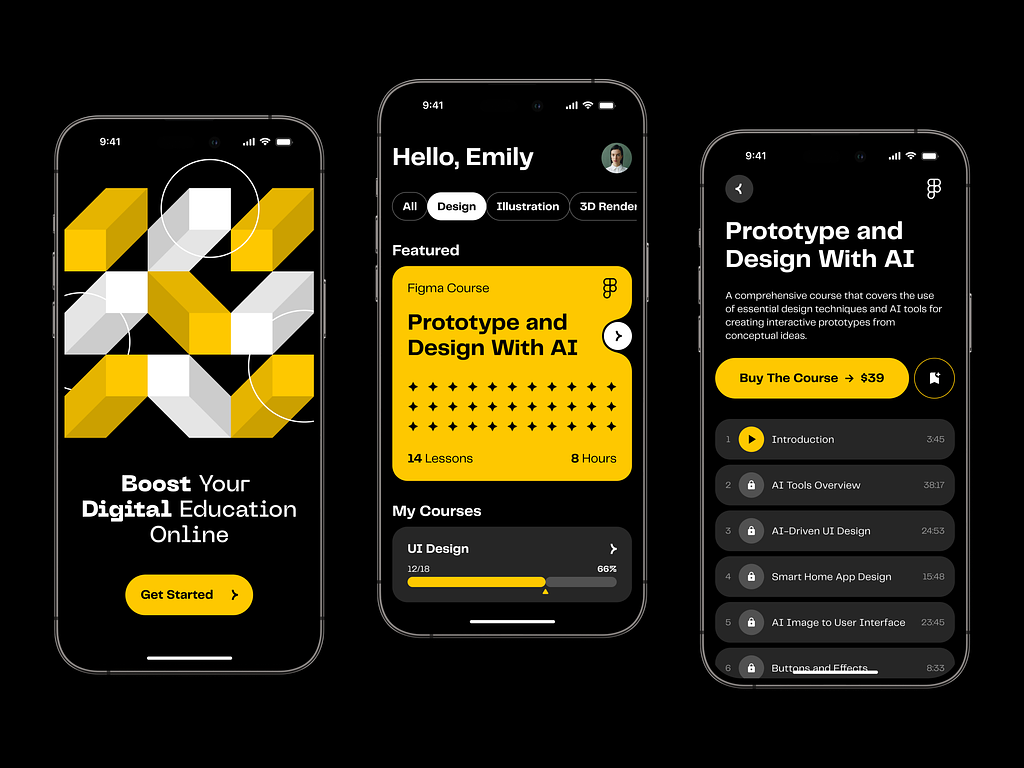
Online Course Educational Mobile App by Shakuro

Cost of AI Learning Platform Development
The budget depends on what already works and what must be built: the learning platform, the AI workflow, data preparation, integrations, review tooling, and operations. A quote should separate initial delivery from ongoing model usage and human quality review.
| Scope decision | Work to include in the estimate | Evidence needed |
| Add AI to an existing LMS | Identity mapping, content access, integration, permissions, fallback | API documentation and a sample course |
| Build a new learning product | Course operations, learner and instructor interfaces, progress records, plus AI | Roles, course structure, launch workflow |
| Prepare data and content | Cleaning, tagging, rights review, versioning, evaluation examples | Representative material and event records |
| Choose model delivery | Provider integration or hosting, retrieval, evaluation, monitoring | Quality tests, data rules, expected peak usage |
| Operate after launch | Inference, storage, support, content review, regression testing | Usage assumptions and named operational owners |
Should you buy, extend, or build?
Buy a product when its course workflows, AI controls, data terms, and reporting meet your needs. Extend an existing LMS when it already handles enrollment and progress reliably. Build custom software when the distinctive learning workflow or integration requirements justify owning the product and its maintenance.
Compare the same scope across proposals. Include licenses, integration, migration, inference or hosting, educator review, support, and the ability to export content and learner records. A lower implementation quote can exclude ongoing work your team will still need to do.
To get a useful estimate, prepare a sample course, learner roles, the first AI use case, existing-system documentation, data restrictions, and expected concurrent usage. Discuss your AI learning platform scope with Shakuro to compare a focused integration with a custom build before committing to the larger project.

Common Challenges in AI Learning Platform Development
The recurring risks are unreliable evidence, unsupported output, exposure of learner data, and operational dependencies. Plan a control and an accountable owner for each before release.
Data quality and misleading signals
Duplicated quiz events, changed answer keys, and missing offline activity can distort a learner profile. Validate event collection against actual attempts and preserve exercise versions. If there is not enough reliable history, use a curated route rather than manufacturing a precise recommendation.
Accuracy and unequal performance
An answer can cite the right lesson and still apply it incorrectly. Test unfamiliar wording, different languages, accessibility needs, and tasks outside the supported curriculum. Keep human review for consequential decisions and a way for learners to challenge feedback.
The NIST AI Risk Management Framework offers voluntary guidance for incorporating trustworthiness into AI design, development, use, and evaluation. It is a risk-management reference, not a certificate that a learning product is safe or effective.
Privacy, access, and retention
Map where student data travels, including prompts, provider logs, analytics, retrieval indexes, and backups. Establish access controls and retention rules for each destination. Check provider terms for storage and training use rather than assuming an API call is private by default.
Requirements depend on the audience, institution, jurisdiction, and contract. In the US, the Department of Education’s FERPA overview explains rights concerning education records and disclosure of personally identifiable information. Use qualified legal review to determine the obligations for your deployment, including any child-specific requirements; a generic consent checkbox is not a compliance plan.
Latency, cost, and graceful failure
Separate course delivery from optional inference so a slow model does not stall a lesson. In video-based learning platforms, playback should remain independent of an assistant generating an answer. Apply usage limits, timeouts, and workload-appropriate queues. If you cache answers, include the relevant course version and authorization boundary; never reuse a personalized response across learners indiscriminately.
Load-test the expected busy period, such as a cohort starting the same exercise. Measure the end-to-end wait and cost of a completed task, not only how fast the model produces its first token.
Our Experience in AI and EdTech Development
Shakuro’s published work shows both education-platform delivery and adjacent data-driven product development. Those cases establish specific capabilities; they do not establish an unmeasured learning improvement or prove that every AI feature described here was shipped in a client product.
For Proko, we designed and developed an art-education platform with course delivery, social interactions, a personalized feed, and responsive interfaces. The published case also describes analytics, basic feedback, and finding courses that match user interests. That is relevant to connecting learning content, product data, and user experience without claiming a particular model or improvement in test scores.
WYSPR is an adjacent example, not an education or AI-tutoring case. We built an iOS app for creatives and a management platform for an influencer-marketing agency, including project workflows, payments, contracts, and statistical data. The documented stack uses React and TypeScript, Ruby on Rails, and Swift.
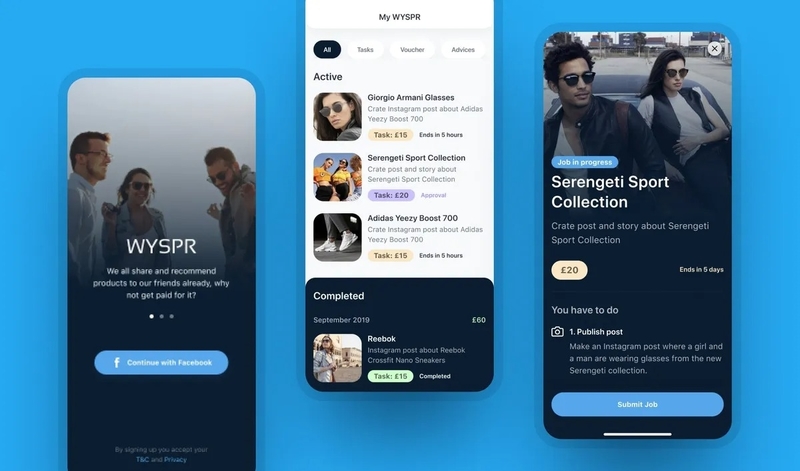
WYSPR, a Crowd-Promotion Service by Shakuro
The relevance of WYSPR is its connected user roles and operational data. For education-specific requirements, the Proko case is the closer reference. When discussing your platform, we can separate proven delivery experience from features that need a new prototype and evaluation.
Why Work with an AI Learning Platform Development Company
A development partner should explain how the learning workflow will be delivered and tested, not simply name a model. You still need an educator or subject specialist who owns the curriculum and assessment criteria.
- Ask for an architecture showing course records, model access, data boundaries, and fallback behavior.
- Ask who prepares evaluation examples, reviews incorrect answers, and approves a release.
- Compare integration and operating costs as well as the first build estimate.
- Agree on ownership of content, code, logs, configurations, and exportable learner records.
- Require a handover and support plan, including model-provider changes and rollback.
Shakuro’s AI development services can support the product and engineering work around those decisions. Bring a course sample and an intended learner workflow so the discussion can start with a concrete scope rather than a list of AI features.
FAQ
How much does AI-powered learning platform development cost?
A meaningful estimate needs the initial workflow, existing platform, content quality, integrations, data requirements, and expected usage. Separate the build from model usage, hosting, educator review, and support. Extending a functioning LMS and building a new multi-role product are different scopes; there is no defensible universal price for both.
Which AI features should an AI learning platform launch with?
Choose one task with available content, a clear baseline, and a review owner. Examples include eligible-course recommendations, instructor-reviewed quiz drafts, or assistance within one course. Start with explicit rules when they solve the task; add a model only when evaluation shows a useful reason.
What data does an AI-powered learning platform need?
It depends on the feature. A course assistant needs approved, permission-controlled source material. Adaptive practice also needs skill mappings and reliable attempt records. Recommendations may use catalog metadata before behavioral history exists. Collect only necessary learner data and define retention and access before using it.
Can AI features be added to an existing LMS?
Yes, if the LMS provides suitable access to courses, identities, permissions, and progress. Keep official records in the system of record, reconcile updates, and test course and tenant boundaries. Restricted APIs or poorly structured content may make integration the main part of the project.
How do you verify that AI improves learning?
Evaluate output quality first, then run a planned pilot against a suitable baseline with educator-defined assessment criteria. Measure performance on relevant tasks, account for starting knowledge, and report limitations. More clicks, longer sessions, or higher chatbot usage do not by themselves demonstrate better learning.
What maintenance does the platform need after launch?
Monitor quality, latency, failures, usage costs, and instructor corrections. Re-test changes to models, prompts, retrieval, and course content before rollout. Maintain permissions and deletion workflows, and keep a tested fallback. Do not automatically reuse student conversations as training data.
Final Thoughts
Before approving a build, confirm the first learning task, approved source material, the owner of quality review, and the action the system must never take on its own. Then choose whether to buy a product, extend your existing platform, or build a custom workflow.
If you are planning an AI-powered learning platform, talk to Shakuro about your learning product. Share the audience, a representative course, and your current systems. We can discuss the product structure, integration approach, and a first release with explicit evaluation and operating requirements.