
EdTech marketplace development is building a platform where many instructors sell courses to learners, with profiles, course publishing, search, revenue sharing between the platform and instructors, and an admin panel. An MVP marketplace with video courses, simple search, and Stripe payments takes around 3–4 months and costs roughly $30,000–60,000. An enterprise platform with live classes, AI-driven recommendations, multi-vendor dashboards, and mobile apps takes 6–9 months or more and costs approximately $150,000–300,000+.
Teachable or Udemy are easier to start with, but you don’t own the audience or the data, and a change in fees or algorithms hits you directly. A custom marketplace costs more to build, but you decide how learning feels and you keep the users. As with other course platforms, a booking system bolted onto a website works for a few students and breaks at scale.
Below, we cover key features, the development process, cost, common challenges, and our own marketplace and edtech software development projects.
For those who prefer to listen rather than read, this article is also available as a podcast on Spotify.
What is an EdTech Marketplace?
At its simplest, an EdTech marketplace is a digital middleman. On one side, you have content creators who have something valuable to share. On the other, you have learners hungry for that specific skill or insight. The platform’s job is to make that connection seamless. It handles the messy bits: hosting the videos, processing the payments, and making sure the right student finds the right teacher. If video is the core of the product rather than one feature, the architecture looks closer to a video-based learning platform.
The instructor creates the course, the custom edtech marketplace helps learners discover it through search or recommendations and then facilitates the transaction. Everyone wins. The teacher gets paid, the student learns, and the platform takes a small cut for keeping the lights on.
Types of Learning Marketplaces
Not all marketplaces are built the same. In fact, trying to copy Udemy’s model when you’re building for corporate compliance training is a recipe for disaster. You’ve got to pick your lane.
Open Marketplaces
This is the “wild west” approach. Udemy or Skillshare looked like this in their early days. Basically, anyone can sign up as an instructor, upload a course, and start selling. Companies that only need to train their own staff are usually better served by an LMS. The barrier to entry is super low.
The upside is you get a massive amount of content quickly. It’s great for scaling supply. But the downside is quality control. You end up with some gems buried under a mountain of mediocre stuff. For founders, this means you need really strong search and rating algorithms, because you can’t manually check every single video. It’s a volume game.
Curated Marketplaces
On the flip side, you have platforms like MasterClass or Coursera. Here, the platform owners actively review and approve content. Sometimes they even produce it themselves.
This builds trust. Learners know that if it’s on the platform, it’s probably good. But multi-tenant SaaS platforms can be hard to scale. In course marketplace development, you’re bottlenecked by your own review team. Startups struggle here because they tried to be too picky too early, ending up with an empty platform. It’s a balancing act. You want quality, but you also need enough variety to keep people coming back.
Niche Marketplaces
Instead of teaching “everything,” these platforms focus on one specific industry or skill set. The category includes coding bootcamps, medical continuing education, or even something hyper-specific like “advanced sourdough baking for professionals.”
Why does this work? Because the audience is targeted. Marketing is easier because you know exactly who your user is. The instructors are often recognized experts in that tiny field, which adds credibility. Plus, you can tailor features specifically for that niche.

Online Education Web Platform Design by Conceptzilla
For example, a coding marketplace might need an integrated code editor, while a music lesson platform needs high-quality audio streaming. One size definitely doesn’t fit all here.
Core Components
Okay, so you’ve picked your type of the course marketplace software. What actually goes into building the thing? It’s easy to get lost in the fancy AI features, but if you don’t nail the basics, the whole thing falls apart. Here are the non-negotiables.
Multi-Vendor System
Unlike a standard e-commerce store where you’re the only seller, here you have hundreds or thousands of “vendors” (instructors). Your system needs to handle separate accounts, permissions, and data isolation for each of them. They need to feel like they have their own little shop within your mall.
Course Management
Instructors need a way to upload videos, write descriptions, add quizzes, and organize modules. It has to be intuitive. If it’s too hard to upload a course, they’ll leave. I’ve seen clunky CMS interfaces kill instructor retention faster than bad pay rates. Keep it simple. Drag-and-drop, clear progress indicators, maybe even a preview mode.
Payment System
In online learning marketplace development, money matters. You need a secure, reliable way to process transactions. However, you also need to split that money. The student pays $100, the platform takes $20, and the instructor gets $80. This “split payment” logic needs to be automated and transparent. Payout delays are a huge pain point for creators, so getting this right is critical for keeping your supply side happy.
User Dashboards
Both sides need a home base. Learners need to see their enrolled courses, progress bars, and certificates. Instructors need analytics: how many views, how much revenue, what the conversion rate is, etc. Instead of just being data dumps, these dashboards should offer insights. Help experts understand how to sell better.
Rating and Review System
Trust is currency in a marketplace. Since learners can’t “try before they buy” in the traditional sense, they rely on social proof. A robust review system allows students to rate courses and leave feedback. But beware: you need moderation tools. Fake reviews or malicious trolling can destroy a platform’s reputation overnight. It’s a little annoying to manage, but absolutely necessary.
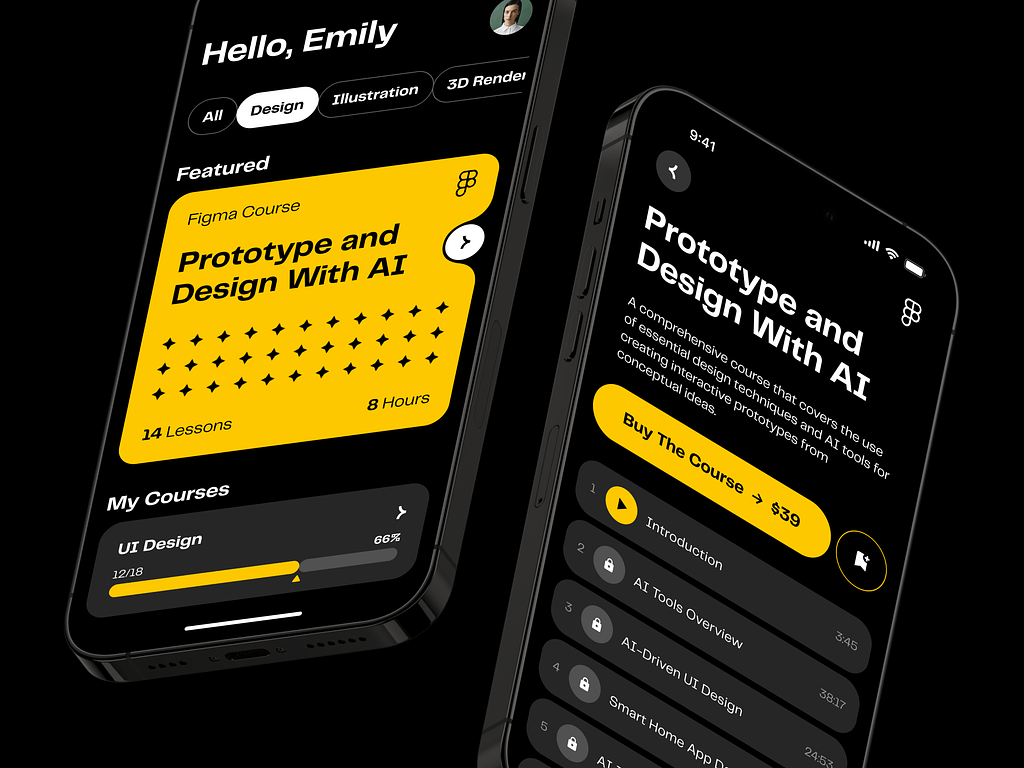
AI E-learning Mobile App by Shakuro
Key Features of an EdTech Marketplace
What actually makes a learning platform marketplace tick? It’s easy to say “we need a video player,” but that’s just the tip of the iceberg. The real magic lies in the features that keep both sides of the marketplace engaged. If you ignore these, you’re basically building a static website with a login button.
Instructor and Student Dashboards
You might think a dashboard is just a landing page after login. But in a marketplace, it’s the command center, and you can’t use the same one for everyone. Their goals are completely different.
Instructors care about money and engagement. They want to see how many students enrolled today, what their current balance is, and which lesson is causing people to drop off. If they have to click five times to find their earnings statement, they’re going to be annoyed. So, give them clear stats, easy access to their course editor, and a direct line to support.
Students, on the other hand, want progress. They want to pick up exactly where they left off. Their dashboard should highlight “Continue Learning” buttons, show completed courses, and maybe suggest the next logical step in their journey. It should feel encouraging, not like a spreadsheet.
Admins need a super-user view. They have to see everything: pending instructor approvals, flagged content, transaction disputes, and overall platform health. If your admin panel is clunky, your operational costs will skyrocket because your team will spend hours doing manual checks.
Course Publishing System
This is where the content lives. For instructors, this needs to be frictionless, like YouTube’s upload flow but with more structure. People need to upload videos, add PDFs, create quizzes, and set pricing.
However, this is more than just uploading files. An elearning marketplace platform requires version control. What if an instructor wants to update a video? Do you lose the old student progress? Can they preview the course before publishing?
The biggest bottleneck here is video processing. Instructors upload huge 4K files from their DSLRs. Your course creation systems need to transcode those into multiple resolutions automatically so they play smoothly on a phone or a laptop. If you skip this step, you’re asking for trouble. Buffering is the enemy of learning.
Payments and Revenue Sharing
Commissions are the standard model. You take a cut, say, 20-30%, and the rest goes to the instructor. They should be instantly calculated and locked in by your system. No ambiguity.
Payouts are where things get tricky. Do you pay out weekly or monthly? What’s the threshold? And how do you handle taxes? If you’re operating globally, you’re dealing with different currencies and tax laws. Integrating with something like Stripe Connect or PayPal Payouts is usually the best option here. Don’t try to build your own payment processing systems from scratch unless you have a team of accountants and engineers who love pain.
Subscriptions are becoming huge in education marketplace development. Instead of buying one course, students pay a monthly fee for access to everything. This changes the revenue sharing model. Now you have to figure out how to distribute that monthly fee among hundreds of instructors based on watch time or engagement. It’s a math problem, but it’s also a retention tool. Subscriptions keep cash flow predictable, which founders love.
Discovery and Search
If people can’t find what they want, they won’t buy it. You could have the best Python course in the world, but if it’s on page 50 of search results, it’s invisible.
Advanced search and filtering are non-negotiable. Users need to filter by skill level, duration, rating, and price. And the search has to be smart. If someone types “JS,” it should know they mean “JavaScript.” ElasticSearch or Algolia are great tools for this. Don’t rely on basic SQL queries; they’re too slow and dumb for this scale.
AI-driven recommendations are the secret sauce. Netflix doesn’t just show you random movies; it shows you what you’re likely to watch. Your platform should do the same. “Because you took Introduction to Marketing, you might like Social Media Strategy.” This drives upsells and keeps users on the platform longer.
Ratings and Reviews
In a physical store, you can touch the product. Online, you rely on other people’s opinions. A robust user feedback system is your best defense against low-quality content.
Still, course marketplace software needs written reviews with mechanisms to verify that the reviewer actually took the course. Fake reviews kill credibility. Also, consider allowing instructors to respond to reviews. It shows they care. It humanizes the platform.
Negative reviews aren’t always bad, though. A mix of 4-star and 5-star reviews looks more authentic than a perfect 5.0. It shows the course is real. Just make sure you have tools to flag abusive language or spam.
Analytics and Insights
Data is useless if you don’t look at it. Both you and your instructors need learning analytics systems. For the platform, you need to track Gross Merchandise Value (GMV), churn rate, and customer acquisition cost. Are you growing? Where are users dropping off?
For instructors, give them actionable insights. Don’t just say “100 views.” Say “80% of students drop off at minute 5 of Lesson 2.” That tells the instructor their intro is boring or the audio is bad. It helps them improve. When instructors improve, your platform gets better. It’s a virtuous cycle.

Landing Page for Drone Education Community by Shakuro
EdTech Marketplace Development Process
1. Product Strategy and Business Model
First of all, you need to know how you’re making money. It sounds obvious, but you’d be surprised how many people skip this.
Begin with the definition of your marketplace type. Are you going open, curated, or niche? This decision dictates everything from your marketing strategy to your tech requirements. If you’re curated, you need admin tools for approval workflows. If you’re open, you need robust automated moderation.
Then, design your monetization model. The standard one is based on commissions. You take a cut of every sale. Simple, but you need volume. Alternatively, you can opt for recurring revenue, which is king for valuation. However, it’s harder to sell initially. You need a lot of content to justify the monthly fee. Finally, featured listings. Instructors pay to boost their courses in search results. It’s a nice add-on, but don’t rely on it as your primary income source early on. It can feel “pay-to-win” if not handled carefully.
Pick one primary model and stick to it for launch. You can add others later. Trying to do all three at once is a recipe for confusion.
2. UX/UI Design for Marketplace Platforms
Design is about removing friction. In a marketplace, you have two distinct users with different goals. You need to map out their journeys separately while working on edtech marketplace development.
- Course discovery: How does a student find the right course? Keep the search bar prominent and use clear categories, showing ratings upfront. Don’t make people click three times to see the price.
- Onboarding: Quite often you lose half of the users at this step. So keep it short and clear. For instructors, let them upload one video before forcing them to fill out their entire tax profile. Give them a quick win. For students, ask for minimal info. Let them browse first.
- Purchases: Apple Pay, Google Pay, credit cards. They should be seamless, one click if possible. Every extra field in the checkout form drops your conversion rate.
3. Stack Selection
There is no such thing as the best technology stack for developing a course marketplace. However, there are some good options that work now.
When it comes to the backend of your app, you have some good options as well. If you plan on implementing any features that would benefit from real-time interaction, such as chat or notifications, go for Node.js. This is a fast solution with easy-to-understand code, which is written in JavaScript or TypeScript, and thus, your backend and frontend engineers will be able to communicate without problems.
Alternatively, if you plan on conducting heavy data analysis or implementing machine learning-based recommendations at some point, opt for Python with FastAPI.
React continues to be the de facto choice for frontend development, having an extensive ecosystem with plenty of developers to hire. Next.js can be combined with React for server-side rendering to achieve better results with SEO. However, for the small team or one that is not proficient enough in React, there is always Vue—an easy-to-learn and highly flexible framework for quick development.
As far as databases are concerned, there is no better option than PostgreSQL for structured data such as user profile information, order info, or metadata. It is stable, reliable, and supports complex queries very well. Nevertheless, for handling unstructured data, like different course structures or system logs, MongoDB will be useful. This database solution allows dealing with dynamic schemas in case of a marketplace.
Lastly, regarding infrastructure, Docker becomes an absolute must. Make sure you have containerized all aspects of your environment to ensure consistency in all stages from development, testing, to production. In terms of orchestration, while Kubernetes could be more than what you need initially, it may be prudent to look into its advantages if scalability is a factor. Another option is to consider managed Kubernetes services such as AWS EKS or GKE.
4. Marketplace Architecture
Instead of building a monolith, go for a modular structure with a multi-vendor system. Each instructor needs their own isolated space. Their data shouldn’t leak to other instructors. To achieve that, use tenant isolation patterns in your design.
Payment and commission handling should be atomic in education marketplace development. If a payment fails, the course can’t be enrolled. If the commission calculation fails, the transaction should roll back. Use database transactions heavily here.
When working on a SaaS architecture, design for failure. Assume your video service will go down. Assume your payment gateway will timeout. With queues (like RabbitMQ or Kafka) for background tasks, you don’t block the user interface while waiting for sending emails or processing videos, for example.
5. Integrations and APIs
Don’t reinvent the wheel. Use existing services for non-core features. For instance, to set up payment systems, leverage the gold standard for marketplaces—Stripe Connect. It handles KYC (Know Your Customer), payouts, and tax forms.
Data analytics platforms are crucial for getting feedback. You can check user behavior with Mixpanel or Amplitude and overview traffic with Google Analytics. A golden standard, too, we use it quite often ourselves.
Email services like SendGrid or Mailgun are great marketing tools. If you’re doing B2B, implement CRM integrations. Make sure your API is clean so you can plug these in easily later.
6. Testing and QA
I know, I know. Testing is boring. But skipping it is expensive. Walk through the entire journey as a student and an instructor. For example, manage courses, upload a video, etc. To test payments, use sandbox environments. Don’t forget about edge cases, like, what happens if a user loses internet during payment? What if two people buy the last spot in a live cohort at the same time?
Another crucial thing you should definitely test during edtech marketplace development is platform reliability. Can it handle 1,000 concurrent users? 10,000? Find the breaking point before your users do.
7. Deployment and Scaling
Launch day is exciting and also terrifying. It’s better to start small: maybe invite-only. Get feedback and fix the critical bugs. Don’t aim for perfection; aim for functionality.
After starting small, you can scale based on growth. The metrics will show you the right moment. If CPU usage spikes, add more servers. If database queries slow down, optimize indexes.
Use auto-scaling groups in the cloud. But keep an eye on costs. Cloud bills can sneak up on you. Some startups spend more on AWS than on salaries in their first year because they forgot to turn off dev environments.
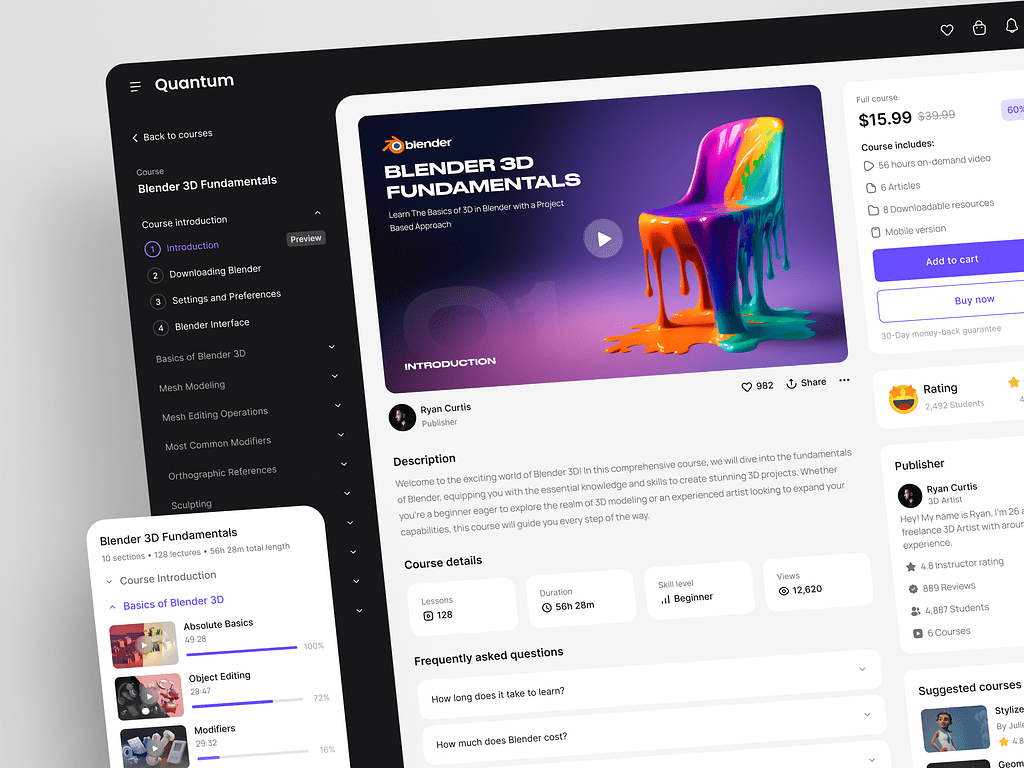
Online Education Web Platform by Conceptzilla

Cost of EdTech Marketplace Development
I hate giving vague answers, but here’s the truth—it depends. It really does. If you ask five different agencies, you’ll get five different numbers, ranging from “cheap if you use WordPress” to “the price of a small house.” The reality is somewhere in between, but it’s heavily influenced by what you’re actually building.
There are a few key factors that drive the price up or down.
First, platform complexity. Are you building a simple video hosting site with a checkout button? Or are you building a live interactive classroom with whiteboards, breakout rooms, and real-time quizzes? The latter requires WebRTC, complex state management, and heavy backend logic. That costs way more. Simple is cheap and complex is expensive.
Second, the number of users you expect. Apart from server costs, you will have to spend resources on architecture. Supporting 100 users is easy. Supporting 100,000 concurrent users requires load balancers, database sharding, caching layers, and a whole lot of DevOps expertise. You pay for that engineering upfront.
If you’re just taking one-off payments, it’s straightforward. But if you need split payments, multi-currency support, tax calculation (like VAT or GST), and automated payouts to instructors in different countries, the complexity spikes. Stripe Connect makes it easier, but implementing it correctly still takes time and testing. Time is money.
Finally, scalability requirements. Do you want to build a custom edtech marketplace to handle a million users from day one? That’s a waste of money. But if you want it to be ready to scale without rewriting the whole codebase in six months, you need to invest in good architecture early. It’s a balance. You don’t want to over-engineer, but you don’t want to build technical debt either.
Let’s look at two realistic scenarios to give you a ballpark.
Scenario 1: The MVP Marketplace
In this scenario, you’re a startup that wants to test the waters. You’re building a niche platform for, say, yoga instructors.
For features, basic user profiles, course upload (video only), simple search, Stripe integration for single payments, and a basic admin panel are more than enough. No live streaming, no complex quizzes.
A small toolkit requires a small team. Maybe one frontend dev, one backend dev, one designer, and a part-time QA. Or a small agency. It might take you around 3–4 months to complete the project. In terms of costs, it’s roughly $30,000 to $60,000.
This gets you a functional product. It won’t be pretty, and it might break if 10,000 people sign up at once, but it works. It proves your concept. In my experience, this is the smartest place to start. Don’t build a Ferrari when you need a skateboard.
Scenario 2: The Enterprise Platform
Here, you’re an established education company or a well-funded startup aiming for global scale. You’re competing with the big players.
That’s why the toolkit will be more vast: live classes with interactive tools, AI-driven recommendations, complex subscription models, multi-vendor dashboards with advanced analytics, etc. To compete with other enterprise businesses, you might need a mobile app for iOS and Android with multi-language support.
Consequently, the team will be bigger. You will need a full squad of edtech platform developers: a project manager, UI/UX designers, multiple frontend and backend engineers, a DevOps engineer, and a QA team. But it will take longer, for about 6–9 months or more.
This is a serious investment: approximately $150,000 to $300,000+. You’re paying for reliability, security, and scale. You’re also paying for the polish that makes users trust you with their credit cards and their time.
The initial build is only half the cost. You need a budget for maintenance, server costs, and updates. So, plan your budget accordingly. Don’t spend it all on development and leave nothing for marketing or operations. That’s a common mistake.
EdTech marketplace MVP vs enterprise platform, based on the two scenarios above:
| Marketplace scope | MVP marketplace | Enterprise platform |
| Features | Basic user profiles, video-only course upload, simple search, Stripe single payments, basic admin panel | Live classes, AI-driven recommendations, complex subscriptions, multi-vendor dashboards, iOS and Android apps |
| Team | One frontend dev, one backend dev, one designer, part-time QA | Project manager, UI/UX designers, multiple frontend and backend engineers, DevOps engineer, QA team |
| Timeline | 3–4 months | 6–9 months or more |
| Cost | $30,000 to $60,000 | $150,000 to $300,000+ |

Online Courses Platform Website by Shakuro

Common Challenges in EdTech Marketplace Development
Balancing Supply and Demand
This is the chicken-and-egg problem, and it’s brutal. You need instructors to attract students, but instructors won’t join if there are no students. And students won’t join if there’s nothing to learn. It’s a deadlock.
Most founders try to solve this by focusing on one side first. Usually, supply. You recruit teachers, get them to upload content, and then—silence. No one buys. The teachers get discouraged and leave. Then you have an empty platform.
The trick is to fake it till you make it. Or rather, curate it heavily at the start. Don’t open the floodgates. Hand-pick 10–20 high-quality instructors. Maybe even pay them to create exclusive content. Then, focus all your marketing energy on getting students for those specific courses. Create artificial scarcity.
Once you have traction on one niche, expand. But trying to launch with 500 mediocre courses and zero marketing budget is a recipe for disaster. You end up with a ghost town that doesn’t generate revenue.
Ensuring Content Quality
In an open elearning marketplace platform, quality control is a nightmare. You’ll get everything from Nobel Prize-winning lectures to someone recording their screen with a shaky phone in a noisy coffee shop. If learners buy a bad course, they blame you, not the instructor. They churn. They leave bad reviews. Your reputation tanks.
So, how do you fix it? You can’t manually review every video forever. It doesn’t scale. You need a hybrid approach. Start with manual approval for the first few hundred courses. Set clear guidelines: audio quality standards, minimum video resolution, and structured curriculum requirements. Then, automate with AI tools to detect poor audio or low-resolution video.
For example, for the Proko platform, we created a spam bot that automatically sorts out adult content. That takes a heavy weight off the company’s shoulders.
But more importantly, rely on your community. Let ratings and reviews do the heavy lifting. But you need enough volume for ratings to matter. In the early days, you might have to be the gatekeeper. It’s tedious, but it protects your brand.
Managing Payments and Payouts
Money is emotional. When an instructor doesn’t get paid on time, they get angry. They tweet about it. They tell their peers. And suddenly, your supply side dries up.
The technical challenge here is complexity. You’re you’re splitting the payment. Calculating commissions. Handling refunds. Dealing with chargebacks. And if you’re global, you’re dealing with different currencies and tax laws. What if an instructor in Germany needs a VAT invoice? What if a student in Brazil pays in Reais?
Stripe Connect helps, sure. But you still need to build the logic around it. A ledger system that tracks every cent with automated payout schedules. A support team that can answer “Where is my money?” questions quickly. If you treat payouts as an afterthought, you will regret it.
Scaling Marketplace Infrastructure
Let’s say you succeed. You balance supply and demand. The quality is good, and people are buying. Now, your server costs explode.
Why? Because video is heavy. Streaming high-quality video to thousands of users simultaneously requires serious bandwidth. If you host videos on your own server, you’ll go bankrupt. You need a Content Delivery Network (CDN) with adaptive bitrate streaming so the video quality adjusts based on the user’s internet speed. Not to mention mobile learning platforms: the video system should be extremely flexible to work well on various smartphones.
However, this is also connected with the database. As you grow, your queries slow down. You need to optimize indexes. Maybe shard your database. You need caching layers (like Redis) to store frequently accessed data so you don’t hit the database every time someone loads a page.
Also, when diving into online learning marketplace development, you might face the spike problem. What if a famous influencer promotes your platform? Traffic jumps 10x in an hour. If your infrastructure isn’t auto-scaling, your site crashes. And if it crashes during a launch, you lose momentum. It’s hard to recover from that.
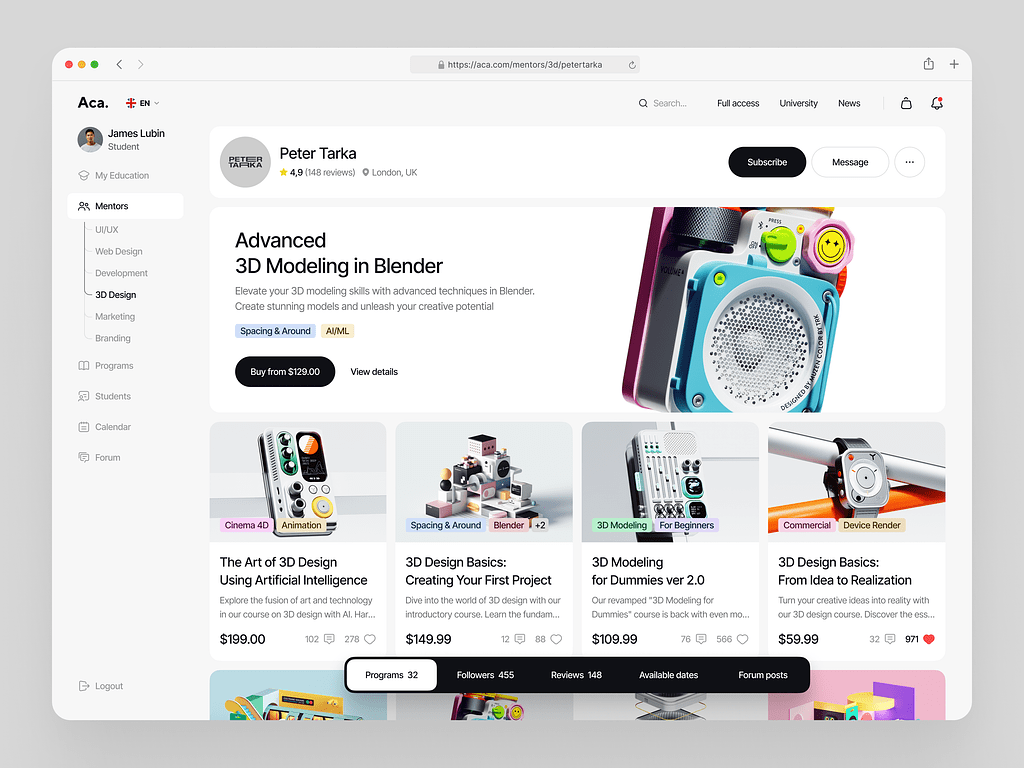
Online Courses Platform Website Dashboard by Shakuro
Our Experience in Marketplace and SaaS Development
For more than 19 years, we have been building marketplaces from scratch, rescued failing SaaS products, and helped startups scale when their servers started smoking.
Writing robust code is nice, but we take one more step and use it to solve business problems. You’ve got multiple players, and they all need to be in sync. We’ve learned that the hardest part is the logic. We’ve built multi-vendor systems that handle thousands of transactions daily. Clear architecture, glanceable dashboards with predictive analytics, sleek designs, and the latest trends—we deliver them all.
SaaS has its own challenges, and the biggest one is retention. That means the product needs to deliver value consistently. We’ve worked on B2B EdTech platforms with thousands of users and courses. Our edtech platform developers follow compliance rules (GDPR, KYC, RBAC, etc.) and integrate features like SSO for additional security. We use microservices where it makes sense and monoliths where it doesn’t. We implement caching strategies that keep load times under a second.
We focus on building sticky products. Tools that people use every day, not just once. That requires deep empathy for the user. You have to understand their pain points better than they do.
Proko: Create an E-Learning Marketplace for Artists
The creator of Proko, Stan Prokopenko, wanted to build a socially oriented educational platform for artists with video courses, feeds, and chats.
Apart from desired features, we also added a high level of personalization powered by AI recommendations. At the same time, the designers kept the UI simple and easy to navigate because there should be no distractions. We also prioritized the video element on the page for the same reason.
As I mentioned before, we created several AI features for Proko: a spam bot for sorting pictures, image, voice & video recognition, and a support bot with a vector search. These tools enhanced course marketplace software and helped Stan make it one of the most popular resources among artists.
Cubebrush: Build a Digital Courses Marketplace
The idea behind Cubebrush was simple: an e-commerce platform where artists could showcase and sell digital resources for both personal and commercial use.
During full-cycle development, we worked on making the user flow more convenient with smart search and personalized recommendations. The close collaboration between developers and designers allowed us to optimize the process, speeding up time-to-market.
As a result, Crubebrush has become a go-to place for purchasing art resources with a smooth UX.

Website Design Concept for Proko by Shakuro
Why Work with an EdTech Marketplace Development Company
Hiring an external team feels like a big step. Maybe you have an in-house developer who’s great at Python. Maybe your co-founder is a wizard with React. So why bring in a specialized agency? Why not just build it yourselves?
It’s a fair question. But edtech marketplace development is different from a native one. It’s a specific beast with its own quirks and pitfalls. If you’ve never done it before, you’re going to learn some expensive lessons. Working with a company that specializes in EdTech marketplaces brings you speed, certainty, and experience.
Here’s why it usually makes sense.
Marketplace Expertise
You can read all the articles you want, but there’s no substitute for having built five of these things before. A specialized team knows the traps. They know that splitting payments incorrectly can lead to tax nightmares. They know that instructor onboarding needs to be frictionless or you’ll lose supply. They’ve seen what works and what doesn’t.
When you work with experts, you skip the “figuring it out” phase. You don’t have to debate whether to use SQL or NoSQL for your course catalog; they already know the answer based on past projects. This saves you months of trial and error. In the startup world, time is your most scarce resource.
Scalable Architecture
I mentioned earlier how easy it is to over-engineer or under-engineer. An experienced team strikes that balance. They build with scale in mind, but they don’t waste budget on infrastructure you don’t need yet. These agencies know how to set up AWS or Azure so that your costs grow linearly with your users, not exponentially.
More importantly, they write clean, maintainable code. If you hire a freelancer who disappears after three months, you’re left with a codebase no one understands. A reputable company provides documentation, testing, and support. They build systems for course marketplace development that your future internal team can actually take over.
UX Optimization
Design is hard. Good design is harder. Great, conversion-focused design? That’s an art form. Specialized agencies have designers who live and breathe UX. They study user behavior to reduce friction and place buttons accordingly.
In EdTech, trust is everything. A polished, professional interface signals quality. If your site looks amateurish, instructors won’t trust you with their content, and students won’t trust you with their money. An expert team ensures your platform looks and feels like a leader in the space, not a weekend project. They iterate based on data, not guesses.
Monetization Strategy
Developers build features; strategists build businesses. A good EdTech development partner asks “how do you want to make money?”
They can advise on the best monetization models for your specific niche. Should you charge a commission? A subscription? Both? They’ve seen the data. They know which models drive higher lifetime value. These experts can help you structure your pricing pages, your checkout flows, and your upsell paths to maximize revenue.
So, is it cheaper to do it yourself? Maybe, initially. But when you factor in the time lost, the mistakes fixed, and the opportunities missed, partnering with experts often pays for itself. You get a better product, faster.

Educational website by Shakuro
FAQ
How much does edtech marketplace development cost?
An MVP edtech marketplace costs roughly $30,000 to $60,000, while an enterprise platform costs approximately $150,000 to $300,000+. The price depends on platform complexity (recorded video versus live classrooms on WebRTC), the number of concurrent users, payment logic such as split payments, multi-currency and VAT, and how ready the architecture must be to scale. Keep budget for maintenance, servers and updates after the initial build.
How long does it take to build an edtech marketplace?
A niche MVP marketplace takes around 3-4 months with a small team: one frontend developer, one backend developer, a designer and a part-time QA. An enterprise platform with live classes, AI recommendations, subscriptions and iOS and Android apps takes about 6-9 months or more with a project manager, UI/UX designers, several engineers, DevOps and a QA team. Invite-only launches help catch critical bugs early.
What should an edtech marketplace MVP include?
An edtech marketplace MVP needs basic user profiles, video-only course upload, simple search, Stripe integration for single payments and a basic admin panel. Leave out live streaming and complex quizzes. Pick one primary monetization model for launch rather than mixing commissions, subscriptions and featured listings. The goal is a working product that proves demand in one niche, even if it won’t yet survive a huge signup spike.
Should I build a custom learning marketplace or sell on Udemy or Teachable?
A custom learning marketplace makes sense when you want to own the audience, the data and the brand. On Udemy or Teachable you control none of those, and a change in their algorithm or fees leaves you stuck. Custom development costs more and is harder, but you decide how learning feels. Companies that only train their own staff are usually better served by an LMS.
How does an edtech marketplace handle payments and instructor payouts?
Most edtech marketplaces take a commission of 20-30% per sale and pay the rest to the instructor, with the split calculated automatically. Stripe Connect or PayPal Payouts cover KYC, payouts and tax forms, but you still need a ledger, payout schedules, refund and chargeback handling, and support for currencies and VAT. Subscriptions add another layer, since fees are shared by watch time or engagement.
How do I choose a development partner for an edtech marketplace?
Choose a team that has built multi-vendor marketplaces before and knows the traps: split payments that create tax problems, instructor onboarding that loses supply, and video delivery that needs a CDN with adaptive bitrate streaming. Ask how they would scale costs with users and whether they provide documentation and tests your future in-house team can take over. A good partner also questions your monetization model.
Final Thoughts
A learning platform marketplace goes a long way from that initial spark of an idea to the full-fledged platform. You face the challenge of keeping it alive as it grows.
Remember, it all starts with the balance. You can have the sleekest app in the world, but if you don’t have instructors creating great content and students eager to learn, you’ve got nothing. Nailing that supply-and-demand dance is your first big hurdle.
Then, keep the experience smooth. I’ll say that again—UX is about removing friction. Make it easy for people to pay, easy for teachers to upload, and easy for learners to find what they need. Every click you save is a conversion you gain.
And don’t forget the money. Pick a monetization model that makes sense for your users and stick to it. If you treat your creators well, they’ll become your biggest advocates.
Scaling comes later. Don’t worry about handling a million users when you haven’t signed up ten. Focus on getting the core right. Build a solid foundation for edtech marketplace development with the right tech stack. Plan for growth, but don’t let it paralyze you.
You don’t have to figure it out from scratch. Partner with a team that’s been there. Let’s build something that actually changes how people learn.
Related reading