
Most products begin with one simple wish: let us build the thing and get it in front of users.
That is why so many teams start with a monolith. And honestly, that is not a bad choice. A monolithic app can be fast to build, easy to understand, and perfectly fine for the first version of a SaaS product, marketplace, fintech tool, or internal platform.
The trouble usually starts later. Releases become tense. One small change in billing makes the user dashboard nervous. A developer wants to update one module, and suddenly everyone is waiting for the same deployment window.
This is where microservices architecture patterns become useful. Of course, they are not magic, and they are definitely not a free upgrade. But used carefully, they can help teams split a large system into smaller services that are easier to own, deploy, scale, and improve.
This guide walks through the practical side: common patterns, a simple microservices architecture diagram, real examples, benefits, risks, security, database decisions, and best practices. We will also look at when it makes sense to ask for outside help, because sometimes a second pair of eyes saves months of architectural wandering.
Key takeaways
- Microservices are useful when a product has outgrown a monolith, but they are not automatically better.
- Core patterns include API gateway, database per service, event-driven communication, saga, strangler migration, and observability.
- A clear microservices diagram should show clients, gateway, services, databases, message broker, integrations, monitoring, and deployment setup.
- Main drawbacks are harder debugging, data consistency issues, more testing, and extra DevOps overhead.
- Security has to be planned early because distributed systems create more APIs, credentials, and permission points.
- Teams should avoid rushing into microservices. Start with real product pain, business domains, and scaling needs.
- Consulting helps when migration, service boundaries, observability, or cloud architecture are already becoming costly or confusing.
What Microservices Architecture Means in Practice
Microservices architecture is an approach where an application is built as a collection of small, independently deployable services. Each service owns a specific business capability. It might handle payments, user accounts, notifications, product catalogs, analytics, search, or permissions.
That definition is tidy. Real life is messier.
In practice, the important part is not that a system has many services. Anyone can split code into ten pieces and call it a day. The important part is whether those pieces have clear responsibilities, clear data ownership, and clear communication rules. If they do, teams can work with less friction. If they do not, the system becomes a distributed mess, which is basically a monolith with extra network problems. It sounds harsh, but it happens.
Microservices vs Monolithic Architecture
A monolith keeps most application logic in one codebase and usually deploys as one unit. That can be comfortable. Developers can trace flows in one place, run the app locally, and make cross-module changes without negotiating with five service owners.
Microservices vs monolithic architecture is not a simple winner-takes-all comparison. It depends on product maturity, team size, domain complexity, and traffic patterns.
A monolith is often the best option when:
- The product is young and still changing direction
- The team is small
- The domain is not clearly understood yet
- Deployment complexity would slow everyone down
- Scaling needs are still modest
Microservices start to make more sense when:
- Different parts of the product need to scale separately
- Teams need independent release cycles
- The product has stable business domains
- Reliability problems in one area should not affect the whole app
- Integrations, data flows, and permissions have become too tangled
In my experience, the mistake is not choosing a monolith early. The mistake is pretending the first architecture will stay right forever. Products grow. So does the mess around them.
Service-Oriented Architecture vs Microservices
This is another common comparison. They are related, but not the same thing.
SOA is an older architectural style built around reusable services, often with centralized governance and enterprise-level integration. It can involve larger services and heavier communication layers. Microservices usually push harder toward small service boundaries, decentralized ownership, independent deployments, and product-team autonomy.
That said, the line is not always clean. Some companies call their system microservices when it behaves more like SOA. Others use SOA language but follow many microservice ideas. The name matters less than the operational reality. Can teams deploy independently? Are service contracts clear? Does each service own its data? Can the system fail in parts instead of falling over as one big block?
Those questions tell you more than the label.
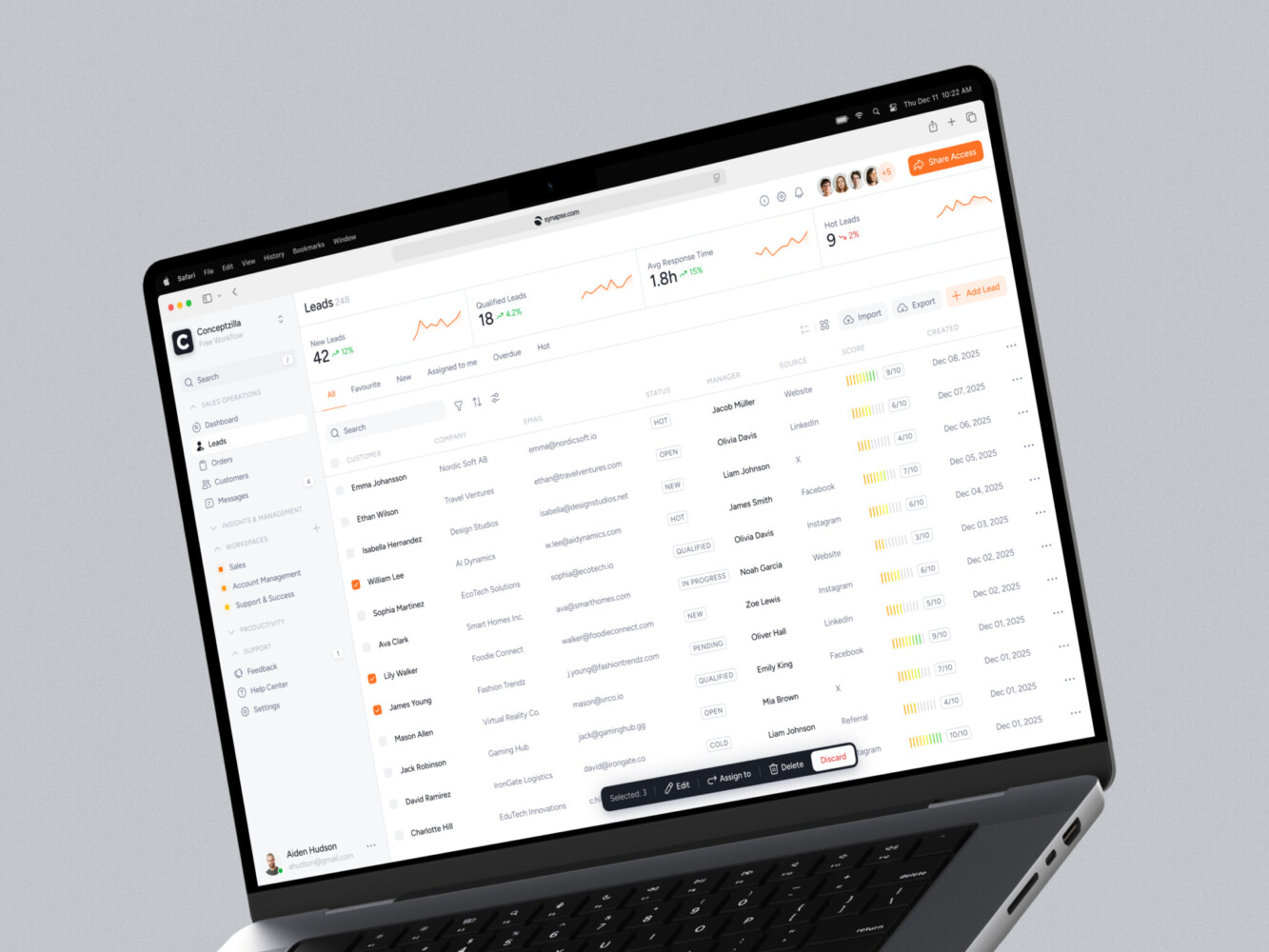
CRM dashboard design by Conceptzilla
Core Microservices Architecture Patterns
Good service patterns are less about clever diagrams and more about reducing future pain. They give teams repeatable ways to solve routing, communication, data ownership, reliability, and migration problems.
Here are the patterns that come up again and again.
API Gateway Pattern
An API gateway sits between client applications and backend services. Instead of a web app or mobile app talking to twenty services directly, it talks to one gateway.
The gateway can handle routing, authentication, rate limiting, request shaping, logging, and sometimes response aggregation. For frontend teams, this can really help. Nobody wants a dashboard page that has to know the exact location and quirks of every backend service.
Still, the gateway should not become a dumping ground for business logic. That is a tempting shortcut. It also turns the gateway into a new bottleneck. Keep it focused on traffic management and edge concerns.
Database Per Service
The database-per-service pattern is one of the most important microservices architecture design patterns and one of the hardest to accept at first.
The idea is simple: each service owns its own data. The order service owns orders. The billing service owns invoices. The user service owns user records. Other services should not reach directly into another service’s database just because it is convenient.
At first, this feels annoying. A shared database is so easy. Need a field? Join another table. Done. But over time, shared databases make services tightly coupled. One schema change can break several teams. Nobody is quite sure who owns a table. Release planning becomes a small political event.
With separate data ownership, services become more independent. The cost is that reporting, consistency, and cross-service workflows need more thoughtful design.
Event-Driven Communication
Not every service needs to call another service synchronously. Sometimes it is better to publish an event and let other services react.
For example, when an order is placed, the order service can publish an OrderCreated event. The payment service, notification service, analytics service, and fulfillment service can respond in their own time. This avoids a long chain of direct calls where one slow service delays everything else.
Event-driven systems are useful for workflows, notifications, audit logs, background processing, and integrations. They also introduce a new mindset. You have to think about retries, duplicate messages, eventual consistency, and what happens when something arrives late.
It is a little weird at first if your team is used to direct request-response flows. But once the pattern clicks, it can make the system much calmer under pressure.
Saga Pattern
Distributed transactions are tricky. In a monolith, one database transaction can sometimes handle a full business process. In microservices, a single workflow may involve several services, each with its own data store.
The saga pattern breaks a large transaction into smaller steps. Each step has a compensating action if something fails.
As an microservices architecture example, let’s imagine a travel booking flow. Reserve a flight. Reserve a hotel. Charge the card. Send confirmation. If the card charge fails, the system may need to cancel the hotel and flight reservations. A saga coordinates that process without pretending all services share one giant transaction.
This pattern matters in fintech, e-commerce, logistics, healthcare, and any product where workflows span several business areas.
Strangler Fig Migration Pattern
Many teams do not build microservices from a clean empty page. They migrate from an existing monolith.
The strangler fig pattern is a gradual migration approach. Instead of rewriting the whole system, you build new services around the old application and slowly route specific features to them. Over time, the old monolith shrinks.
It is not glamorous, but it is practical. Big rewrites sound exciting in planning meetings and terrifying six months later. A gradual migration gives teams a safer path, especially when the old system still makes money every day.
Observability and Centralized Logging
Microservices need serious observability. Without it, debugging becomes a guessing game.
You need logs, metrics, traces, dashboards, and alerts that show how requests move through services. If a user says checkout failed, the team should be able to trace the request through the API gateway, cart service, payment service, inventory service, and notification service.
This is one of those areas where teams often say, “We will add it later.” Then later, it arrives during an incident, and everyone regrets being optimistic. Add observability early. Future you will be grateful.
Task management dashboard by Shakuro
Microservices Architecture Diagram: What to Include
A good system diagram should not try to show every tiny implementation detail. The goal is to help people understand the system shape.
A simple diagram usually includes:
- Client applications, such as web, mobile, or admin panels
- API gateway or backend-for-frontend layer
- Authentication and authorization service
- Core business services
- Separate databases or data stores
- Message broker or event bus
- External integrations
- Monitoring, logging, and tracing
- CI/CD and deployment environment
- Cloud infrastructure and security boundaries
The best diagrams are boring in a useful way. You should be able to show one to a developer, a product manager, and a CTO, and each person should understand the main flow. If the diagram needs a 40-minute explanation, it is probably doing too much.
Simple E-Commerce Microservices Architecture Example
An e-commerce platform might use separate services for:
- User accounts
- Product catalog
- Search
- Cart
- Checkout
- Payments
- Orders
- Inventory
- Notifications
- Reviews
- Promotions
In this e-commerce setup, the checkout service might call the cart service, publish an order event, trigger payment processing, reserve inventory, and ask the notification service to send an email. Some steps happen immediately. Others happen through events.
The useful thing in microservices architecture patterns is separation. The search service can scale heavily during a sale. The notification service can fail briefly without taking down checkout. The payment service can be locked down with stricter security rules. Different teams can work on catalog, orders, and marketing features with fewer collisions.
SaaS Platform Example
A SaaS platform might have services for tenant management, billing, subscriptions, user permissions, analytics, notifications, integrations, audit logs, and admin workflows.
This kind of architecture is common when a product has different customer accounts, role-based access, subscription tiers, reporting needs, and third-party tools. It is also where data boundaries become extra important. One tenant should not accidentally see another tenant’s data. Sounds obvious, yes, but multi-tenant bugs are not the kind of surprise anyone wants.

Telematics Dashboard by Shakuro
Benefits of Microservices Architecture
The benefits of microservices architecture are real, but they come with conditions. You get the value when the system is designed carefully and the team can operate it.
Independent Deployments
Independent deployment is probably the benefit teams feel first. If the billing service needs an update, the whole product should not have to redeploy. Smaller releases are easier to test, easier to roll back, and less emotionally dramatic.
This really helps teams that release often. It also reduces the “everyone freeze, we are deploying” energy that appears in large systems.
Better Team Ownership
Microservices database architecture can match software boundaries to team boundaries. One team owns payments. Another owns search. Another owns notifications.
When ownership is clear, people make decisions faster. They know which code is theirs, which metrics matter, and which incidents they need to care about. Of course, this only works when service boundaries are sensible. If every service needs three teams to approve a change, something has gone wrong.
Targeted Scaling
Not every part of a product has the same load. Search may get hammered. Reporting may run heavy background jobs. Notifications may spike after a campaign. Payments may need strict reliability, but not the same traffic profile as browsing.
Microservices let teams scale specific parts of the system instead of scaling everything at once. That can save infrastructure costs and improve performance.
Technology Flexibility
Some teams use different tools for different jobs. A real-time feature may need one stack. A reporting service may need another. A machine learning pipeline may live somewhere else entirely.
Microservices can make that possible. But, small caveat, technology freedom should not become technology chaos. If every service uses a different language, framework, database, and logging style, onboarding becomes a headache. A little standardization is healthy. A runtime like Dapr can help here by giving every service the same building blocks for messaging, state, and secrets.

Disadvantages and Common Challenges
Now the less cheerful part in microservices architecture patterns. Microservices can make things better, but they can also make a team’s life harder if adopted too early or designed loosely.
Distributed Debugging
Debugging one application is usually easier than debugging ten services talking across a network. A request can fail because of a bad payload, a timeout, a retry loop, a queue delay, a database issue, or an expired token in a downstream service.
Without tracing and good logs, engineers end up reading fragments from different systems and trying to reconstruct the story. It is not fun. It has a bit of detective work to it, but without the nice music from a TV show.
Data Consistency
When each service owns its own data, the system often becomes eventually consistent. That means one part of the product may update before another part catches up.
This is fine for many workflows. A notification arriving a few seconds later is usually okay. A bank balance being wrong for a few seconds is very much not okay. The architecture has to respect the business context.
Testing Complexity
Unit tests are not enough. Teams need contract tests, integration tests, end-to-end tests, load tests, and deployment checks. They also need test environments that behave enough like production to reveal real problems.
That is a lot. But skipping it is worse.
Operational Overhead
Microservices require infrastructure maturity: CI/CD, container orchestration, monitoring, logging, secrets management, service discovery, API versioning, and incident response.
For a small team, this can be too much. That is why a monolith is still a good choice in many early-stage products. If your business logic is changing every week and the team has four developers, splitting everything into services may slow you down instead of helping.
Owari platform by Shakuro
Security Architecture for Microservices
Microservices security architecture needs attention from the beginning. Once the system is distributed, there are more service-to-service calls, more APIs, more credentials, and more places where permissions can drift.
Start with authentication and authorization. Users should prove who they are, and services should check what those users are allowed to do. In larger systems, service-to-service communication should also be authenticated. A request from another service should not be trusted just because it came from inside the network.
Use secure API gateways, short-lived tokens, role-based access control, secrets management, network policies, and audit logs. For sensitive products, add encryption, dependency scanning, vulnerability checks, and clear incident procedures.
By the way, security is not just a backend concern. Admin panels, dashboards, internal tools, and support workflows can expose sensitive data if permissions are too broad. I have seen teams focus heavily on public APIs while forgetting that internal tools are also part of the product surface.
Development Process for a Microservices-Based Product
A good process starts before coding. That may sound obvious, but it is where many projects drift.
1. Discovery and Domain Mapping
Start by mapping the business domains. What are the main capabilities of the product? Where are the natural boundaries? Which workflows need strong consistency? Which parts change often?
This step usually involves product owners, engineers, designers, and sometimes support or operations people. The support team often knows where the product is painful because users tell them directly. Do not ignore that.
2. UX/UI and User Flow Planning
Architecture should support the user experience, not float somewhere above it. If a user dashboard needs real-time updates, the backend should be designed for that. If onboarding has many permission checks, service boundaries should not make the flow painfully slow.
3. Service Boundary Design
Define which services exist, what each owns, and how they communicate. Keep the first version modest. It is better to start with a few well-defined services than twenty tiny services that nobody wants to maintain.
4. API and Data Model Planning
Design APIs, events, data ownership, and versioning rules. Decide which workflows are synchronous and which should be event-driven. Write these decisions down. Future developers should not have to guess why the system works the way it does.
5. Core Backend Development
Build services with clear responsibilities, automated tests, and deployment pipelines. This is where stack choices matter. Shakuro’s backend work, for example, often includes .NET, Python, cloud infrastructure, CI/CD, Kubernetes, Terraform, Prometheus, and Grafana depending on the product needs.
6. Frontend Integration
Frontend developers should not have to fight a maze of services. API gateways or backend-for-frontend layers can give web and mobile apps cleaner data shapes.
7. Testing, Observability, and Deployment
Set up contract testing, integration testing, logging, metrics, tracing, alerts, and rollback procedures. This is not the glamorous part. But it is the part that makes production less scary.
8. Scaling and Support
After launch, watch real traffic. Some services will behave exactly as expected. Others will surprise you. That is normal. Architecture is not a painting you hang on the wall. It is more like a garden. You keep trimming, adjusting, and occasionally admitting that one decision looked better on paper.

Financial Market Trading Analytics Tool Dashboard Design by Shakuro
Microservices Architecture Best Practices
The best practices here are mostly about restraint. It is easy to over-engineer. It is harder to keep the system understandable.
First, start from business domains, not technical layers. A UserService, BillingService, and NotificationService usually make more sense than splitting everything into generic data, logic, and utility services.
Second, keep services small enough to own, but not so small that every feature requires seven network calls. There is no perfect size. A useful rule is that a service should have a clear business reason to exist.
Third, avoid shared databases. If services share tables, they are not really independent. Use APIs, events, read models, or reporting pipelines instead.
Fourth, automate testing and deployment. Manual releases do not scale well in distributed systems. They also create nervous teams, and nervous teams move slower.
Fifth, build observability early. Logs, metrics, and traces are not extras. They are how you understand the system once it is alive.
Sixth, document ownership. Every service should have a team or person responsible for its health, roadmap, and incidents. “Everyone owns it” often means nobody does.
A solid microservices reference architecture can help here, but do not copy one blindly. Reference models are starting points, not instructions from the sky.
Our Experience in Creating Microservice Architectures
Architecture is easier to discuss when there are real products on the table. Two Shakuro projects fit this topic well.
CGMA: Build Virtual Classroom Platform
CGMA is a virtual classroom platform for digital artists. We redesigned and developed the platform, migrated data into a new structure, and connected tools like Discord, Zoom, PayPal, Freshdesk, Salesforce, and ActiveCampaign. The stack included Ruby on Rails, Docker, AWS, MySQL, PostgreSQL, React, and Next.js.
This case is relevant because it has many things that make architecture tricky: user roles, learning workflows, payments, third-party integrations, data migration, admin needs, and scalability. It is not just “build a website.” It is a platform with moving parts.
Symbolik Social: Create a Comprehensive Financial Platform
Symbolik Social is a social platform for financial analysts. Shakuro worked on a product with real-time updates, financial data, social features, and secure user flows. The stack included Next.js, React, TypeScript, ASP.NET Core, MySQL, WebSockets, RabbitMQ, Auth0, logging, monitoring, and AWS S3.
This is a useful example for microservices thinking because real-time systems force serious decisions about communication, reliability, data access, and monitoring. Add financial context, and the tolerance for sloppy architecture gets very low.

Symbolik Social by Shakuro
When to Hire Microservices Architecture Consulting
Outside consulting makes sense when the stakes are high enough that trial and error will be expensive.
You may need help if:
- A monolith is slowing releases and nobody knows where to split it
- Cloud costs are rising but performance is still uneven
- Services already exist, but they are tangled together
- Data consistency bugs keep appearing
- The team lacks DevOps or observability experience
- Security and compliance requirements are becoming stricter
- A migration has started, but progress is painfully slow
An outside team can help map domains, design service boundaries, plan migration stages, set up CI/CD, improve monitoring, and make sure the new architecture supports product goals. Not in a dramatic “throw everything away” way. More like, let us look at the system honestly and choose the next best move.
That is often enough to get unstuck.
Final Thoughts
Microservices can make software products more scalable, flexible, and resilient. They can also make them more complicated. Both things are true.
The best architecture is not the one with the most services. It is the one that fits the product, the team, and the business moment. Sometimes that is a monolith. Sometimes it is a modular monolith. Sometimes it is a carefully designed set of services with strong ownership, good observability, and clear deployment rules.
If you are planning a new platform or trying to modernize an existing one, start with the real questions. What hurts today? What needs to scale? Which teams need independence? Which data must stay consistent? Which risks can the business tolerate?
Answer those honestly, and the architecture becomes much easier to choose.
And one more point: do not rush the split. A clean service boundary is worth more than a fashionable diagram. It saves time, reduces stress, and makes future development feel less like walking through a dark room full of furniture. We have all been there, unfortunately.
If your team is exploring microservices, platform modernization, or scalable web app development, Shakuro can help shape the architecture, design the user experience, build the product, and support it after launch.

Sales Analytics Dashboard by Shakuro
FAQ
What is the Best Microservices Architecture Pattern to start with?
For most teams, the API gateway pattern and database-per-service pattern are good starting points. They shape how services communicate and how ownership works. Event-driven communication is also useful, but it should be added where workflows truly need it, not everywhere by default.
Are Microservices Always Better Than a Monolith?
No. A monolith can be the better choice for early-stage products, small teams, and products with changing requirements. Microservices help when the product has clear domains, scaling pressure, independent teams, and mature deployment practices.
What Should a Microservices Architecture Diagram Show?
It should show client apps, API gateways, core services, data stores, message brokers, external integrations, monitoring, deployment environments, and security boundaries. Keep it readable. A useful diagram explains the system quickly.
Why is Database Design Difficult in Microservices?
Each service should own its data, which reduces coupling but makes reporting and consistency harder. Teams need APIs, events, read models, and sometimes data pipelines to share information safely.
When Should a Company Consider Microservices Architecture Consulting?
Consulting is useful when a monolith is blocking growth, service boundaries are unclear, cloud costs are rising, releases are risky, or the team needs help with migration, DevOps, security, or observability.
Related reading
- Frontend Architecture: Patterns, Diagrams, and Micro Frontend Choices for Modern Products
- High-Load .NET Architecture: Expert Insights From Our Lead Developer
- Multi-Tenant SaaS Architecture: Patterns, Best Practices, and Examples
- React Web App Development: Process, Benefits, and How to Build Scalable Apps