
There is a moment in many software projects when everyone realizes the same uncomfortable thing: the app looks fine, the screens are moving along, but the backend contract is still a little foggy. The frontend team is waiting. The mobile team is making assumptions. Someone from sales has promised an integration with a partner tool. And the API? Well, it is being figured out as we go.
That works for a while. Sometimes. But if the product needs to connect with other services, support several user interfaces, or scale into a platform, this loose approach starts to hurt.
API-first development solves that problem. In practice, it is pretty simple: decide how the system will communicate before everyone starts building their own part in isolation.
In this article, I’m going to walk you through what API-first actually looks like in the wild. We’ll talk about when it matters (and when it doesn’t, because let’s be honest, not every project needs this level of rigor). We’ll cover how to plan it without bogging down your roadmap.
Key takeaways
- API-first development means designing the API contract before writing the main application code. The API becomes the shared agreement between backend, frontend, mobile, QA, product, and integration teams.
- It is especially useful when a product needs multiple frontends, partner integrations, SaaS workflows, payments, analytics, AI features, or long-term scalability.
- Compared with code-first development, API-first can feel slower at the start, but it usually reduces rework, miscommunication, and broken integrations later.
- Common risks include stale documentation, unclear API ownership, breaking changes, overengineering, and weak security planning.
- Cost depends mostly on integration complexity, data model complexity, security/compliance needs, public API access, documentation depth, testing, performance, and support.
What is API-First?
This approach means the API contract is designed before the main application code is written. The team defines endpoints, request and response formats, authentication rules, error behavior, versioning, documentation, and sometimes even mock responses early in the project.
In plain English, the API becomes the agreement.
Instead of saying, “Let’s build the backend and see what the frontend needs later,” the team says, “Let’s agree on how the product pieces talk to each other first.” That agreement gives developers, designers, QA engineers, product managers, and integration partners something concrete to work with.
If you have ever worked on a project where the response shape changed three times in one week, you know why this matters. A changed field name can look tiny in a pull request. In real life, it can break a dashboard, a mobile screen, a webhook, and some poor QA engineer’s afternoon.
API-First vs Code-First Development
Code-first development starts with implementation. Developers build the backend logic, then expose an API based on what the code does. This can be fast for small internal tools or prototypes. No need to overcomplicate a tiny admin panel that three people will use.
The problem appears when the API has to serve many consumers. A web app, a mobile app, a partner integration, maybe an AI feature, maybe a reporting dashboard. Suddenly the API is not just a byproduct of the code. It is the product interface.
That is the heart of the API-first vs code-first debate. Code-first can move quickly in the beginning. API-first usually gives you fewer surprises later.
API-First vs Design-First API Work
You may also hear people talk about design-first API work. It is closely related. This usually means planning the contract, often using OpenAPI, Swagger, or similar tools, before implementation. API-first is a bit broader. It treats APIs as a strategic foundation for the whole product, not just a technical artifact.
So yes, there is overlap. People use the terms differently, which can be mildly irritating. If you see the phrase API-design first, read it as a reminder that the API should be thought through before it becomes hard to change.
Task management dashboard by Shakuro
Why Starting With APIs Matters
The main reason this matters is that modern software rarely lives alone. Even a “simple” SaaS product might need payments, analytics, email, CRM sync, AI services, role permissions, mobile access, and admin reporting.
That is a lot of talking between systems.
An API-first approach helps teams make those conversations clearer. Frontend developers can build against mocks while backend work continues. Mobile developers do not need to wait for every endpoint to be finished. QA can write tests against the agreed contract. Product managers can spot missing workflows earlier, before the team has already spent two sprints building around the wrong assumption.
And one more point: partners appreciate predictable APIs. Nobody enjoys integrating with an API that behaves like a half-finished group chat. Clear docs, stable versioning, and sensible error messages make a product feel more mature.
This is also where an API-first strategy becomes a business decision, not just an engineering preference. If a company wants to build a platform, not just an app, APIs become part of the customer experience. Developers are users too. Sometimes very impatient ones.
Core Principles of an API-first development
There is no single sacred checklist, but good API-first teams tend to follow a few common habits.
Contract Before Code
The contract defines how the API behaves. It should include endpoints, data formats, status codes, authentication requirements, pagination, filtering, rate limits, and error responses. OpenAPI is a common choice here because it gives both humans and tools a shared format.
The contract does not need to be perfect on day one. Honestly, it never is. But it should be good enough for teams to discuss real behavior instead of vague ideas.
Clear Versioning
APIs change. New fields appear, old workflows get retired, and business logic shifts. Without versioning, every change becomes risky.
A good API-first design includes a plan for backward compatibility. Maybe that means versioned routes. Maybe it means additive changes only for public endpoints. The exact method depends on the product, but the team should decide early.
Authentication and Permissions From the Start
Security is much easier to plan early than to bolt on later. It is also less dramatic, which is nice. API-first teams should define how authentication works, what roles can access which resources, and how sensitive data is handled.
This matters even for MVPs. Especially for MVPs, actually, because those “temporary” shortcuts tend to stay around longer than anyone wants to admit.
Documentation That People can Actually Use
API documentation should not read like a legal appendix. It needs examples, edge cases, sample responses, and notes about common mistakes. If possible, docs should be generated from the API specification and kept close to the implementation.
You know the feeling when documentation says “returns object” and nothing else? Let’s not do that to people.
Mocking and Testing Before Launch
Mock APIs help frontend and mobile teams move before the backend is done. Contract tests help make sure implementation does not drift away from the spec. This really helps. I have seen teams catch silly but expensive mistakes simply because the contract test complained before staging did.
Sales Analytics Dashboard by Shakuro
API-First Architecture: Main Components
API-first architecture is the system shape that supports this way of building. It is not only a set of endpoints. It includes all the boring but important pieces that make the API reliable in production.
At minimum, most products need:
- API contracts and schemas
- Authentication and authorization
- Service boundaries
- API gateway or routing layer
- Rate limiting and throttling
- Logging and monitoring
- Error handling standards
- Webhooks or event-based communication where needed
- Documentation and developer onboarding
- CI/CD checks and automated tests
An API-first platform may also include SDKs, a developer portal, sandbox environments, usage analytics, and partner management. That sounds like a lot, and sometimes it is. But not every product needs the full platform treatment from the first release.
The trick is to design the architecture so it can grow. Start with clean contracts, predictable data models, and sensible boundaries. Leave room for webhooks, public integrations, and versioning. Future-you will be grateful. Or at least less annoyed.

How the Development Process Works
The process can vary, but a healthy API-first project usually follows a path like this.
1. Discovery and Product Strategy
Start with the product goal. Who will use the API? Internal teams? Mobile apps? External partners? Customers with their own developers? These groups need different levels of documentation, support, security, and flexibility.
This is where product and engineering should sit together. Not in a twelve-person meeting where everyone politely nods, but in a real working session. What actions does the user need to complete? What data moves between systems? What can go wrong?
2. User Flows and Integration Mapping
Before endpoint design, map the important workflows. For example: signup, payment, onboarding, file upload, report generation, notification delivery, admin approval, partner sync.
This step in API-first development often reveals missing states. What happens when payment succeeds but account creation fails? The problem grows when a product uses several payment providers, which is where a dedicated payment orchestration platform helps. What if a third-party API is down? What if a user belongs to two organizations? These are not glamorous questions, but they prevent messy fixes later.
3. API Contract and Schema Design
Now the team defines the contract. This includes resources, naming, payloads, response codes, errors, pagination, filtering, sorting, and authorization behavior.
Good naming matters more than people think. A confusing endpoint name can haunt a product for years. I still remember one project where “account” meant user account in one service and billing account in another. Not fun. Small words, big confusion.
4. UX/UI and Frontend Parallel Work
Once the contract exists, frontend teams can work with mock data. Designers can validate edge cases. QA can start thinking about test scenarios. The backend team can build without every screen waiting on them.
This is one of the quiet wins of this method. The work feels less blocked. People still need to talk, of course, but they are talking around a shared object.
5. Backend Implementation
Implementation should follow the contract as closely as possible. If the contract needs to change, change it deliberately and communicate it. Do not let the implementation drift silently.
Framework choice depends on the product. FastAPI can be a good fit for Python teams that need typed schemas, automatic docs, async workflows, and readable backend structure. Node.js, .NET, Ruby on Rails, and other stacks can also work well. The principle matters more than the logo on the framework website.
6. API Testing, Documentation, and Security Review
Testing should cover the contract, business rules, permission logic, performance expectations, and integration behavior. Documentation should include examples. Security review should look at auth, data exposure, rate limits, logging, and abuse cases.
It is a little tedious, yes. But production incidents are more tedious.
7. Deployment, Monitoring, and Iteration
After launch, watch how the API behaves. Which endpoints are slow? Which errors happen often? Are partners using the API as expected? Are frontend teams asking for the same workaround again and again?
Monitoring turns API design from guesswork into feedback. That is where the product starts to mature.
SaaS marketing dashboard by Conceptzilla
Technology Stack for API-First Approach
The stack depends on the team, but common tools include OpenAPI or Swagger for specs, Postman for testing and collaboration, API gateways for routing and rate limits, Docker and Kubernetes for deployment, and CI/CD pipelines for automated checks.
For backend frameworks, FastAPI is worth mentioning because it supports Python type hints, Pydantic validation, automatic documentation, async workflows, dependency injection, and WebSockets. There is also the practical side of this work: API design, backend logic, database structure, testing, documentation, third-party integrations, and microservices when they make sense.
I like that last caveat: when they make sense. Microservices can help, but they can also turn a small product into a distributed headache. Sometimes a clean modular monolith is the best option for the stage you are in. Boring? Maybe. Useful? Very.
Common API-First Use Cases
An API-first strategy is useful in many types of products, but it becomes especially important when several systems need to share data or behavior.
SaaS Platforms
SaaS products often need subscriptions, user roles, billing, analytics, admin controls, integrations, and customer-facing dashboards. Cloud-based products, flexible scaling, remote access, and connected business ecosystems—that is exactly where APIs do much of the heavy lifting.
Fintech Products
Fintech software depends on secure data flows, auditability, permissions, third-party integrations, and reliable transaction handling. A sloppy API design can create real risk here. Not just technical risk, but compliance and trust issues too.
E-learning Platforms
Learning platforms may connect video tools, payment systems, messaging, course management, certificates, support systems, and analytics. In this context, API-first planning helps keep the product from becoming a pile of disconnected features.
Marketplaces and Commerce
Marketplaces need inventory, payments, seller tools, buyer flows, notifications, search, shipping, and reporting. APIs define how all those pieces cooperate.
Mobile and Web Apps Sharing One Backend
This is a classic use case. If web, iOS, and Android teams all depend on the same backend, an API contract keeps everyone aligned. Without it, each client can start developing its own little interpretation of the product.
AI Products and Data-Heavy Tools
AI features often rely on data pipelines, model APIs, user-facing workflows, streaming responses, and background processing. API-first planning helps keep the AI part connected to the real product, not floating around as a demo that only works on a good day.

Marketing analytics dashboard by Shakuro
Common Challenges in API-first Development
API-first is helpful, but it is not magic. Teams still run into problems.
One common issue is unclear ownership. Who owns the contract? Backend? Architecture? Product? If nobody owns it, the spec gets stale. If one person owns it too tightly, everyone else works around it. The best setup is shared ownership with clear decision rules.
Another challenge is documentation drift. The spec says one thing, the implementation does another, and the docs are quietly living in 2022. Automated documentation and contract tests help, but someone still needs to care.
Breaking changes are also a big one. Internal teams may tolerate a sudden change, though they will complain in Slack. External partners will be less forgiving. Versioning and deprecation policies are not fancy extras. They are part of the product experience.
Then there is overengineering. This happens a lot when teams get excited about architecture. Not every MVP needs a gateway, event bus, public developer portal, SDKs, and five services. Start with the shape that fits the product. Make it clean enough to grow.
Security is the non-negotiable piece. Authentication, permissions, rate limits, input validation, audit logs, and safe error messages should be planned early. It is not dramatic work, but it protects the product from painful surprises.
What Does API-First Development Usually Cost?
Costs vary a lot, because this is not a single feature. It is a way of planning and building the product.
For a small MVP, the cost usually depends on core workflows, number of endpoints, authentication, basic documentation, and a few integrations.
A mid-level platform adds more roles, admin tools, payment flows, analytics, testing, and third-party services.
An enterprise product may require public APIs, partner portals, advanced security, compliance work, SDKs, audit trails, and heavy monitoring.
The biggest cost drivers are usually:
- Number and complexity of integrations
- Data model complexity
- Security and compliance requirements
- Public vs internal API access
- Documentation depth
- Testing and automation
- Performance expectations
- Long-term support needs
If I had to give one practical piece of advice, it would be this: do not cut planning time too aggressively. It is tempting. Everyone wants to start building. But a few careful days spent on API contracts can save weeks of confused rework later. I have seen that trade many times.
Our Experience in API-First Approach
The CGMA case is a good example of why architecture and integrations matter in real products. CGMA needed more than a nicer interface. The platform required a new foundation, data migration, Discord integration, Zoom integration, PayPal payments, video management, automated PDFs, support tools, CRM connection, and email marketing automation. That is not “just a website.” That is a connected product ecosystem.
The Symbolik Social case is another useful reference. It involved a financial social platform with frontend work, backend API architecture, WebSockets, RabbitMQ, Auth0, logging, monitoring, background jobs, and AWS S3 storage. What stands out to me is the mix of real-time interaction, financial data, security, and collaboration features. Those are exactly the kinds of products where API decisions show up everywhere.
These examples show a more practical point: API planning matters most when the product has many moving parts and users expect everything to feel connected.
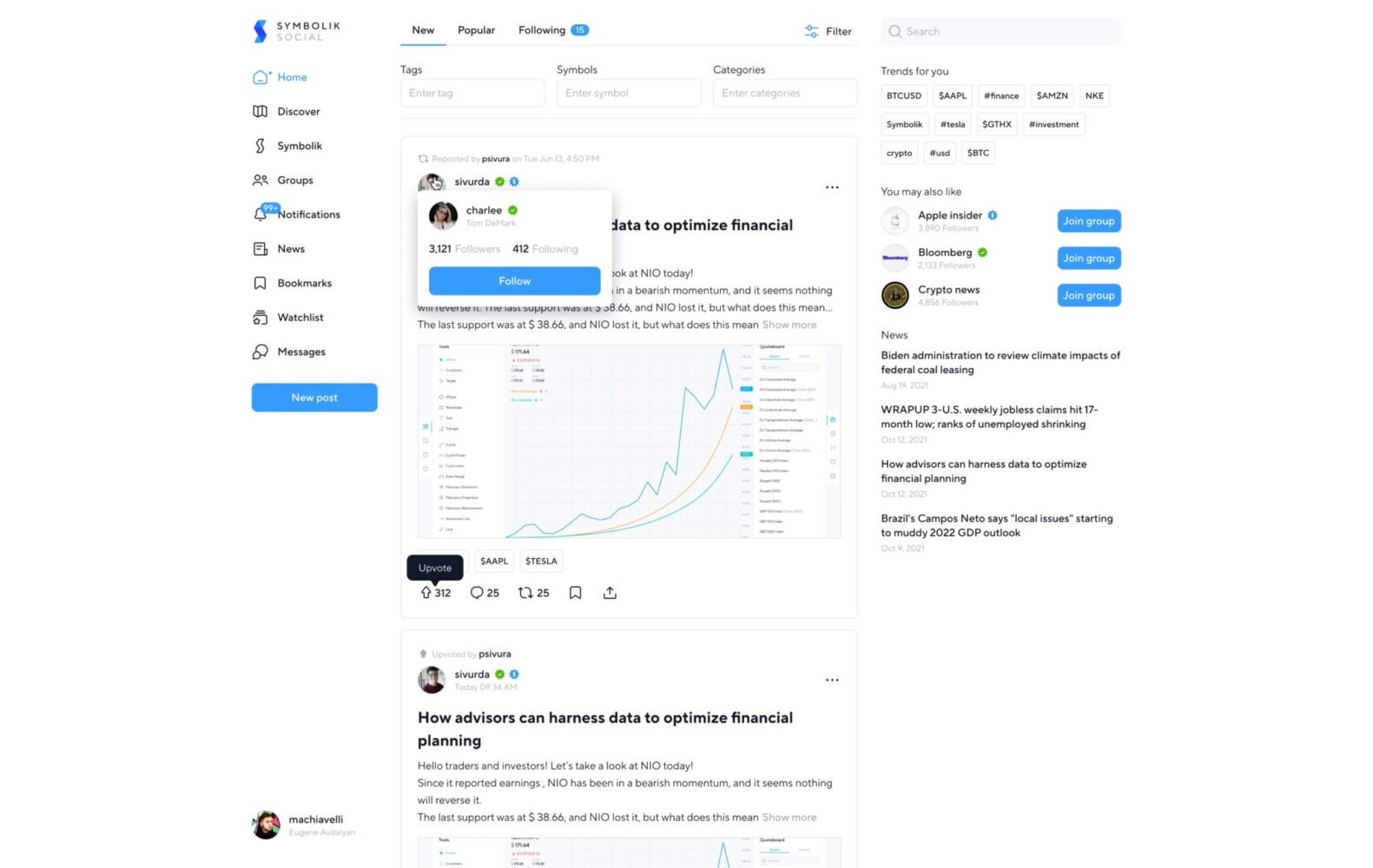
Symbolik Social by Shakuro
Why Work With a Development Company?
You can build API-first products with an internal team, an outside team, or a mix of both. The important thing is that product, design, backend, frontend, QA, DevOps, and security decisions stay connected.
A development company can help when the product has a lot of uncertainty: a new platform, a backend rebuild, a partner API, a multi-role SaaS product, or a system with several third-party integrations. The value is not only writing endpoints. It is asking the awkward questions early.
What happens if the payment provider fails? Who can see this data? Will mobile need offline support later? Should this be synchronous, or should it become a background job? Do we really need microservices now?
Those questions can feel slow at the start. But they usually make the build faster in the end. You agree, that sounds good, doesn’t it?
Shakuro’s web development work includes custom web apps, QA, support, CI/CD, and SRE practices. For API-heavy products, that mix matters. An API is not finished when the endpoint returns 200. It needs to be tested, documented, monitored, secured, and improved as the product changes.
Final Thoughts
This way of working is not about making a project more complicated. At its best, it does the opposite. It gives teams a shared agreement before the product becomes too tangled to reason about.
If your software needs integrations, multiple frontends, partner access, real-time features, or long-term scalability, designing the API early is simply a calmer way to work. Not always easy. But calmer.
Three things are worth remembering:
- The API is part of the product experience, not just backend plumbing.
- A clear contract helps teams move in parallel without guessing.
- Good API design saves future effort, especially when the product starts growing.
If you are planning an API-first product, rebuilding an older backend, or trying to make a platform easier to integrate with, it is worth talking through the architecture before the codebase gets too comfortable in the wrong shape.
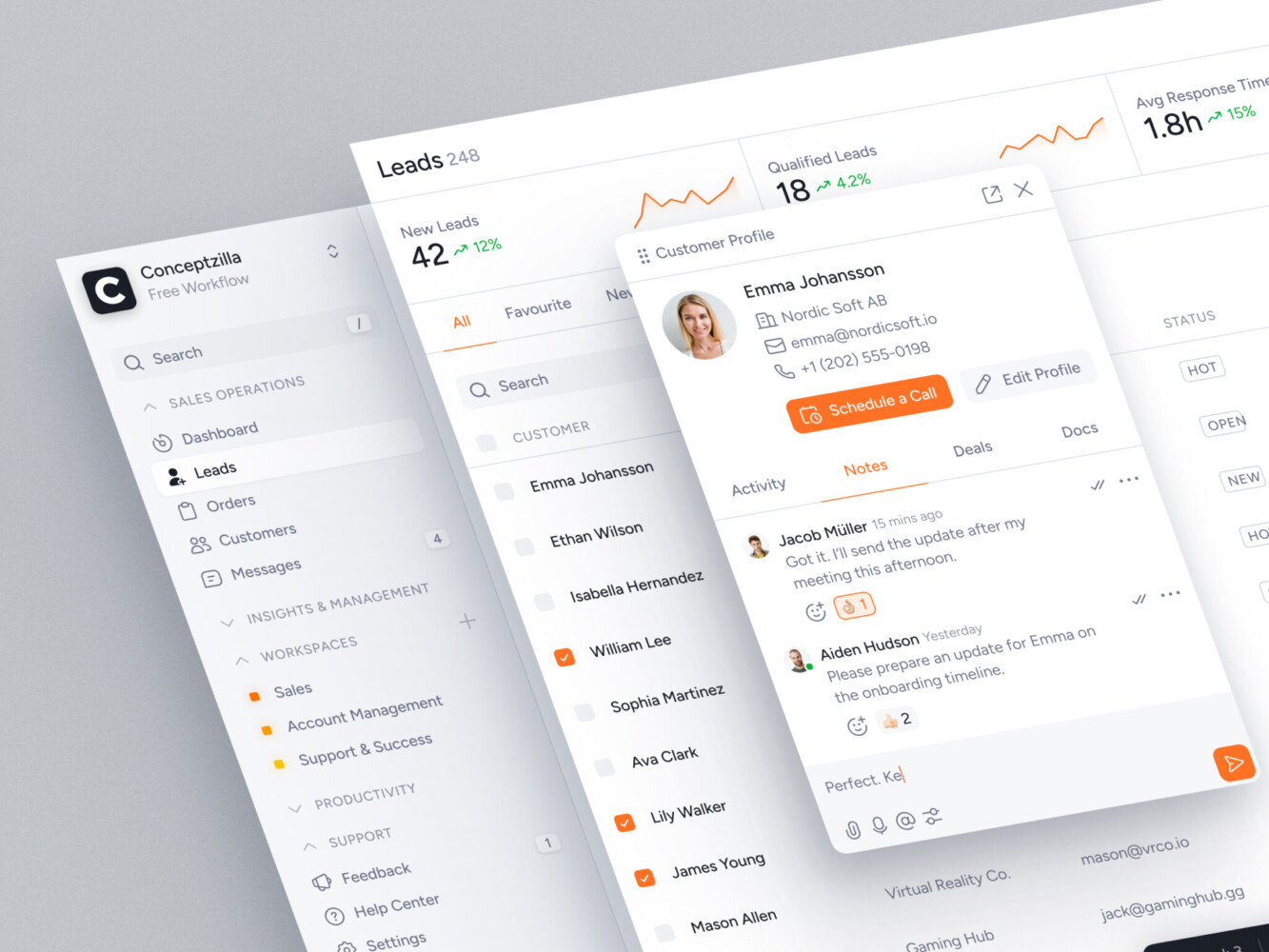
CRM dashboard design by Conceptzilla
FAQ
What Does API-First Mean in Software Development?
It means the API contract is designed before the main application code. The team agrees on endpoints, data formats, authentication, errors, documentation, and integration behavior early in the project.
What is the Difference Between API-First and Code-First?
Code-first starts with implementation and exposes an API afterward. API-first starts with the contract, then builds the implementation around it. Code-first can be fine for small tools, while API-first is usually better for platforms, integrations, mobile apps, and products with several consumers.
Is API-First Only for SaaS?
No. SaaS is a common use case, but API-first thinking also helps fintech products, e-learning platforms, marketplaces, mobile apps, AI tools, healthcare systems, and internal enterprise software.
How Does API-First Improve Scalability?
It improves scalability by creating cleaner service boundaries, predictable data models, better versioning, and clearer integration patterns. That makes it easier to add new clients, partners, features, and services without constantly rewriting core behavior.
What Tools are Used in This Workflow?
Common tools include OpenAPI, Swagger, Postman, FastAPI, API gateways, CI/CD tools, Docker, Kubernetes, monitoring platforms, and automated testing frameworks. The exact stack depends on the product and team.
Related reading