
E-learning market statistics point to steady growth: Research and Markets estimated the worldwide e-learning market at $398 billion in 2026, a 300% boost from $107 billion in 2015, and Technavio predicted that the education apps market would expand by $46.9 billion with a CAGR of about 26%. Education is also the third most popular category on the App Store and the second on Google Play.
Educational apps help people learn for personal interest or significantly improve their current career with new applicable knowledge. Demand for online education grew sharply during the pandemic, and for entrepreneurs and startup owners, the market is worth studying before building a product.
This article covers educational apps market statistics, the benefits of making an educational app for your business, e-learning app ideas in demand, top educational apps, market growth factors and hindrances, e-learning trends, the geography of the online learning market, and other business aspects of e-learning app development.
Educational apps market statistics
The question of how to create an educational app has its answers, but in this article, we’ll take a look at why would you want to do it and what’s in it for you. The current situation with the quarantine and shutdowns being repeatedly turned on and off all over the globe and their consequences drew the attention of entrepreneurs, startup owners, and investors to the areas of business that were previously if not neglected then underrated. In addition to the healthcare industry, it’s education and learning of various kinds.
The first online education programs began to appear in the 1990s with the widespread usage of the internet but the impact of online learning on education was really starting to be felt about a decade ago with the further development of technologies that made it available to more people. The active development of the market and a significant increase in demand for online education made it so that now the audience of e-learning courses has millions of users. Schools and companies deliver many of those courses through a learning management system such as Moodle or Canvas.
Education is the third most popular category on the App Store, beaten only by Games and Business, and on Google Play, e-learning is even higher in the second place. Though on both platforms the category has a similar percentage of almost 9% of the total.
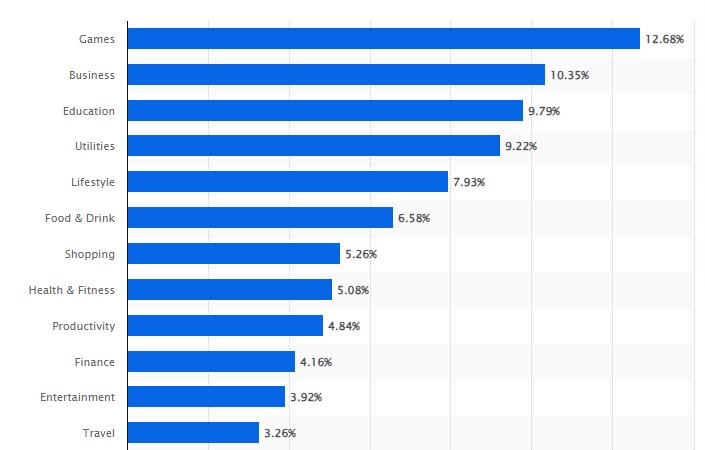
Technavio, a market research firm that recently released its latest 2020-2024 research on the education apps market, predicts that it will expand by $46.9 billion with a CAGR of about 26%.
Following another set of predictions by the Research and Markets data provider, the worldwide e-learning market is estimated to be worth $398 billion in 2026. That is a 300% boost from 2015’s 107 billion.
The online education market is developing rapidly and is being encouraged by raising capital. The most substantial section is in the USA (42.9%) and China (21.4%). Investors prefer to put their money into learning tools based on artificial intelligence (this category occupies 19.7% of the investment structure) and mobile learning (15.9%).

Landing page template – Isometric by Dmitrii Horai
Why educational app development is beneficial for your business
Education is popular. Anatomy, physics, chemistry, astronomy, and art apps win design and interface awards and get downloaded by hundreds of thousands of users. Online courses from learning foreign languages to medicine are now available for both children and adults. Self-education was never easier than today, both for personal and academic education.
The rhythm of modern life dictates its laws, and often the only free time we have is while driving or commuting, so smartphones become the most affordable way to get new information quickly and easily. If you don’t give up and try to devote every minute to self-development, then your choice is training with a mobile application.
That’s why an increasing number of people are using educational apps, no matter their age or professional background. It means that by creating an educational app, you can provide specific value to consumers and businesses resulting in a popular and profitable product.
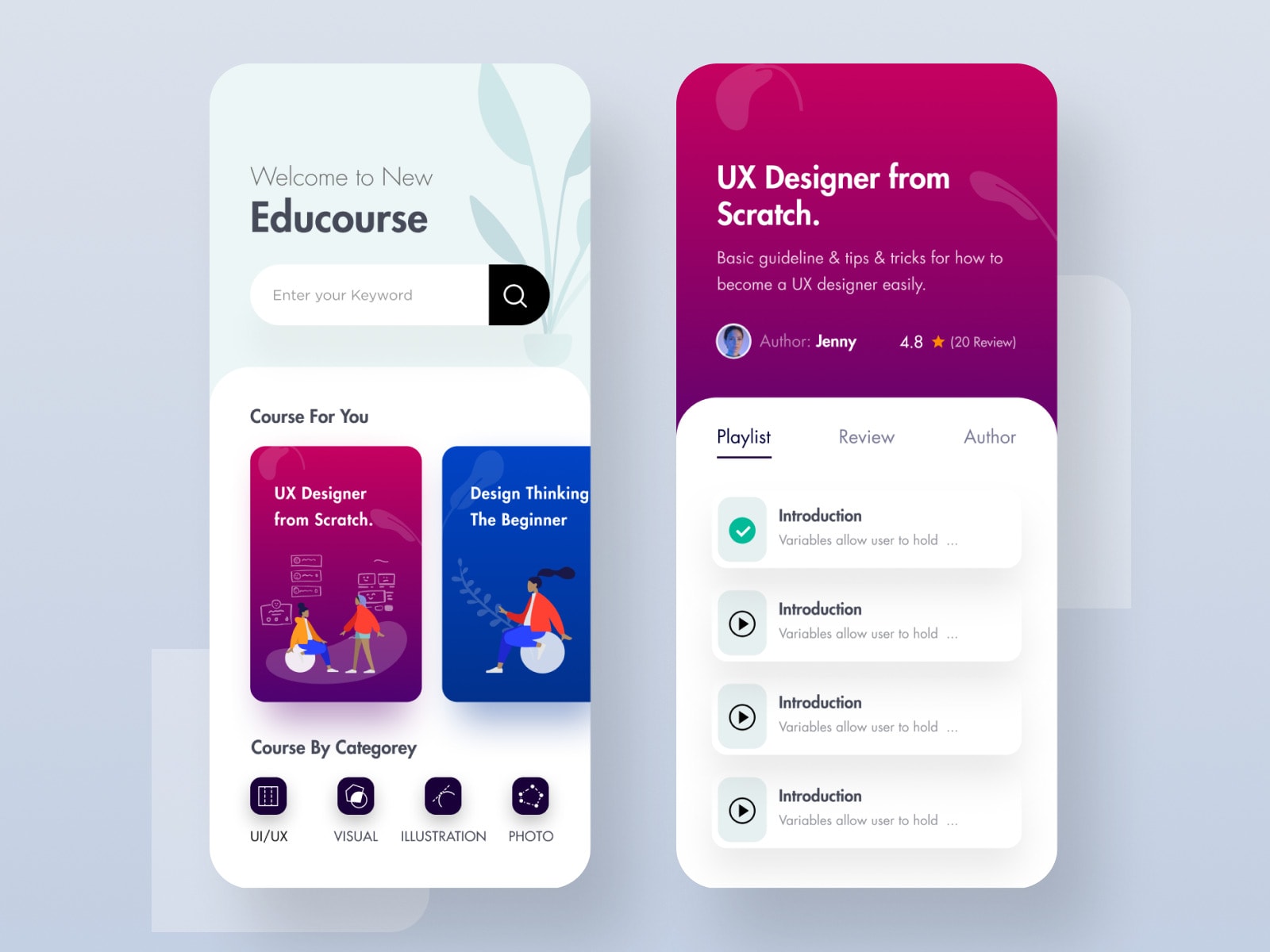
Online Course & Educational App UI by Niaz Mahmud
Benefits for customers
For the users of e-learning mobile apps, they present a set of distinct benefits:
- Convenience — studying at your own pace and saving valuable time.
- Availability and cost-effectiveness — no traveling, no specific rooms, or spaces required.
- Knowledge — developing new skills to improve your current life situation.
- Engagement — modern e-learning solutions are exciting and social.
- Interactivity — a better connection between students and teachers.
- Personalization — faster progress because of the possibility to learn only what’s needed.
- Fresh learning approaches — gamification, micro-training, and other new methods.
- Productivity tracking — an easier option to track one’s performance.
Benefits for businesses
- Huge profit opportunities — taking into account the above-mentioned popularity of mobile e-learning solutions.
- Making use of the latest technology advances — some apps for educational purposes get to be popular because of incorporating modern tech. It’s a great place to introduce something revolutionary in everyday life.
- Ability to change and improve people’s lives — many startup owners dream about making an impact. Here’s an opportunity.

Illustration for presentation. world scientists by Yuliya Volodina
More and more companies, including huge enterprises, recognize the booming popularity of educational content the demand for which skyrocketed during the first months of the pandemic. For example, in May 2020 TikTok announced its desire to encourage its community to self-educate by launching its new #LearnOnTikTok platform. $14.6 million of investments are said to be assigned for the use of hiring the services of various institutions and experts with experience in creating engaging educational content.
E-learning app ideas that are in demand
App with local courses for learning enthusiasts
Such an application brings together people interested in self-development and offers various courses (it doesn’t matter if paid or free, taking place online, or requiring a real presence). In addition, the application should provide the ability to select the area to find courses with a convenient location and search for online classes around the world.
The opportunity to learn and engage in self-development is incredibly in demand today. You can start with a local application offering online and offline courses in your area or city and then expand the location. The idea of this application may be of interest to companies offering educational programs.
Book sharing app
Book lovers will appreciate it. Not everyone who enjoys reading has enough money to buy e-books all the time. In this situation, your application will save them. The essence of the service is simple: users collect books in their mini-library and provide an opportunity for others to read them too. As additional features, you can add chat, the ability to schedule offline meetings, ranking books by category, and so on.
App to find an online tutor
COVID-19 has changed the entire education system and forced students to change their traditional education format to online education. And the need for tutors has not disappeared. On the contrary, it has grown: the majority of schoolchildren find it harder to study remotely. So there is a big demand for online tutors. You can solve this problem by creating a tutor finder app that considers location, experience, skills, tuition fees, and so on. A step further is AI tutor app development, where the tutor itself is software.
There are two main options for monetizing an app. You can either charge a monthly tuition fee or request a specific payment for each lesson.
Reading aloud app
You have had a long day; you have no strength to do anything when you return home. There’s an email from your mom right in your inbox, and you don’t have the energy to read it. Just scan the letter and let this app read it aloud. The same is for big articles or posts.
If you can create such an application, it will become famous among those who like to procrastinate, and perhaps it will become a hit overnight.
App with a deadline simulator
It is challenging to organize and deliver the project on time, and sometimes a person needs to be dropkicked right back. So that it irreplaceably accelerates the work process. So, we propose to create a deadline simulator application.
It convinces a person to move on with their work with the help of reminders that sound like their virtual boss. All points are displayed on the timer.
Medical app
Being a medical professional is one of those occupations that require constant continuous improvement of knowledge and skills. New research and development create new best practices for instant retraining and further education. Thankfully, there’s a way to ease the educational process and make it more engaging for students as well as for instructors — you can use special mobile apps for doctors, in other words, use the benefits of e-learning in healthcare.
Depending on the general purpose and features, your e-learning medical app will belong to one of several basic categories. You can either build a separate mobile education app or make it a reinforcement to an e-learning platform:
- Educational platforms: An educational platform is a customizable resource that contains learning materials. Such platforms are usually web healthcare education solutions with mobile applications for students and cloud-based data exchange. The list of popular medical educational platforms includes projects like Osmosis — a learning resource that contains a library with more than 1,300 videos, 15,000 flashcards, and 8,000 case questions that cover various medical topics.
- Medical reference apps: They contain reference materials for doctors of various profiles, medication specifications, identifiers of pills, medical news, etc. For example, there are special calculators for body mass index, infusion, and renal excretory function. In addition, such contain information on the side effects of drugs. The most popular reference e-learning apps for healthcare practitioners are Medscape Mobile, Human Anatomy Atlas, and Brainscape.
- Virtual and augmented reality simulations: Medicine is a great area for applying virtual and augmented reality technologies. You can train doctors and nurses using special mobile applications with VR and AR features. For instance, they learn how to use new equipment without studying printed instructions but using augmented reality technology with “tips” popping up about various device parts. VR trauma simulators help to acquire new skills without the possibility of making real-life mistakes and in less stressful environments, which is especially welcomed by early-career medical personnel. There are many free or paid medicine-related apps to explore complex problems with the help of VR/AR mobile learning technologies in healthcare, like Touch Surgery, Airway EX Virtual Surgery Simulator App, and others.
- 3D imaging and 3D MOA (Mechanism of Action): One of the aspects of healthcare education is knowing exactly how internal organs function. The developers of educational medical applications can digitally visualize internal organs, thus making the compulsory practice on cadavers almost obsolete. 3D imaging makes studying less expensive and more convenient, for both students and experienced medical personnel. A separate type of 3D imaging solution is an MOA (Mechanism of Action)—showing how various processes happen inside a human organism, how different systems are connected, and what changes occur when a particular substance is introduced to a body. One example of a 3D imaging app is the free and popular Complete Anatomy, which offers the most advanced anatomy mobile platform.
Webinar apps: Webinars are still a simple yet powerful tool, and they are the most popular one for education in healthcare. Their main advantage is interactivity—the ability to discuss newly received information here and now. Mobile solutions for e-learning for healthcare professionals like Docquity use webinars as one of their features.

Online learning by Cami
Top educational apps
In 2022, Duolingo was the most popular e-learning app in the world, with 98 million downloads. However, if we take the revenue, the results will be a bit different:
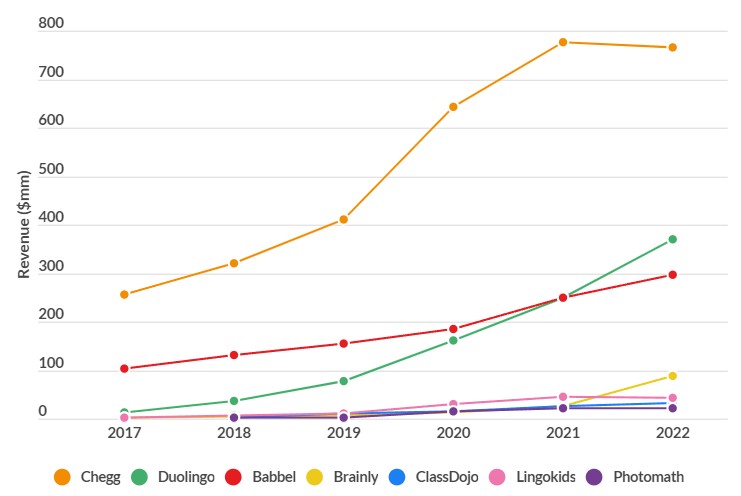
Chegg is an educational technology company that provides a variety of services and resources. The Chegg app is one of their offerings, and it helps students with their academic needs. The application has an interesting feature – textbook rentals. Using this option, the learners can rent textbooks and save money.
Educational apps market growth factors and hindrances
Technavio also highlights the increasing user interest in STEM apps and game-like learning. Other global factors worth noting are:
- The universal acceleration in the use of mobile apps
- The rising number of mobile users
- Progressing usage of AR & VR applications and blended learning.
Some active factors are directly connected with the benefits of educational apps:
- Affordable charges
- Versatility of learning
- Enhanced efficiency.
Factors that hinder the further development of the e-learning market include:
- Issues with data security — the massive shift to remote learning that happened this year introduced new privacy questions.
- Low connection speed and other issues like technology obsolescence are still some serious challenges in e-learning market development worldwide.
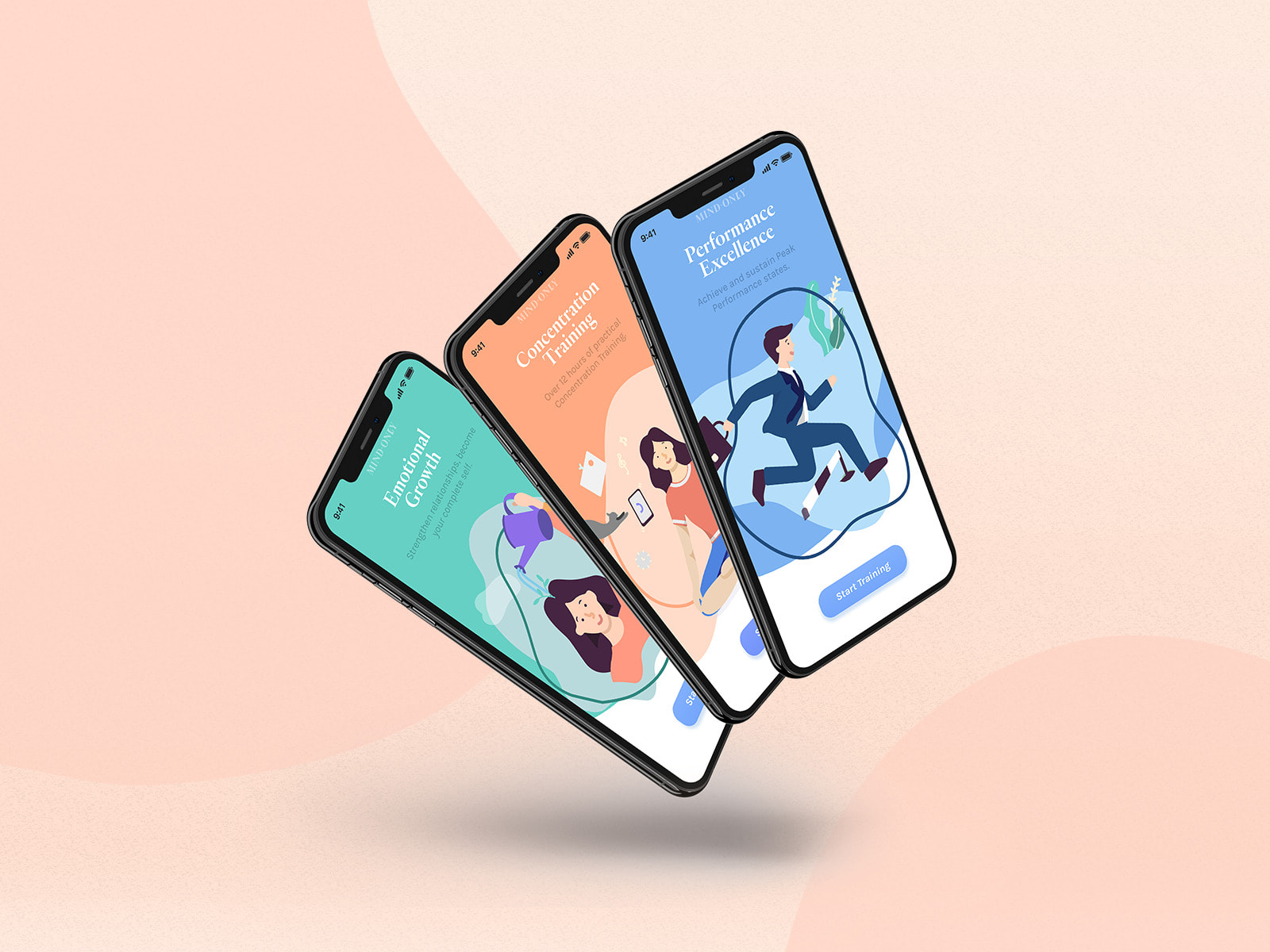
Mind Only – Courses App Onboarding 💡 by Pedro Gil
E-learning app market tendencies
The most prominent trend in educational mobile app development is the burgeoning use of wearable tech, as mentioned in multiple papers, the one by Maximize Market Research among them.
Wearable technology efficiently engages students making it easier for them to concentrate on the process. It further intensifies creativity and ingenuity letting students go beyond the usual limits and work closely with their surroundings. For example, with Autographer — a wearable digital camera — students can take photos of their teachers’ notes. Muse’s headband keeps track of students’ brain activity. Other examples of tech like smartwatches, GoPro, and Google Glass are more familiar to the wider audience.
What also stimulates the expansion of the education apps market is the wide use of smartphones and tablets for studying purposes. For example, 81% of US college students say that they owe the improvement of their grades to the advances in digital learning technologies.
The development of cloud and smart technologies for collecting and storing data leads to further ease of accessibility and cost savings, more secure data storage, and minimization of hardware requirements. With cloud storage and computing, there’s no need to invest in expensive PCs, hence the further e-learning mobile app development.
There’s also growth in microlearning. This technique allows condensing the most important information into small blocks of 3 to 15 minutes of audio or video materials, adapting to our ever-shortening attention spans.
AI integration in e-learning mobile apps offers numerous benefits, enhancing the learning experience for users and providing personalized, adaptive, and engaging content. For example, you can analyze user behavior, learning patterns, and preferences to create personalized learning paths. Thus you will deliver tailored content to meet specific learning needs. The same goes for smart assistants, which can evaluate people’s knowledge and answer their questions.
Another e-learning trend is gamification. It’s been around for a while, but mostly in apps for kids. Now you can integrate gamified elements to motivate adult learners using badges, rewards, and leaderboards. Powered by AI learning analytics, the teachers track their student’s performance and engagement. This way, they gain insights into learning patterns and identify areas for improvement.

Virtual reality by Serj Marco
Online learning market geography
A greater number of reports, including the one by Fortune Business Insights, predicts that North America will have the largest educational app market size in 2020-2025 because of stability in economic growth, rapid adoption of technological developments, and the rising penetration of smartphones across the region, mostly the USA and Canada. Other resources name the APAC (Asia Pacific) region as the one with the highest predicted augmentation due to the wide student base in India, China, and Japan and the implementation of the latest technologies in countries such as Australia and Singapore.

FAQ
How big is the e-learning market?
According to Research and Markets, the worldwide e-learning market was estimated to be worth $398 billion in 2026, a 300% boost from $107 billion in 2015. For the education apps segment, Technavio’s research predicted growth of $46.9 billion with a CAGR of about 26%. The first online education programs appeared in the 1990s, but the market grew fastest once mobile technologies made learning available to millions of users.
Which countries lead the online education market?
The largest segments of the online education market are in the USA, with 42.9%, and China, with 21.4%. Reports such as the one by Fortune Business Insights name North America as the region with the largest educational app market, thanks to stable economic growth and smartphone penetration, while the Asia Pacific region shows the highest predicted growth because of the wide student base in India, China, and Japan.
How popular are educational apps in the app stores?
Education is the third most popular category on the App Store, behind only Games and Business, and it ranks second on Google Play. On both platforms, the category holds almost 9% of the total. In 2022, Duolingo was the most popular e-learning app in the world with 98 million downloads, although the ranking by revenue looks different.
Where do investors put money in e-learning?
Investors prefer learning tools based on artificial intelligence, which take 19.7% of the investment structure, and mobile learning, with 15.9%. Large companies also invest in educational content: in May 2020, TikTok launched its #LearnOnTikTok platform and assigned $14.6 million to hire institutions and experts that create educational content.
What drives the growth of the educational apps market?
The main growth factors are the universal acceleration in mobile app use, the rising number of mobile users, AR and VR applications, blended learning, and user interest in STEM apps and game-like learning. Smartphones and tablets matter too: 81% of US college students say they owe the improvement of their grades to digital learning technologies. Data security issues and low connection speeds hold the market back.
What are the main e-learning app trends?
The key trends are wearable tech in learning, cloud technologies that cut hardware costs, microlearning with blocks of 3 to 15 minutes of audio or video, AI that builds personalized learning paths and powers smart assistants, and gamification for adult learners with badges, rewards, and leaderboards. AI learning analytics also help teachers track student performance and engagement.
E-learning is the future
It’s a booming industry, as the above exciting e-learning business statistics clearly show. Many are finding that e-learning is not just a viable alternative, it’s a better one. Interactive and gaming technologies allow applications to communicate with us, adjust to our level of knowledge, and at the same time be entertaining. And the smartphone is always at hand, so you can learn something new anywhere and anytime.
If you are still in doubt, about whether it’s worth hiring an app developer for creating an educational app or not, then you should analyze the educational app market. Hope that the information above was helpful. Write us a few words and let’s discuss your educational app idea.
Related reading
- Can E-Learning Replace Classroom Learning?
- Online Course Platform Development: How to Build a Scalable eLearning Business
- Educational SaaS Platform Development: How to Build Scalable EdTech Products
- E-Commerce Mobile App Development: Features, Trends, Cost
* * *
Further reads on e-learning app development:
- How to Create an Educational App and How Much It Costs
- Make It Work: Tips On E-Learning App Development
- 8 E-Learning App Trends Defining Educational App Development
- E-Learning App Design And How To Make It Better