SaaS mobile app development company
Create a flexible SaaS mobile app that can be easily scaled up or down depending on your business needs. Boost your regular workflows and give access to your services from mobile devices anytime and anywhere.
- 5,063 reviewsWith a Clutch rating of 5 out of 5 based on 63 reviews, our goal is to make you our next satisfied client.
Flexible approach
Through clear communication and consistency, we create intuitive, responsive interfaces with a compelling UX.Result-oriented
We focus on delivering solutions that drive growth, efficiency, and measurable success for your project.

SaaS mobile app development
Our team delivers robust mobile applications that correspond to your exact requirements: goals, current industry, desirable toolkit, pains of the potential users, etc. We pay close attention to all these factors and fine-tune the solution to meet the needs one hundred percent. Depending on the project, it can be a custom approach with specific features or a cookie-cutter one aimed at quick release and convenience.

“Our members loved the new iOS app. Our ratings shot up in the App Store from a 3.8 rating to a 4.8 rating”

Our SaaS app development process
We focus on delivering measurable results that boost your business and help your clients solve issues. The team integrates flexible solutions right from the start so you can quickly scale from MVP to full-fledged cloud apps. The strategy we create fully corresponds to your business goals and is aimed at delivering a suitable solution. Since SaaS products can be connected with sensitive information, the team implements the latest security practices.
Gathering information
We check what issues your business and the users currently face and how they can be effectively resolved with the SaaS app. Based on this data, the team creates a development plan.
Creating UI/UX design
The team builds prototypes to check hypotheses and then, after polishing the interfaces, optimizes them for mobile screens. We also transform the user flow so it will be convenient for people to work with complex data and item management.
Integrating third-party services & APIs
The team writes code and integrates the necessary services, for example, payment systems or GPS tracking. They all synchronize seamlessly with the web version, allowing users to benefit from continuous workflow and valuable features on all platforms.
Running compliance checks
SaaS mobile apps keep clients’ sensitive data, so we incorporate enhanced security features like 2FA and data encryption. The team adheres to compliance standards such as GDPR or HIPAA.
Testing & iterating
To catch any missed errors, we conduct all types of tests, including load, spike, endurance, and performance testing to check how the mobile application handles a certain number of users or items.
Deploying & maintaining
We deploy the application to the app markets and monitor the situation. After the release, the team keeps supporting your product with enhanced features and security updates. It stays with the flow of the latest trends and compliances.
Why opt for a SaaS mobile application?
It offers significant strategic and operational advantages because people can work from almost any location. They have access to critical tools and data from mobile devices. These qualities give additional value to the core SaaS solution as well.
Apart from easy data access and product value, there are other key advantages that level up business operations.
- Offline functionality
Users have access to your services even if they don’t have an Internet connection. They continue to complete tasks and manage items without falling behind or losing time. What’s more, when users are back online, the data gets synced. This feature gives staff a high level of flexibility and stimulates productivity. People benefit from continuous workflow without any interruptions.
- Interoperability
SaaS mobile apps are easy to integrate with other resources you already have. It can be integrated, for example, with your marketing platform, email service provider, and customer support tools. Again, it speeds up operations and eradicates a lot of drudgery: people don't need to log in or switch between a dozen apps.
- Scalability & cost-effectiveness
You scale usage up or down depending on the context. So you pay only for what you truly consume. This allows you to skip enormous initial investments and invest in more important features. Extremely useful for startups with less money and a smaller team.
- User insights and analytics
With a SaaS mobile app, you can watch what users do with the product (session length, feature adoption, drop-off points). With this data, you can improve UX, onboarding, and feature uptake. In addition, the analysis suggests power users and at-risk customers as targets for outreach.

Symbolik Social: A network for traders and analysts
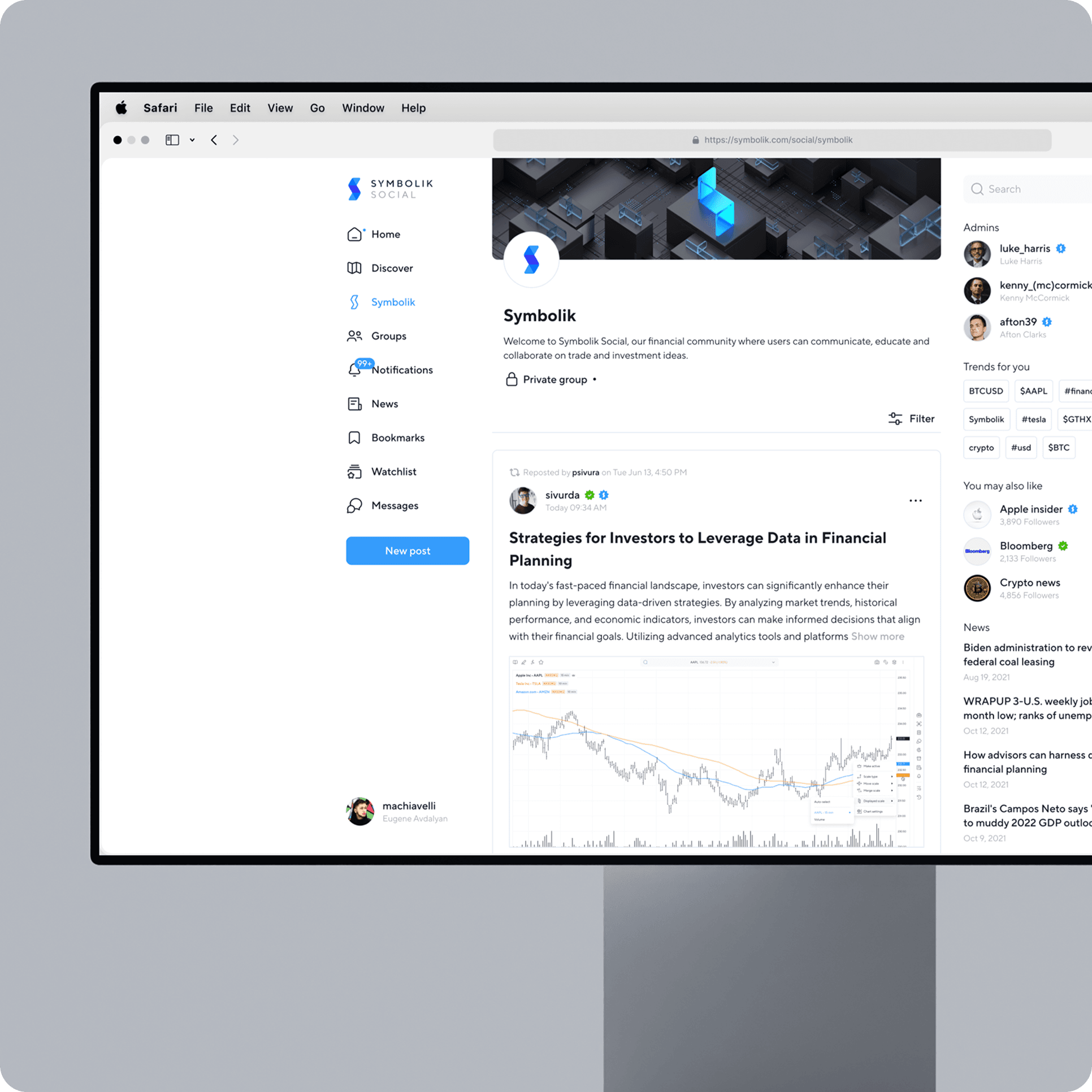
We designed and built a dedicated web platform where traders and analysts can share charts and market insights, discuss ideas in groups, and message each other privately. We added real-time updates to discussions and watchlists.
Shakuro does a phenomenal job at asking the right questions, and by understanding our needs, they define what needs to be created.T.J. DeMarkPresident, Symbolik
Industry awards & recognitions
Shakuro is recognized by platforms like Clutch, GoodFirms, and Dribbble for building high-quality SaaS platforms.


Benefits of our SaaS mobile apps
We think that making SaaS apps should be beneficial for your business and for the people who use them. It helps make decisions easier and solves problems quickly. That's why we do in-depth research and use the most up-to-date trends. This method finds the specific needs that are often missed.
Responsive UI
We optimize the layouts and workflows for the diverse sizes of mobile screens. It enhances the user experience because people have different smartphones, and, therefore, the layout can change drastically: buttons move, colors shift. The team also pays attention to accessibility since people may have disabilities.
Cross-platform development
Apart from the native approach, we have experience with building apps for both iOS and Android. Cross-platform applications attract a larger target audience. They are also cost-effective because they use one code base. So a single team handles everything.
Hybrid and headless architectures
Headless backends (API-first) make it easier to create mobile apps with the same data layer. No need for a separate server and duplicating logic. The data is synced across all products. One backend can serve web, mobile (iOS/Android), and even IoT devices.

Our toolkit for SaaS app development
We take advantage of both standard and custom tools to deliver responsive mobile apps. Determined by the project requirements and market situation, the instruments offer high performance, which is a must for cloud-based applications. At the same time, they comply with the security standards.


iOS development
Swift, SwiftUI, and Xcode are the three tools that we use to develop iOS applications. They are considered to be the gold standard in the industry. Apple itself has given its seal of approval to these technologies, which means that they provide the native experience and incorporate the latest features from the recent versions of iOS. They are designed to create mobile applications that are versatile, high-performance, and compatible with every iOS device.


Android development
The Android OS is compatible with a large number of different devices, and this sheer number demands the use of dependable tools. After a long testing and analysis, we picked Kotlin and Java as the key programming languages. They are simple to operate, convenient, and provide a large number of cutting-edge instruments. We leverage them to create reliable SaaS mobile applications that are resistant to high load.

Cross-platform development
When we work on projects designed for several platforms, we turn to Flutter. With the help of this framework, we provide a consistent user experience across all target platforms, despite the differences. Thanks to a single code base, the development process stays cost-effective. Since you don’t need two teams, it saves the budget and speeds the workflow.
Custom development tools
When you need a custom approach, we opt for tools like GraphQL and Firebase. The first one offers convenient API management, and the second one is responsible for real-time analytics and databases. To build a robust backend, the team uses Node.js.

Testing & DevOps
To deliver results that improve metrics, we conduct different test types. For example, to check how a SaaS app handles a large number of users, the team conducts load and stress tests. TestFlight, Espresso, JUnit, and Appium are our primary tools for testing. CI/CD pipeline automation is built with Jenkins and GitHub Actions.
Our expertise in SaaS mobile app development
Shakuro’s portfolio includes a dozen real-life SaaS products that have become successful after release. In each case, we’ve archived the business goals and created an application that helps users reach their goals as well.
150+
500+
19 years
years
48+
Discover the products we’ve crafted




Questions about SaaS mobile app development
Reach out to us if you don’t see the question you’re interested in. We’ll reply to you asap.
- What are the key benefits of a mobile app for a SaaS product?
To put it short, it makes the product more accessible, responsive, and user-friendly. People can work from anywhere, with real-time access to data, updates, and collaboration tools. These features improve user experience and engagement.
- How long does it take to develop a SaaS mobile app?
If your project is rather simple, it might take you around 3 to 6 months. This includes integration with an existing backend, of course. However, in case your project is more advanced, aim at 6+ months.
- How much does it cost to build a SaaS mobile app?
It all depends on what you pack under the hood, as well as the team location. The range spans from $50,000 to $150,000+. For simple apps, a budget of around $50K will be enough. At the same time, complex apps might cost around $150K. Don’t forget about ongoing maintenance, and add 15–20% of the initial cost annually.
- Do you develop for both iOS and Android?
Yes, we offer cross-platform development services. For each platform, the team uses a certain set of tools. This allows us to deliver high-performance applications with near-native experiences.
- Can the app support different user roles?
Yes, we can create different versions of the app or integrate role-based data access. In both cases, people with lower access won’t see the data meant for admins or experts.