
Ruby on Rails is a strong choice for e-commerce because it speeds up development, cuts costs, and gives an online store a secure, flexible back end. Ready-made gems cover authentication, payment systems, and carts, built-in protection guards against common attacks such as XSS, CSRF, and SQL injection, and the modular architecture lets a store grow from a simple shop into a complex B2B or B2C platform.
The back end is what makes an online store work: forms, logins, carts, and checkout all depend on it, so the technology choice is one of the decisive factors at the start of a project. Practice shows that Ruby on Rails can cut coding time by up to a third, which matters when you need to show the product to customers and investors quickly.
Below, we explain Ruby on Rails and e-commerce web development in plain terms, the reasons to choose Rails for an online store, and why custom e-commerce development can beat boxed solutions.
On Ruby on Rails and e-commerce web development
Imagine that your (future) e-commerce website is a restaurant and remember the last time you visited one yourself. You come in, sit at your table, interact with waiters, make your choice and get your food, enjoy it (or not), pay, and leave. In most cases, you can’t see the kitchen, exactly how your order gets prepared, and other behind-the-scenes. You make an order and the magic happens.
The same happens when you visit an online store. All you can actually see and interact with is the beautiful front end, while parts you can’t see, such as servers, databases, and APIs, are the back end. The latter is mostly responsible for how tasty your “dishes” are, how fast is your service, and how smooth the check-out process is.
Ruby on Rails, RoR, or simply “Rails” is a web framework written in the Ruby server-side scripting language for back-end web development. The back end is what makes your e-commerce website tick: receiving information from users, processing and saving it, getting the info from a database upon requests. In still other words, when users fill in forms, log in and out, put products in a cart, check out — all these are actions that the back end makes possible and are the whole point of online stores.
So why is Ruby on Rails the choice for e-commerce web development?
When you are in the early stages of developing a new e-commerce project, choosing the right technology stack goes a long way in ensuring its longevity. What’s more, as a business owner, your mind is going to be more occupied with sales to make, orders to fill, and profits to grow than going too deep into technical details. So the significance of choosing a reliable option from the start cannot be overemphasized.
You have various popular options for back-end development besides Ruby, like Python, Java, PHP, and more. But how do you choose the right one and why choose Ruby on Rails in particular? In one of our earlier articles, we discussed the reasons that make RoR popular and why even after more than 15 years of its existence it shows no signs of slowing down. We also touched on the advantages and disadvantages of Ruby on Rails development there, check this article to get a better general understanding of this framework. This time, we are going to focus on benefits for e-commerce projects specifically.
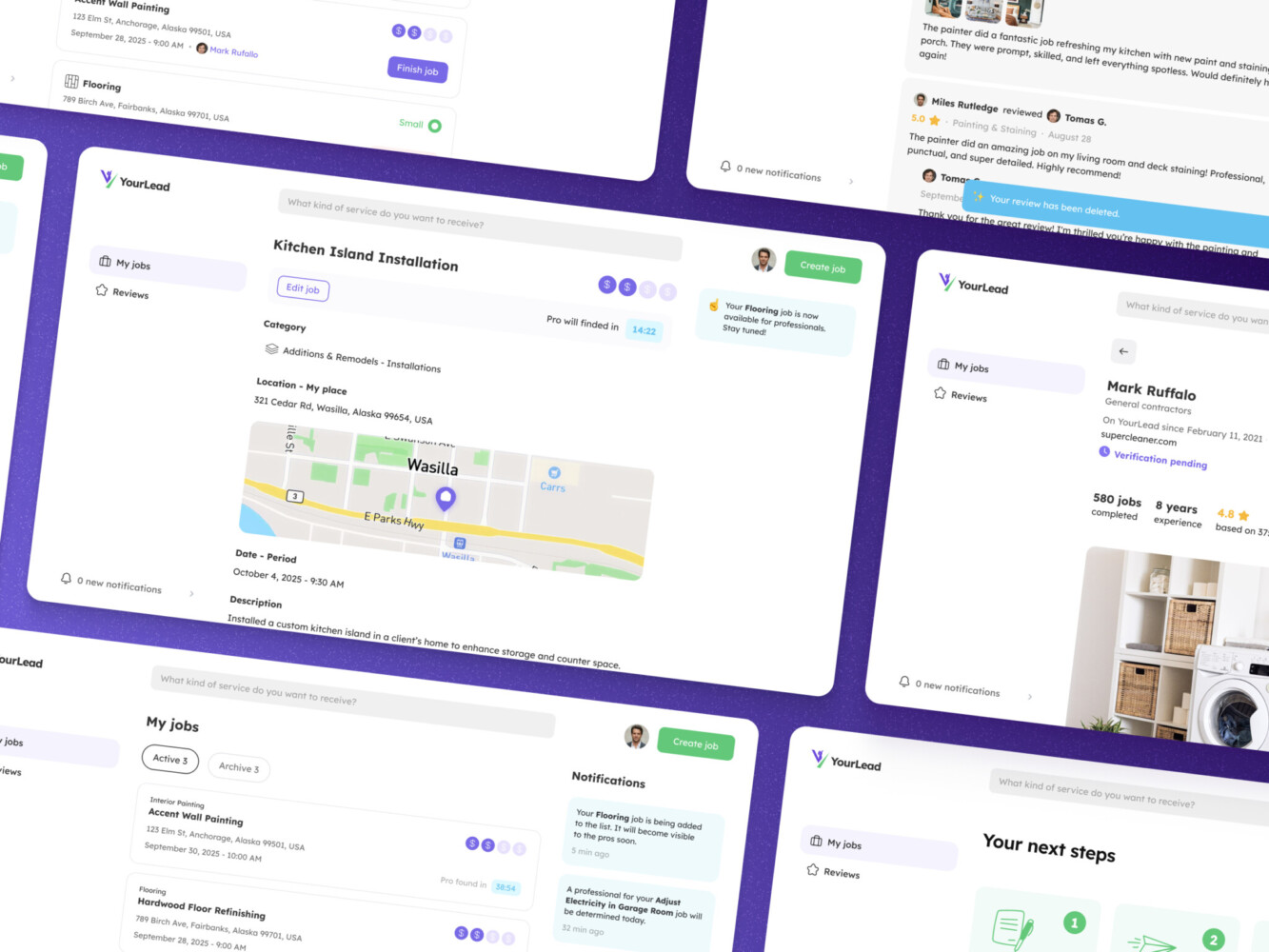
Design for Construction Lead Generation Platform by Shakuro
Ruby on Rails is fast and cost-efficient
So why pick Ruby on Rails for ecommerce? RoR’s speed of development is its key characteristic that makes it popular in the business world, especially in the startup community.
Time = money. Online stores exist to make money. To test a business model, you need to show customers (and investors) your product as quickly as possible to see whether they are willing to use it and pay for it. Ruby on Rails is famous for its ability to cut down the development time and hence money. Practice shows that using Ruby on Rails can cut coding time up to a third compared to any other programming language or framework.
This is possible for several reasons. Back when in 1995, Ruby was created with developers’ desire to make it as simple and effective a language as possible. Rails’ Doctrine names programmer happiness as the “core motivation for creating Ruby”. So it’s no wonder that it has become famous for its simplicity and ease of use. RoR is loved by developers and trusted by some major companies like Netflix, Airbnb, and Doordash.
Secondly, there are many tools and ready-made solutions available for Ruby on Rails called “gems” which means that things like authentication and authorization, payment systems, cart, and more don’t get developed from scratch.
All in all, building an e-commerce website with Ruby on Rails allows you to launch the first version in a matter of months. This is a huge advantage, especially for startups that often base their business model on the MVP product.
For example, when developing Cubebrush — an e-commerce platform for digital artists — using RoR, we were impressed that it took only a year from ideation to the launch, considering that there were only 2 developers working on this project and taken into account that the scope of the released functionality is a full-fledged custom e-commerce project with an admin panel, roles, several payment gateways, and integration with Discourse — a Ruby on Rails application for forums.
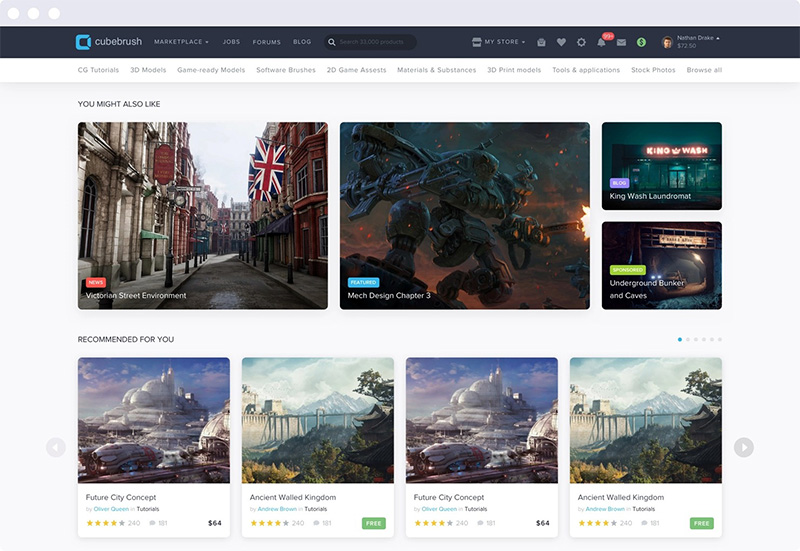
The Cubebrush project by Shakuro
Plus, RoR is an open-source framework available free of cost (those gems mentioned earlier are free too). Being open-source is how Ruby helps startups compete with experienced players on the market.
RoR saves both time and money.
Ruby on Rails is popular
RoR culture is very social. Ruby on Rails has one of the largest and most active developer communities in the world. For professionals, it means easier and faster development when in case you run into a problem, you can always rely on the community and get a solution from experienced developers (which, by the way, in the majority of cases, would already be published).
For business owners, it means that developers working on their projects have access to thousands of shared solutions someone came up with earlier, tested, and made ready for implementation which significantly saves development time and increases the “expertise level” of your team. In essence, it means that you kind of have a giant IT department behind your project even if just a couple of developers work on it directly.
As of now, there are over 194K gems in their wide ecosystem available.
RoR has an abundance of reusable tools and an active developer community.
Ruby on Rails is secure
When a business owner thinks about his online store, they usually dream of a reliable and stable website that brings constant income. But in practice, this is not always the case.
The essence of e-commerce operations is multiple dealings with sensitive financial data. Though the majority of today’s users are used to provide the details of their credit cards, very little is needed to lose their trust forever when things concern financial matters. Every mistake of this kind is very expensive. Credit-card fraud, customer base hijacking, website downtime with no sales, losses from PPC ads leading nowhere — these are just some of the results of the possible security issues.
Though no code is totally bug-free, a lot depends on the initial choice of technology. Seeing the power of Ruby on Rails in ecommerce on the internet, like Etsy and Fab, you can guess that its team takes the subject of security seriously even if you use the out-of-the-box solutions. Ruby on Rails is heavily geared towards project security by default and successfully lived through many security vulnerabilities. The built-in protection against such common attacks as XSS, CSRF, and SQL, which are considered to be among the most popular attacks on web applications, is pretty much helpful.
Not only does the Rails team perform constant work on enhancing the framework’s ability to withstand hackers’ attacks actively investigating and patching vulnerabilities, but they also offer a bounty program that pays for anyone who finds the previously undetected ones.
Besides, despite a decent number of security measures RoR has from the start, a sensible developer usually implements something extra that suits a project especially when it concerns sensitive and personal data. Plus, Ruby developers use different security techniques such as Code review, Penetration testing, and Static Analysis. There are also a number of gems created specifically for security vulnerability detection.
RoR takes the subject of security seriously.
Ruby on Rails is flexible
Many of our customers reach us when they face the problem of the inability to scale because of technical limitations that stem from their limited ready-made solutions’ functionality. Ruby on Rails is flexible and goes along well with other technologies, both back-end and front-end.
Ruby on Rails has a modular architecture which means that the capabilities of any RoR product can easily be expanded and transformed when needed.

Ruby less “creative” than some other languages. On the other hand, the modular architecture makes the development very alterable and the products made with it — easy to modify and improve in the future. They don’t require a total rehaul when you need to introduce a few changes and make it snappy. It’s a great advantage for complex web applications that take time and for startups that are prone to the rapid growth of team and technology and cannot suffer slow introduction of changes.
Thanks to all this, Ruby on Rails equally well suits various varieties of e-commerce platforms including B2C, B2B, as well as the B2B2C model which is a combination of both. Ruby on Rails allows you to easily integrate the necessary features and plug-ins like various payment gateways in the case of e-commerce projects.
RoR is great for startups and complex projects.
Ruby on Rails is stable and reliable
The “Convention over Configuration” principle is one of Ruby on Rails’ pillars (you can read about it in the Doctrine also). It’s a software design paradigm that aims at freeing developers from making some mundane decisions and leaving more time to focus on deeper logic. It comes in handy while working with a variety of frameworks though it was first formulated to describe the philosophy of Ruby on Rails. It means that the Ruby code is structured so that other developers have a better understanding of each other’s decisions using this principle as a common ground. Following conventions like this makes it easy for other developers to take the project on the fly and provides opportunities for an easier onboarding process.
What’s more, seeing that Ruby was developed in 1995 and Rails in 2004, it makes them genuinely mature. From the developers’ standpoint, it’s not hip and intriguing anymore, but on the other hand, maturity means more stable and refined code and hence the greater confidence in the future which is critical for business.
RoR is your choice for long-term projects.
Why custom e-commerce development?
A couple of words about why some companies and business owners choose custom web development services for their products and why it might be better than choosing packaged software.
Boxed solutions are not suitable for websites with high requirements for speed and performance. In these cases, develop an e-commerce website that would be able to carry this load, a programmer themselves develops the basis of the website. Why do all this work when you can find and use a boxed template? The answer is again flexibility.
Because great e-commerce is more than just publishing your goods. A bespoke solution is a way to distinguish you from your competitors with less sophisticated platforms and make a foundation for future changes. A simple online store? Done. A shop with elements of a social network? You got it. Add a personal account for partners? OK! If you want your project to have a strong technical foundation, if it must be quick, and handle high loads, then choose Ruby on Rails development.
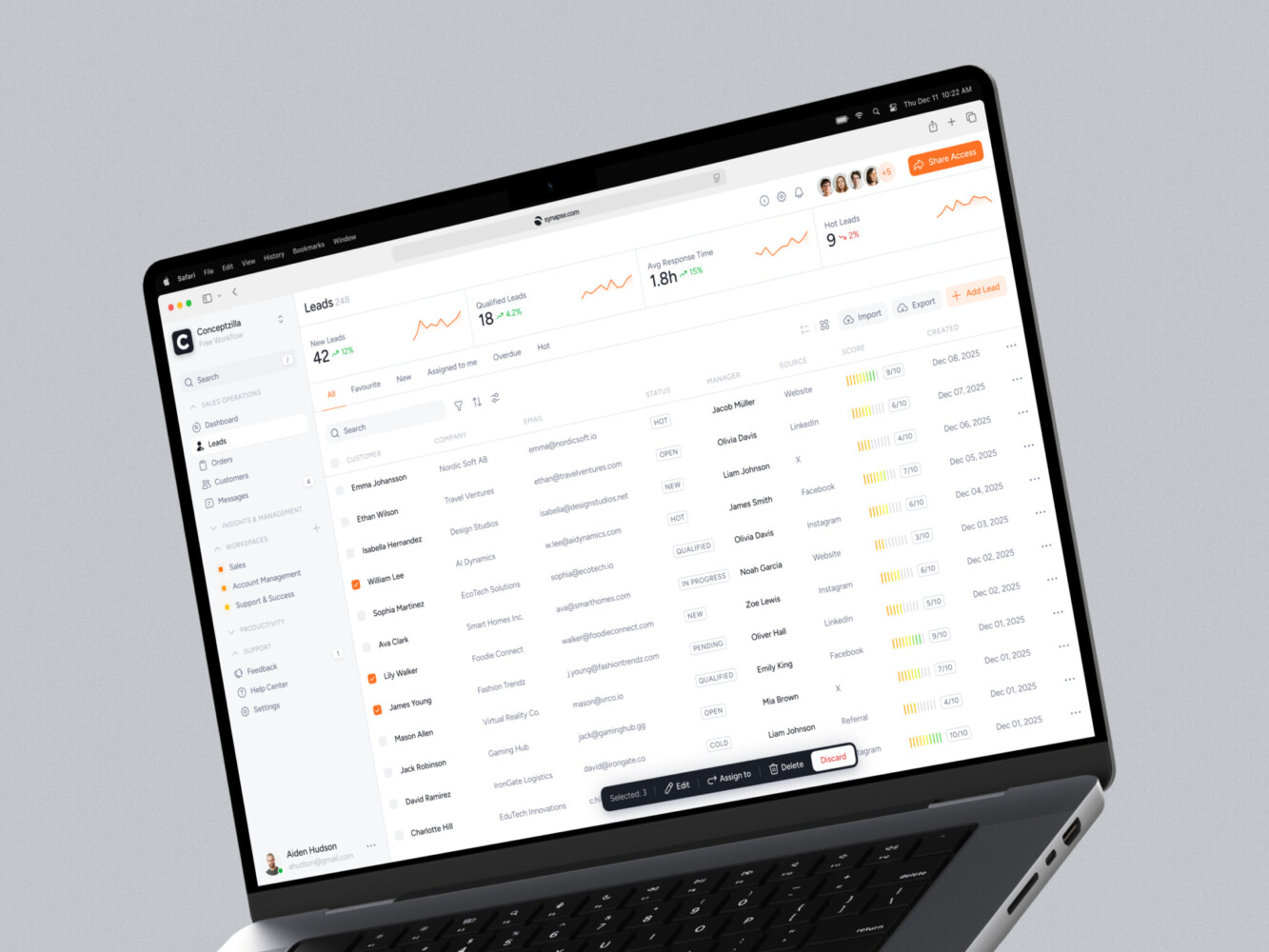
CRM dashboard design by Conceptzilla
Get advice from a Ruby on Rails development company
Ruby was invented with developers’ happiness in mind. It is known for its flexibility, startup-friendly nature, vibrant community, and useful tools. It saves time, money and hikes productivity.
What can be more profitable than to make the two worlds meet? E-commerce evolved much during the last decade. Pandemic made the situation even more prominent. Picking Ruby on Rails for e-commerce web development is a sensible option because it is a powerful framework to build powerful, stable, and reliable products while being one of the most attractive options in terms of cost-effectiveness.
Looking for someone to help you develop your next e-commerce web project? Contact us. As a Ruby on Rails development company, we can describe the capabilities of this technology and offer you various ways to construct your project for successful participation in the e-commerce race.
* * *
This article was originally published in February 2021 and was updated in July 2026 to make it more relevant and comprehensive.
FAQ
Is Ruby on Rails too slow for high-traffic stores?
No. Rails is famous for development speed, and it runs large platforms: companies like Netflix, Airbnb, and Doordash trust it, and e-commerce marketplaces like Etsy were built with it. Its modular architecture lets you expand and transform a product when needed. Boxed solutions are the ones that struggle with high requirements for speed and performance, which is why stores with heavy loads often choose custom Rails development.
Is Rails flexible enough to scale beyond a monolith?
Yes. Ruby on Rails has a modular architecture, so the capabilities of any RoR product can be expanded and transformed without a total rehaul when you introduce changes. It also works well with other back-end and front-end technologies. That makes it suitable for startups that grow fast and for complex platforms, including B2C, B2B, and B2B2C e-commerce models.
How does the cost of Rails development compare to other stacks like Node.js or Python?
Rails is usually cost-efficient, especially early on. The “Convention over Configuration” principle frees developers from mundane decisions, and free, open-source gems provide authentication, payment systems, carts, and more, so they don’t get developed from scratch. Practice shows Rails can cut coding time by up to a third. At Shakuro, 2 developers took Cubebrush from ideation to launch in a year.
Can we still use React or Vue for the frontend if we choose Rails?
Yes. Ruby on Rails is a back-end framework: it handles what users don’t see, such as servers, databases, and APIs, receiving, processing, and saving data when shoppers log in, fill in forms, or check out. It goes along well with other front-end technologies, so you can build the storefront with React or Vue while Rails runs the business logic.
Is Ruby on Rails secure enough for online payments?
Rails is heavily geared toward security by default. It has built-in protection against XSS, CSRF, and SQL injection, among the most popular attacks on web applications, and the Rails team actively patches vulnerabilities and runs a bug bounty program. Developers add project-specific measures, code review, penetration testing, and static analysis, and there are gems for security vulnerability detection.
Why build a custom e-commerce website instead of using a boxed solution?
Boxed solutions don’t suit websites with high requirements for speed and performance, and they limit how far you can scale. A custom store is more flexible: it sets you apart from competitors on less sophisticated platforms and creates a foundation for future changes, such as social network elements or personal accounts for partners, without rebuilding the site.
Related reading