Big data platform development means building a system that collects, stores, processes, and analyzes large datasets from apps, logs, APIs, transactions, and other sources. An initial platform with 2–4 data sources, a basic data lake, and scheduled batch pipelines takes 3–6 months and costs $60,000–150,000. An enterprise platform with lakehouse architecture, governance, lineage, and near-real-time processing takes 6–12+ months and costs $400,000–1,000,000+.
Companies reach this point gradually. Product events, payment records, server logs, IoT signals, and third-party feeds pile up until the usual database-plus-dashboard setup starts to bend. A good platform lets a SaaS product or an internal team process large datasets without long waits and turn them into analytics, machine learning inputs, and reports. Common technologies include Spark, Hadoop, S3, Python, and Kubernetes.
This guide covers what a big data platform is, key features, big data platform architecture, the development process, cost, and common challenges.
Quick Facts
| Question | Answer |
| Best for | Companies that need to store, process, and analyze large datasets from multiple sources. |
| Typical timeline | 3-6 months for an initial platform; 6-12+ months for larger or enterprise systems. |
| Core components | Data ingestion, distributed storage, processing layer, metadata/governance, and analytics access layer. |
| Common tools | Spark, Hadoop, S3, HDFS, Python, Kubernetes, SQL engines, and cloud data services. |
| Main risk | Overbuilding the architecture or underestimating data quality, infrastructure cost, and long-term maintenance. |
What Is a Big Data Platform?
A big data platform is a distributed system built to collect, store, process, organize, and provide access to large datasets. Often these datasets are too large, too fast, or too varied for traditional relational databases to comfortably handle.
The classic way to describe big data is with three ideas:
- Volume: the data can be in terabytes, petabytes, or more.
- Velocity: Data is arriving all the time (from apps, APIs, logs, devices, or external systems).
- Variety: Data types include structured, semi-structured, and unstructured.
Traditional systems are usually built for a single database, fixed schemas, and predictable query patterns. Big data architecture is a different animal. It’s built around distributed storage, parallel processing, and horizontal scaling, so the system can grow by adding more nodes, instead of making one machine do the impossible.
That shift matters. A SaaS company analyzing product behavior, a fintech platform monitoring transactions, and a healthcare product working with large operational datasets all need different data flows. But the underlying goal is similar: move from scattered raw data to reliable insight.
Types of Big Data Platforms
Data lake platforms store raw, structured, semi-structured, and unstructured data at scale. They are useful when you do not yet know every future use case, but you want to preserve the data in a flexible format.
The lakehouse platforms borrow concepts from data lakes and data warehouses. They retain the scale and flexibility of a lake but add more structure, governance, and query performance.
Analytics platforms are all about analysis and reporting. They help teams analyze large data sets, build dashboards, and make business intelligence workflows easier.
But in practice, the border between all these categories can often become blurry. Many systems start as a data lake and then turn into a lakehouse or analytics platform as teams ask for better governance, faster queries, and clearer ownership.
Core Components
Most big data solutions include a few core pieces:
- distributed storage, often using data lakes or object storage;
- data ingestion systems for moving information from source systems;
- processing engines for batch or hybrid workloads;
- metadata management for cataloging and understanding datasets;
- a query and access layer for analysts, apps, APIs, and machine learning tools.
The exact mix depends on the product, team, compliance requirements, budget, and expected scale. There is no single perfect stack. There is only the stack that fits the job and can still be operated six months from now.
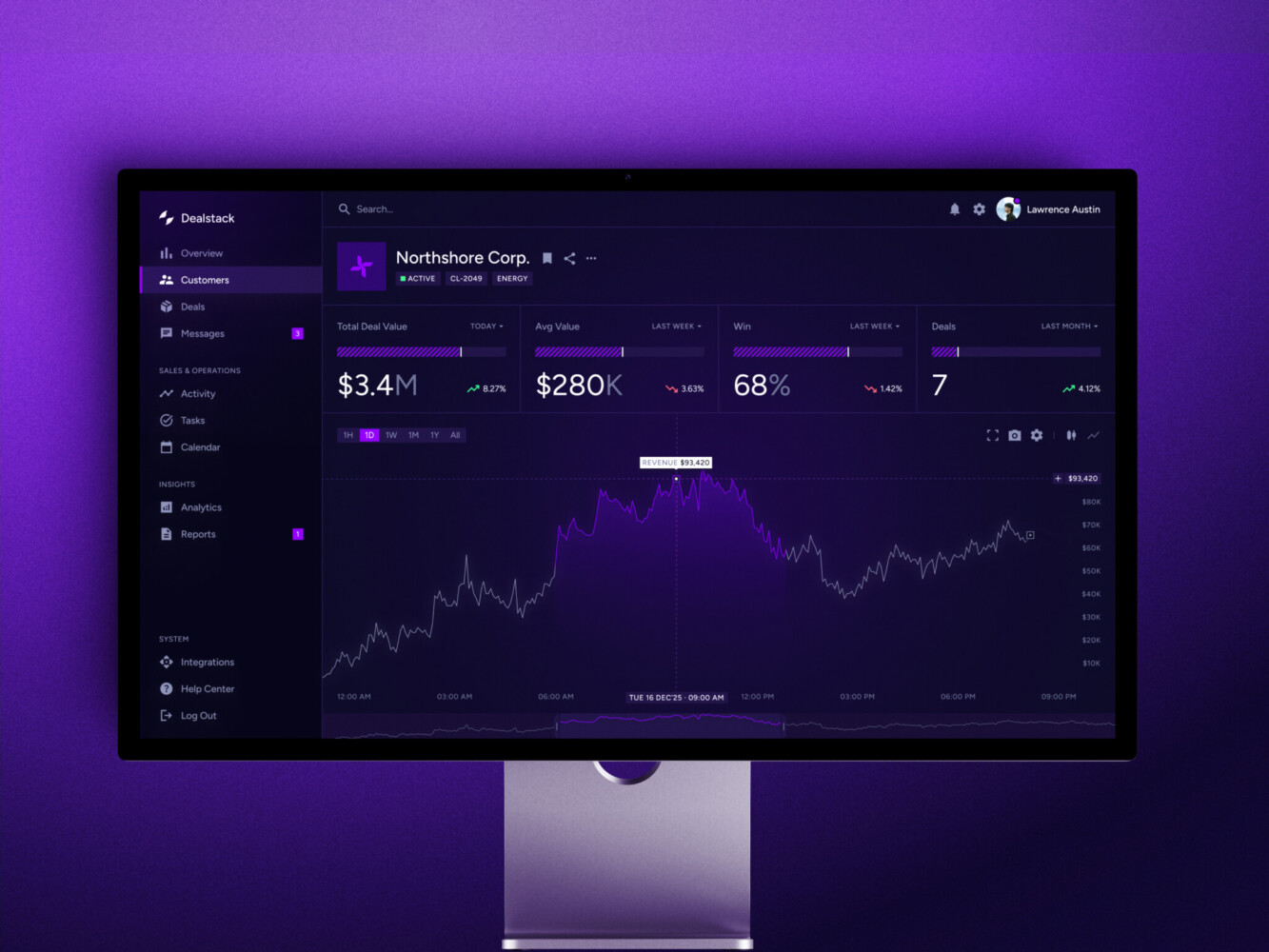
Sales Analytics Dashboard by Shakuro
Key Features of Big Data Platforms
Distributed Storage
The storage layer spreads data across multiple machines or storage partitions. This is what lets teams work with huge datasets without relying on one oversized server.
For some companies, “huge” means years of application logs. For others, it means transaction history, documents, images, events, or machine-generated records. Either way, systems at that scale need storage that can grow with the business and still remain accessible.
Parallel Data Processing
Big data processing systems divide work into smaller tasks and run them in parallel. Instead of one machine reading the full dataset from start to finish, many workers process chunks at the same time.
Frameworks such as Spark and Hadoop made this model common. Today, many teams use Spark-based processing, managed cloud services, or hybrid approaches depending on workload size and team experience.
Schema Flexibility
Data does not always arrive neatly. Product events change. API responses vary. Logs contain odd edge cases. External systems send fields your team did not expect.
A platform should support both structured and unstructured data, especially in early stages. This is one reason data lake development is common for companies that want flexibility before locking everything into strict models.
Data Lake and Lakehouse Support
Raw data and processed data often need to live in the same environment, but with different rules. Raw data should be preserved. Cleaned data should be easier to query. Business-ready datasets should be governed and documented.
Lakehouse-style systems aid that progression. They let teams store data at scale, adding structure, quality checks, access control, and performance improvements over time.
Integration With Analytics and AI
In big data platform development, the product is not the ultimate goal. It is the foundation for what comes next: dashboards, forecasting models, recommendation systems, risk scoring, anomaly detection, and other AI-driven analytics.
For example, a fintech product might need fraud signals from transaction streams. A SaaS company might want churn indicators based on user behavior. In both cases, the platform has to prepare data in a way that downstream systems can actually use.
If AI is part of the roadmap, it helps to design the data foundation early. We cover this topic in more detail in an article on AI-driven analytics.
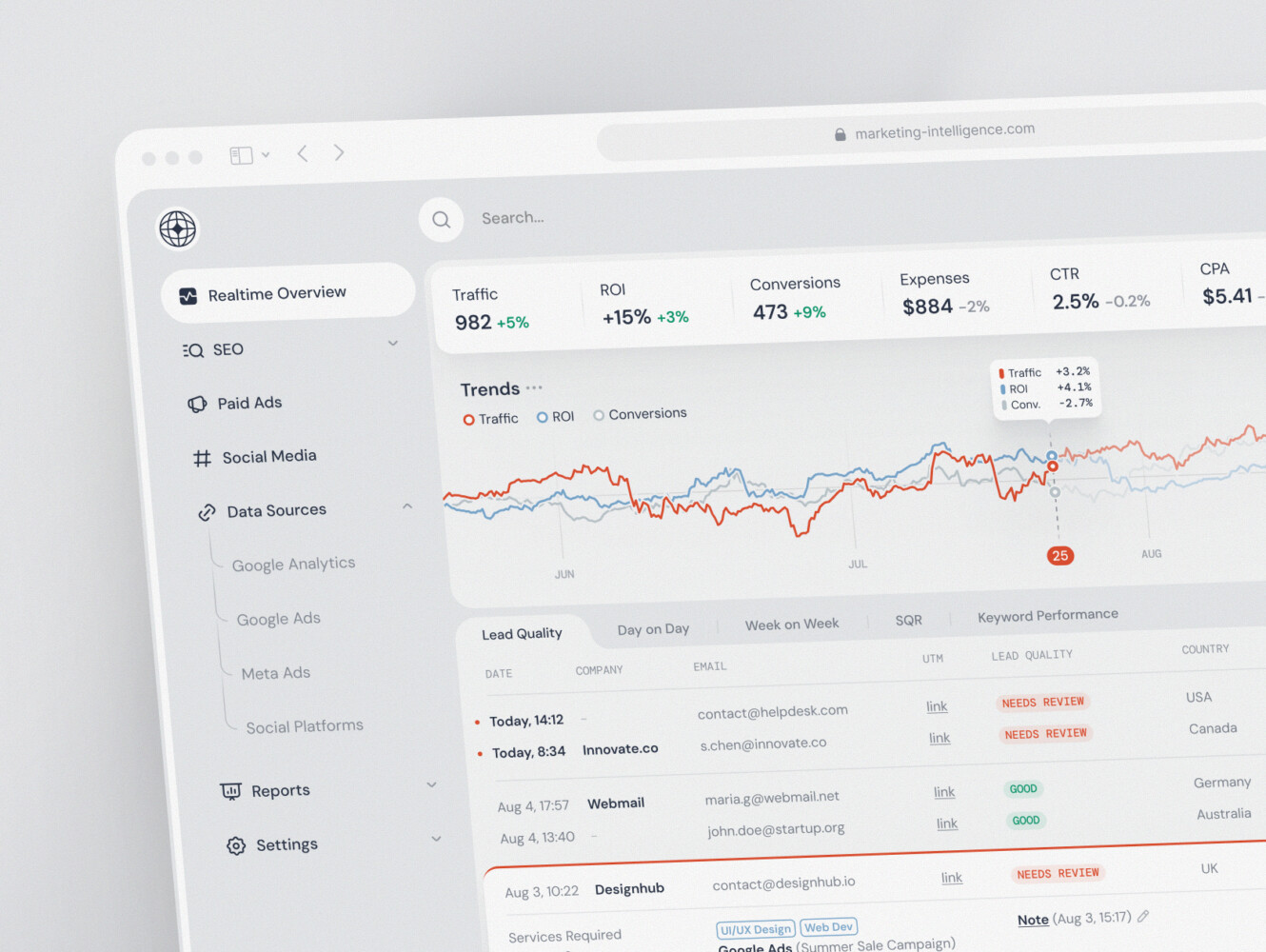
SaaS marketing dashboard by Conceptzilla
Big Data Platform Architecture
Big data infrastructure is usually layered. Each layer has a job, and the boundaries between them keep the system easier to reason about.
Data Ingestion Layer
The ingestion layer collects data from applications, APIs, logs, external databases, third-party services, and sometimes devices or streaming sources.
This layer needs to answer practical questions:
- Which sources are critical?
- How often does data arrive?
- What happens when a source fails?
- Does the platform need real-time ingestion, scheduled batch jobs, or both?
For many products, ingestion is where hidden complexity first appears. The source data may be inconsistent, duplicated, late, incomplete, or poorly documented. A clean architecture helps, but so does patient data engineering.
Storage Layer
The storage layer holds raw, cleaned, and prepared datasets. Common options include cloud object storage such as S3, distributed file systems such as HDFS, or managed storage services from cloud providers.
The important part is not only where the data sits. It is how it is organized. Partitioning, naming, lifecycle policies, access rules, and file formats all affect cost and performance.
Processing Layer
The processing layer turns raw data into useful datasets. This may include cleaning, validation, enrichment, aggregation, feature preparation, and transformations for reporting.
Batch processing is still common because many analytical workloads do not need instant updates. Spark and Hadoop are often associated with this layer. Some platforms also use hybrid processing models, where batch jobs handle heavy historical work and streaming systems handle time-sensitive events.
Metadata and Governance
Without metadata, a big data architecture slowly becomes a storage bucket with rumors attached to it.
Metadata management helps teams understand what a dataset contains, who owns it, how fresh it is, where it came from, and whether it can be used for a specific purpose. Governance adds policies around access, lineage, retention, quality, and compliance.
This part is easy to delay and painful to add later. Honestly, it is one of the places where mature platforms separate themselves from improvised ones.
Query and Access Layer
The access layer gives people and systems a way to use the data. That can mean SQL engines, APIs, notebooks, dashboards, internal tools, or integrations with analytics platforms.
This is also where product experience matters. A technically strong platform still fails if analysts cannot find datasets, business users cannot trust dashboards, or internal tools are too clumsy to use. For web-based analytics products and admin interfaces, teams often combine backend data work with web platform development and careful UX decisions.
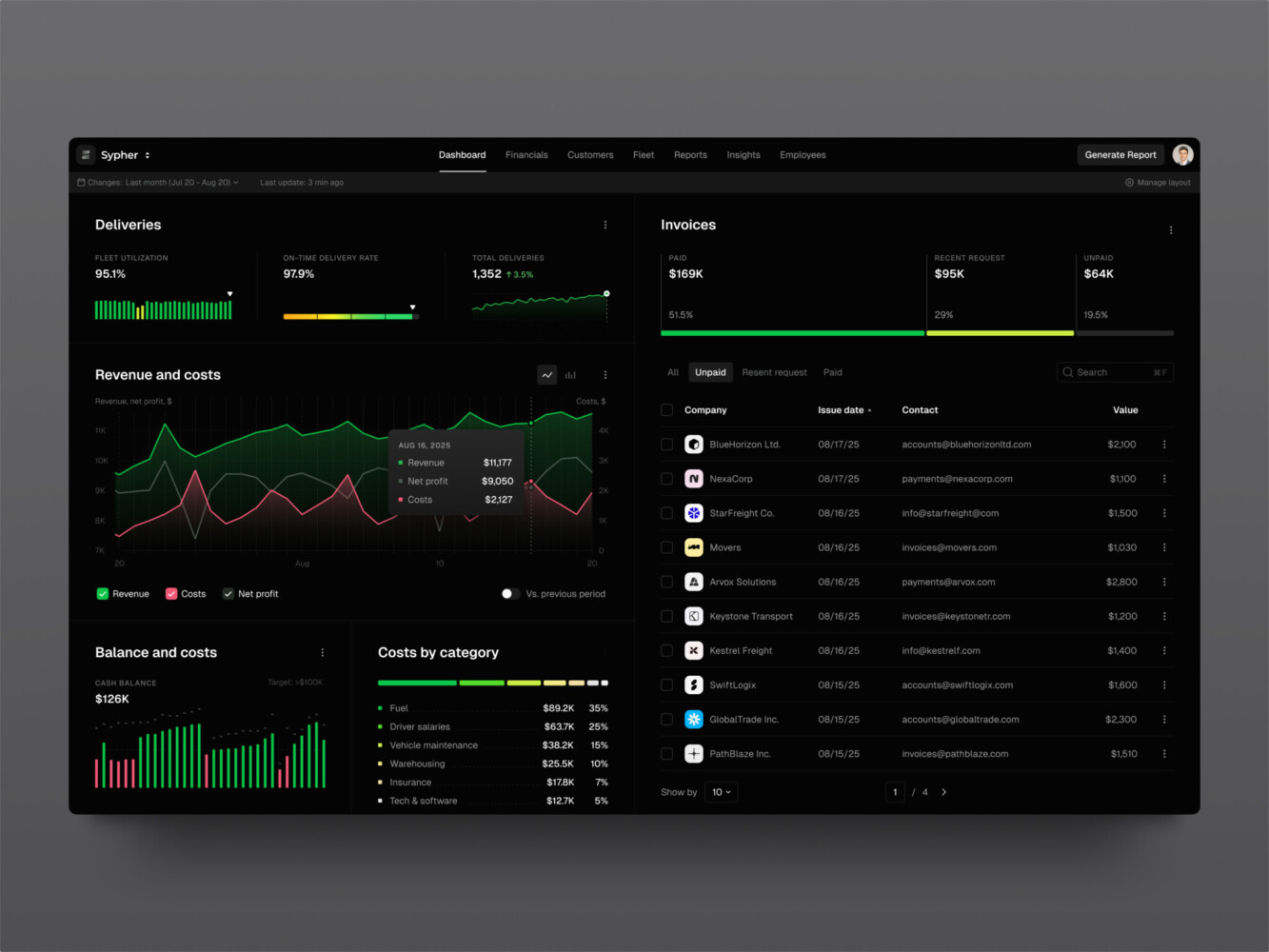
SaaS analytics platform by Shakuro
Big Data Platform Development Process
The development process depends on scope, but most projects move through the same core stages.
1. Data Strategy and Use Case Definition
Before choosing tools, define the business reason for the platform.
Start with the basics:
- What decisions should this platform support?
- Which data sources matter most?
- How much data exists now, and how fast will it grow?
- Who will use the output: analysts, customers, internal teams, AI models, or operational systems?
- What level of freshness is actually required?
This stage keeps architecture grounded. It also prevents teams from building a complex distributed data platform when a smaller warehouse or analytics setup would solve the first version.
2. Architecture Design
Architecture design turns the strategy into a technical plan. Teams decide whether they need a data lake, lakehouse, warehouse-adjacent setup, or a custom combination.
They also choose between batch, streaming, and hybrid processing. The first one is often simpler and cheaper. Streaming is useful for time-sensitive use cases, but it adds operational complexity. The latter can cover both, though a hybrid approach needs stronger engineering discipline.
3. Choosing the Technology Stack
The technologies should match the workload and the team’s ability to maintain it. It will be of no use if your team has little knowledge of the stack you picked up: you will waste time learning.
Common choices usually include Spark or Hadoop for distributed processing. Data? S3, HDFS or cloud-native storage. Need to set up backend services or automations? Python is a good choice (we use it too). Container orchestration and scalable deployments? Go with Kubernetes.
Our Python development team works regularly on backend systems, automation, APIs, and data-heavy products where reliability is as important as feature delivery.
4. Data Ingestion and Pipeline Setup
Once the architecture is established, engineers will establish ingestion pipelines. These pipelines transfer data from source systems to the storage layer, often with validation, deduplication, retries, monitoring, and error handling.
This step is not glamorous, but it is critical for data lake development. If ingestion is unreliable, every dashboard, model, and report downstream inherits the problem.
5. Data Modeling and Organization
Raw data is useful, but people rarely want to query raw data directly. Data modeling turns messy input into datasets organized around business concepts.
For example, an event stream may become product usage tables. Transaction records may become customer risk features. Logs may become operational health metrics.
Good modeling improves query speed, lowers processing costs, and makes analytics easier to trust.
6. Testing and Optimization
Testing for big data engineering is broader than checking whether code runs. Teams need to test data integrity, pipeline reliability, transformation logic, access permissions, performance, and failure recovery.
Optimization is just as important. Poorly partitioned data, inefficient jobs, and oversized clusters can quietly burn a budget. Well-tuned jobs can make the same platform faster and cheaper without changing the business logic.
7. Deployment and Scaling
Deployment brings the platform into real use. This includes infrastructure setup, environment configuration, monitoring, alerting, access control, documentation, and cost tracking.
Scaling should be planned, not guessed. Some systems need to handle growth in data volume. Others need to support more users, more frequent processing, or stricter uptime requirements. Ongoing support helps keep the platform healthy after launch, which is when the real data starts behaving in real ways.
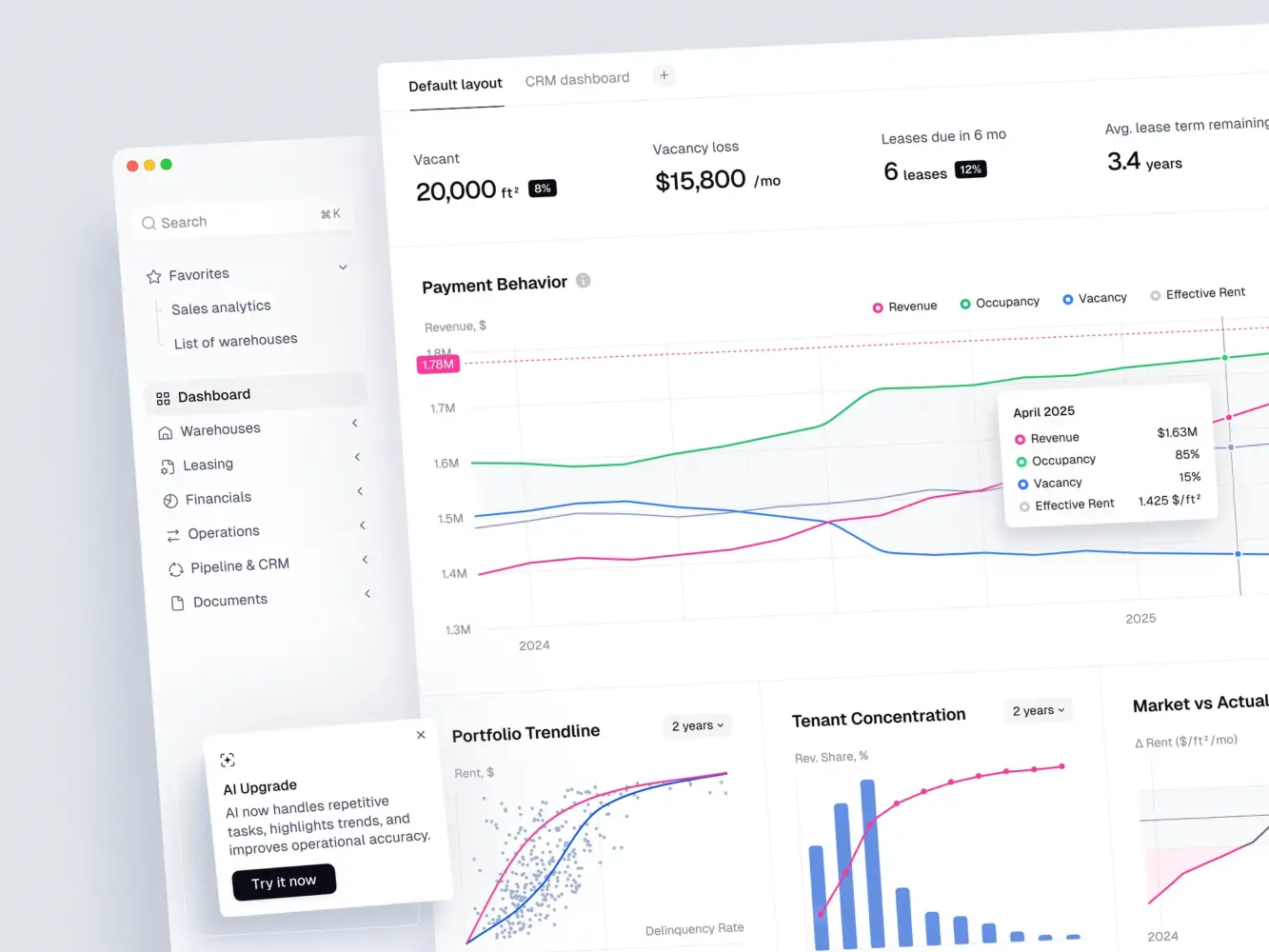
ERP Dashboard Design for Warehouse Portfolio Management by Shakuro

Cost of Big Data Platform Development
Project cost depends on four main factors.
Data volume affects storage, processing time, backup strategy, and infrastructure planning. A small internal analytics system and a petabyte-scale platform are not the same kind of project.
Infrastructure complexity also matters. Managed cloud services can reduce operational burden, while custom distributed systems give more control but require deeper engineering effort.
Processing requirements shape the architecture. Batch workloads are usually more predictable. Real-time or near-real-time workflows often cost more because they need stronger monitoring, lower latency, and more careful failure handling.
Storage strategy affects both the build and the long-term bill. File formats, compression, lifecycle policies, partitioning, and data retention rules can all change monthly cloud costs.
As a rough way to think about it:
- An initial data platform may focus on a few sources, a data lake, scheduled processing, and a small analytics layer.
- An enterprise big data system may include multiple domains, strict governance, hybrid processing, advanced monitoring, access management, and integrations with AI or reporting tools.
The second version is not just “more of the same.” It needs more architecture work, more testing, and more operational planning.
| Scenario | Best for | Typical scope | Approximate development cost | Ongoing cost factors |
| Initial data platform | Startups, MVPs, or teams building their first centralized data foundation | 2-4 data sources, basic data lake, scheduled batch pipelines, simple transformations, one analytics or reporting layer, basic monitoring | $60,000-$150,000 | Cloud storage, small processing workloads, pipeline maintenance, basic support |
| Middle-size platform | Growing SaaS, fintech, e-commerce, or operational products with regular analytics needs | 5-10 data sources, stronger data modeling, workflow orchestration, Spark-based processing, role-based access, dashboards, data quality checks, staging and production environments | $150,000-$400,000 | Compute usage, orchestration tools, data quality monitoring, dashboard maintenance, DevOps support |
| Enterprise-level platform | Large organizations with high data volume, multiple teams, compliance needs, or AI/ML workflows | Many internal and external sources, lakehouse architecture, batch and near-real-time processing, metadata management, governance, lineage, advanced security, observability, disaster recovery, AI-ready datasets | $400,000-$1,000,000+ | Large-scale storage, distributed compute, security and compliance, platform operations, optimization, long-term support |

Common Challenges in Big Data Platform Development
Data growth is the obvious challenge. Storage fills up, processing jobs take longer, and queries that worked yesterday begin to crawl.
Infrastructure cost is another. Distributed systems can become expensive quickly if teams overprovision clusters, keep unnecessary raw data forever, or run inefficient jobs on a schedule no one questions.
Data quality is often harder than expected. Missing values, duplicate records, inconsistent event names, late-arriving data, and undocumented source changes can all break trust.
Architecture complexity grows with every new source, consumer, and compliance rule. This is why teams need clear ownership, documentation, monitoring, and governance from the start.
And then there are streaming systems. They are powerful, especially for fraud detection, operational alerts, and live product analytics. But they add their own design questions around ordering, retries, state, and latency. Shakuro’s article on streaming systems goes deeper into that area.
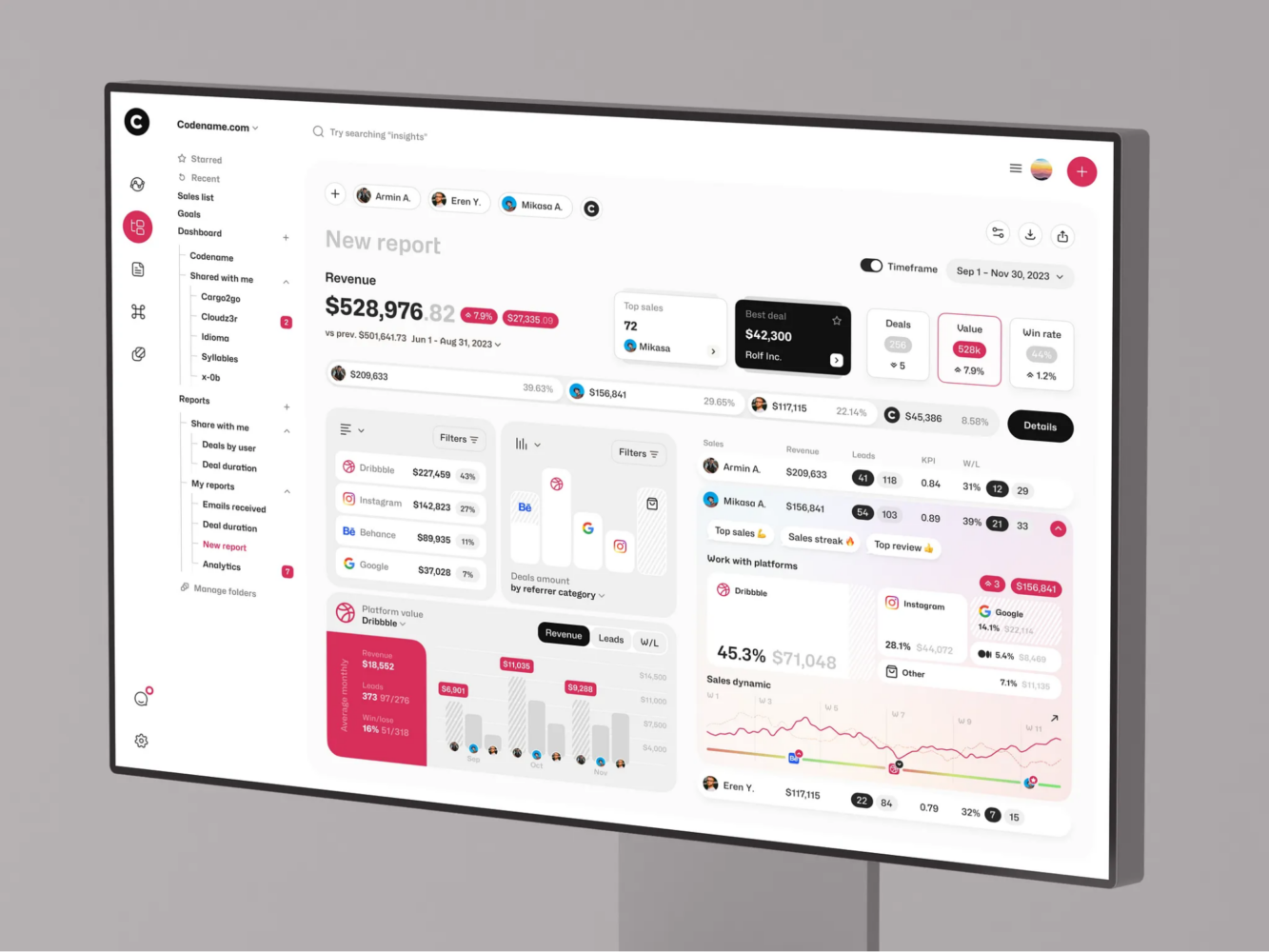
Sales Tracking SRM Dashboard UI/UX Design by Shakuro
Our Experience in Data Platform Development
We work with products where backend engineering, analytics, UX, and scalable infrastructure need to fit together. That includes SaaS platforms, fintech products, analytics systems, and data-heavy web applications.
The useful part is not only writing processing jobs or choosing storage. It is connecting the full product picture:
- what data the business needs;
- how the platform should process it;
- how users will access the results;
- where the system needs to scale;
- how to keep cost and complexity under control.
Symbolik: Create a Large-Scale Data System
Projects like Symbolik show the kind of product thinking that matters here: complex systems still need to feel understandable to the people using them. That same idea applies to analytics dashboards, internal platforms, and data products. The backend can be sophisticated, but the experience should not make users fight for every answer.
For Symbolik, we’ve created easy-to-use and glanceable charts that help improve decision-making. The architecture is resilient and can deal with large amounts of financial data. This allows people to manage their resources effectively.
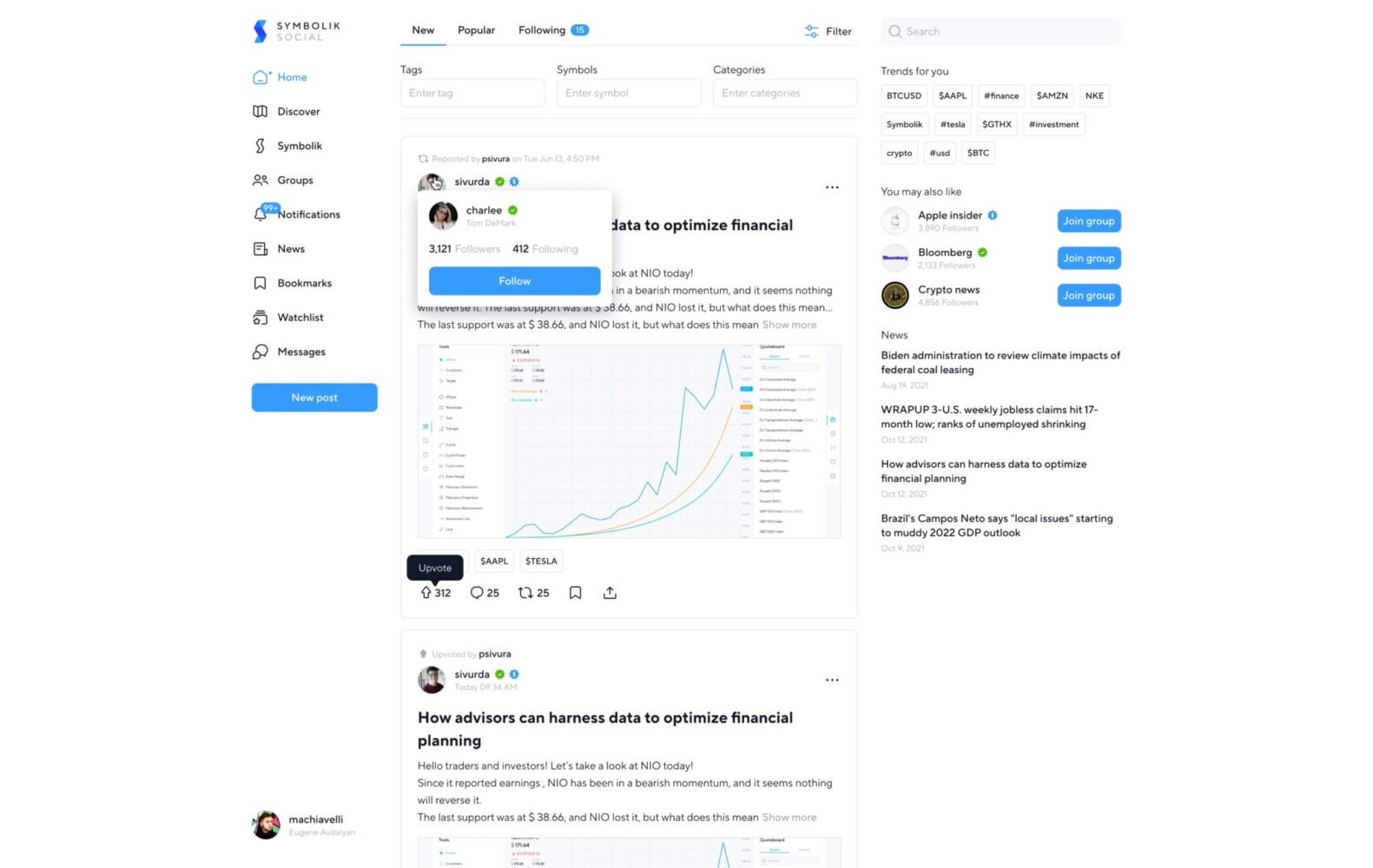
Symbolik Social by Shakuro
Why Work with a Big Data Platform Development Company
Building this kind of platform with an experienced team can save a lot of rework.
A specialist development company brings experience with distributed systems, data pipelines, backend architecture, analytics products, and production infrastructure. That helps teams avoid common traps, such as overbuilding the first version, choosing tools that are hard to operate, or ignoring governance until the platform becomes messy.
There is also a cost angle. Good distributed data platform is not always the biggest architecture. Sometimes the right move is a lean data lake, a few reliable pipelines, and a clear path toward more advanced processing later. Sometimes the product really does need a large distributed setup from day one.
The difference is knowing which situation you are in.
Final Thoughts
Big data solutions take data through a long path: collection, storage, processing, organization, access, and, finally, insight. Each step affects the next one.
The most successful platforms usually have three things in common. Their architecture matches the business use case. Their data is organized well enough for people to trust it. Their infrastructure is built with cost and operations in mind, not just scale on a diagram.
Planning to build a big data platform? Shakuro can help shape the architecture, develop the backend and data pipelines, and turn the platform into something your team can actually use. Start with the problem you need to solve, and build from there.
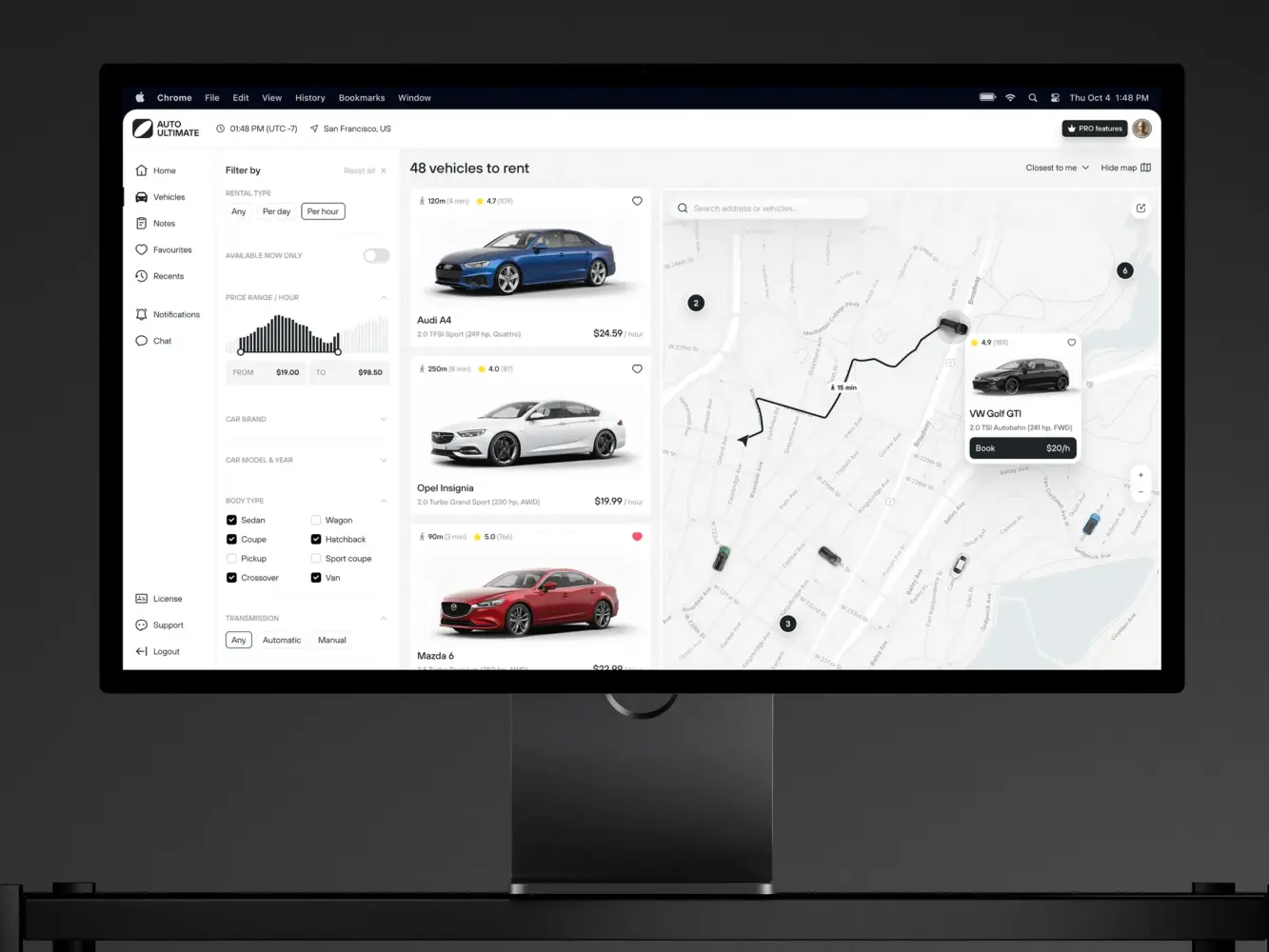
Dashboard Design For a Car Rental Service by Shakuro
FAQ
What does big data platform development include?
Big data platform development covers the design and construction of systems that ingest, store, process and deliver large quantities of data from apps, logs, APIs, transactions and other sources. These platforms usually depend on distributed storage, parallel processing, data pipelines, metadata management and analytics tooling. The work moves from data strategy through architecture design, technology selection, pipeline setup, data modeling and testing to deployment and scaling.
What sets a big data platform apart from a data warehouse?
A data warehouse is generally built for structured, cleansed data and business reporting. A big data platform handles a broader range of data types, including raw, semi-structured and unstructured data, and usually adds heavier processing, data lakes and machine learning pipelines. Many teams start with a data lake and move toward a lakehouse, which keeps the scale of a lake but adds structure, governance and query performance.
What technologies are used in big data platform architecture?
Common technologies include Spark and Hadoop for distributed processing, S3, HDFS or cloud-native storage, Python for backend services and automation, Kubernetes for container orchestration, SQL engines, workflow orchestration tools and cloud data services. The right stack depends on data volume, processing needs, team skills and budget. A stack your team cannot operate wastes time on learning instead of delivery.
Does a big data platform need real-time data processing?
No, many companies can start with scheduled batch processing and still get strong business value. Real-time processing is useful when speed changes the outcome, such as fraud detection, live monitoring, time-sensitive recommendations or operational alerts. Streaming adds design questions around ordering, retries, state and latency, so a hybrid model often works best: batch jobs for heavy historical work and streaming for time-sensitive events.
How long does it take to build a big data platform?
An initial big data platform typically takes 3-6 months, while larger or enterprise systems take 6-12+ months. A focused first version with a few sources and batch pipelines sits at the shorter end. Enterprise platforms with governance, multiple data domains, hybrid processing, lineage, disaster recovery and advanced analytics take longer because they need more architecture work, more testing and more operational planning.
How much does big data platform development cost?
Approximate development cost is $60,000-$150,000 for an initial platform with 2-4 data sources and scheduled batch pipelines, $150,000-$400,000 for a middle-size platform with 5-10 data sources and Spark-based processing, and $400,000-$1,000,000+ for an enterprise lakehouse with governance and near-real-time processing. Data volume, infrastructure complexity, processing requirements and storage strategy drive where a project lands within these ranges.
What ongoing costs should you expect after launching a big data platform?
Expect recurring spend on cloud storage, compute usage, pipeline maintenance, data quality monitoring, dashboard maintenance and DevOps support, with security, compliance and platform operations added at enterprise scale. Costs grow quickly when teams overprovision clusters, keep unnecessary raw data forever or run inefficient jobs on a schedule nobody questions. Partitioning, file formats, compression, lifecycle policies and retention rules all change the monthly cloud bill.
Related reading
- Data Analytics for eLearning Platforms: How to Build Data-Driven EdTech Systems
- SaaS Dashboard Development: How to Build Scalable Product Dashboards
- Trading Software Development: How to Build a Custom Trading Platform
- Corporate Training Platform Development: How to Build Scalable Employee Learning Systems