By 2026, UX/UI design is tightly tied to how a product is built and maintained. For web and mobile teams, design decisions affect development speed, technical debt, usability in real conditions, and how painful future changes will be. Because of this, the choice of a design agency has become a product decision, not a cosmetic one.
This article looks at top UI/UX design agencies that work on web and mobile products in production, not just on visual concepts. These are teams that design SaaS platforms, mobile apps, enterprise tools, and data-driven systems where interfaces have to survive real usage, edge cases, and ongoing development.
Each agency is described in practical terms: what they usually work on, where they tend to be strong, and in what situations they are a reasonable choice. The focus is on day-to-day product work rather than positioning statements or trend-driven design.
The list is meant for teams comparing agencies for actual product work in 2026, whether that is a new web or mobile build, a redesign, or a long-term collaboration.
TL;DR
This article reviews top UI/UX design agencies that work with web and mobile products. The list is based on client reviews, real project portfolios, industry experience, and overall reputation.
Below is a short breakdown of which agency usually fits which type of project.
| Agency | Location | Specialization | Rating | Best for | Notable strengths |
| Shakuro | USA (San Francisco), distributed | UX/UI + development | Clutch: ~5.0 DesignRush: 4.7 GoodFirms: 5.0 |
SaaS and fintech teams | Design that survives development, strong production UI, experience past MVP |
| Momentum Design Lab | USA (Palo Alto / SF Bay Area), global | Enterprise & B2B UX | Clutch: ~4.9 DesignRush: 5.0 GoodFirms: listed profile |
Large, already complex products | Role-based UX, dense workflows, predictable long-term work |
| Neuron | USA (SF, LA, Boston) | UX research & structure | Clutch: ~5.0 DesignRush: 4.3 GoodFirms: 5.0 |
Workflow-heavy or messy products | Untangling logic, research before UI, working inside existing systems |
| UX studio | Hungary (Budapest), EU/UK/US | Research-driven UX/UI | Clutch: ~5.0 DesignRush: 4.8 GoodFirms: 5.0 |
Teams that want decisions backed by research | Strong discovery, clear reasoning, scalable systems |
| Creative Navy | UK (London), Germany (Berlin) | UX for complex software | Clutch: ~5.0 DesignRush: 4.9 GoodFirms: 5.0 |
Data-heavy B2B products | Discovery, handling complexity without flattening |
| Goji Labs | USA (Los Angeles) | Design + build | Clutch: ~5.0 G2: 5.0 DesignRush: 5.0 GoodFirms: 5.0 |
Startups, fast-moving teams | One team for design and dev, shipping focus |
| Guidea | USA (Austin, TX) | UX strategy & research | Clutch: ~5.0 DesignRush: 5.0 GoodFirms: not listed |
Early-stage direction and alignment | Senior UX input, stakeholder-heavy work |
| Clay | USA (San Francisco), global | Product UX/UI + brand | Clutch: ~4.8 DesignRush: 4.9 GoodFirms: listed profile |
Brand-sensitive products | High-end UI, structured delivery |
| Ramotion | USA (San Francisco), global | Product + brand UX/UI | Clutch: ~4.9 DesignRush: 4.9 GoodFirms: listed profile |
Consistent UX across product & marketing | Cohesive systems, close collaboration |
| Metalab | Canada (Victoria / Vancouver) | Product interface design | Clutch: Listed (no rating) DesignRush: 4.9 GoodFirms: not listed |
Teams choosing by portfolio | Interface polish, shipped products |
What Makes a Good UX/UI Design Agency?
A good UX/UI agency isn’t the one with the nicest screens. Those are easy to produce. The difference shows up later, when the product is being built, changed, and argued over.
When you’re choosing an agency, the useful questions are usually very practical.
Things that actually matter:
- Do they ask uncomfortable questions early
About tech limits, deadlines, internal politics, legacy decisions. If everything sounds easy at the start, it usually isn’t. - Can they explain their decisions without hiding behind terminology
You should be able to understand why something works, what problem it solves, and what was sacrificed. If every answer turns into a framework, the thinking probably isn’t finished. - Have they worked on products like yours, not just “in the industry”
A SaaS dashboard, a consumer app, and an internal tool behave very differently. Past experience saves a lot of time and bad assumptions. - How they deal with change
Requirements always move. A good agency doesn’t panic or restart from scratch every time something shifts. - How design connects to development
This is where most projects break. Agencies that are used to working with engineers tend to design things that don’t fall apart at handoff. - What happens after the first version
Launch is rarely the end. Good agencies think about what happens when features pile up and quick decisions start to haunt the product. - Whether their strengths match your situation
Some teams are great at figuring things out early. Others are better at cleaning up and scaling. The mistake is picking based on reputation instead of fit.
Good UI/UX design services don’t make a product “beautiful.” They make it easier to build, easier to change, and easier to live with six months later. That’s usually the real test.
How We Tested the Best UX/UI Design Agencies
There wasn’t a formal scoring model or a spreadsheet with weighted coefficients behind this list. The agencies were filtered the same way most product teams filter partners in real life: by looking at what they’ve actually shipped, how they work, and whether their strengths show up consistently over time.
First, we looked at public work. Not concept shots or single-screen case studies, but products that appear to be in use: SaaS platforms, mobile apps, enterprise tools, and systems with obvious complexity. If an agency’s portfolio didn’t show how design holds up beyond the “happy path,” it didn’t make the cut.
Client feedback was used as a signal, not a verdict. Clutch and similar platforms helped confirm patterns: long-term engagements, repeat clients, and consistent comments about process and collaboration. One-off praise or vague testimonials weren’t treated as meaningful on their own.
We also paid attention to the type of problems these agencies tend to be hired for. Some teams are repeatedly brought in to untangle workflows, others to stabilize mature products, others to design and build from scratch. Agencies that had a clear pattern—rather than claiming they do everything equally well—stood out.
Finally, we looked at how agencies position their work relative to development. Teams that treat design as something separate from implementation tend to create friction later. Design agencies that show awareness of technical constraints, handoffs, and long-term maintenance are usually easier to work with once a product is in motion.
The goal wasn’t to crown a single “best” UI design company, but to identify teams that consistently do solid work in real product environments. That’s also why this list doesn’t rank agencies from one to ten—context matters more than scores.
The 10 Best UX/UI Design Agencies for Web & Mobile in 2026
Shakuro
- Location: USA (San Francisco), distributed team
- Website: https://shakuro.com
Platform ratings
- Clutch: ~5.0 / 5 (90+ reviews)
- DesignRush: 4.7 (4 reviews)
- GoodFirms: 5.0 (48 reviews)
Brief info
Shakuro is usually brought in on projects where separating design from development would just create problems later. They tend to work on products where interface decisions immediately affect how the system is built, extended, and maintained, so the team handles UX, UI, and engineering together instead of passing things along. This comes up a lot in SaaS and fintech work, where even small design choices have technical consequences that can’t be ignored.
Portfolio & examples
If you look through the portfolio, most of the work feels like real products that had to function beyond launch—SaaS platforms, fintech tools, dashboards, consumer apps—rather than one-off design concepts. The interfaces account for different states, edge cases, and real usage patterns, which usually means design decisions were made with implementation in mind from the start.
Projects typically include both design and development, which helps avoid the usual situation where something looks good in design files but becomes painful or expensive once engineers start building it.
Client / industry feedback
- Clients often describe the collaboration as structured but not bureaucratic, with designers and developers working alongside each other instead of in separate stages.
- There’s also a recurring emphasis on consistency over time, especially on longer projects where the product keeps changing after release rather than being “done” once it ships.
Notable strengths
- Design decisions that don’t fall apart once development starts, largely because technical constraints are considered early instead of being treated as an afterthought.
- UI work that holds up in production, including complex states and ongoing iteration, not just the happy path shown in mockups.
- Experience working with products past the MVP phase, when the main challenge is cleaning up early decisions and making the system easier to evolve.
Best fit
Teams that don’t want to manage a handoff between design and development and would rather work with one group that is responsible for both, especially on SaaS or fintech products that are expected to grow and change over time.
Momentum Design Lab
- Location: USA (Palo Alto / San Francisco Bay Area), plus global delivery
- Website: https://www.momentumdesignlab.com
Platform ratings
- Clutch: ~4.9 / 5 (94 reviews)
- DesignRush: 5.0 (4 reviews)
- GoodFirms: listed profile
Brief info
Momentum Design Lab works primarily with enterprise and B2B software teams whose products have already reached a level of complexity where structure, permissions, and long-term consistency matter more than visual experimentation. Their typical projects are not short redesign sprints but extended engagements focused on stabilizing UX, clarifying workflows, and putting order into systems that have grown organically.
Portfolio & examples
- The portfolio includes fintech platforms, internal enterprise systems, dashboards, and operational tools where data density and role-based access are core constraints rather than edge cases.
- Engagements usually combine UX strategy, interaction design, and UI systems that are expected to survive multiple roadmap cycles without constant rework.
Client / industry feedback
- Clients tend to describe the work as predictable and well-paced, with few surprises once the process is established.
- Longer-term collaborations are common, especially on enterprise products that evolve gradually rather than through major redesigns.
Notable strengths
- Comfortable working with role-based interfaces, dense tables, and multi-step operational workflows without flattening them for the sake of simplicity.
- A clearly documented process with regular checkpoints, which tends to reduce subjective decision-making and late-stage reversals.
- Design systems built to support scale and team handoff rather than visual presentation alone.
Best fit
Enterprise SaaS and B2B platforms that already exist and need to be structured, stabilized, and extended carefully without disrupting ongoing operations.
Neuron
- Location: USA (San Francisco, Los Angeles, Boston)
- Website: https://neuronux.com
Platform ratings
- Clutch: ~5.0 / 5 (52 reviews)
- DesignRush: 4.3 (1 review)
- GoodFirms: 5.0 (3 reviews)
Brief info
Neuron usually gets called in when teams feel that the UI is moving faster than the thinking behind it. A lot of their work is around B2B and internal products where getting the workflow right matters more than how the interface looks.
Portfolio & examples
Most of their portfolio is made up of internal tools and enterprise platforms, not marketing-focused products. Projects often start with research and UX work, with UI coming later, before engineering decisions are fully set.
Client / industry feedback
Clients often note that changes in scope are easier to handle once the core UX logic is agreed on. Communication is generally described as straightforward and to the point.
Notable strengths
They’re good at sorting out messy workflows in business software where requirements aren’t clear or keep changing. Research is usually translated into concrete screens and flows, without a lot of conceptual overhead. They’re also comfortable working within existing products rather than redesigning everything from scratch.
Best fit
B2B and enterprise teams working through early redesigns, workflow confusion, or products that grew faster than their UX structure.
UX studio
- Location: Hungary (Budapest), EU/UK/US delivery
- Website: https://uxstudioteam.com
Platform ratings
- Clutch: ~5.0 / 5 (41 reviews)
- DesignRush: 4.8 (28 reviews)
- GoodFirms: 5.0 (2 reviews)
Brief info
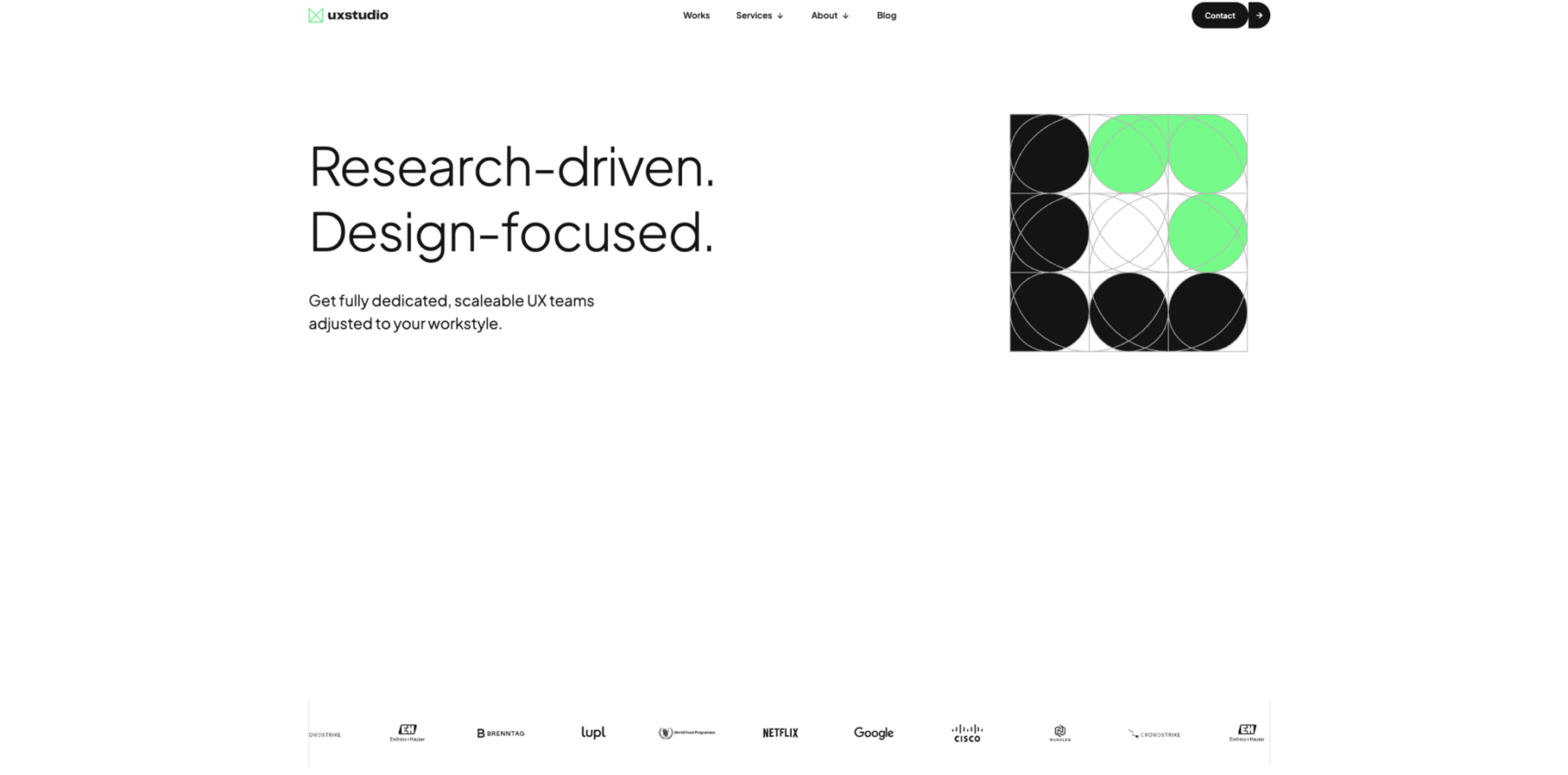
UX studio runs research-heavy UX projects where assumptions are expected to be tested and decisions defended, not simply agreed on internally. Discovery, interviews, and testing aren’t treated as a formality here—they’re part of the actual work, and UI decisions usually come out of what’s found along the way, not out of preference.
Portfolio & examples
The case studies tend to show how early research influenced later design decisions, rather than presenting UI in isolation. The work usually covers research, testing, UX direction, and UI design as one connected flow.
Client / industry feedback
- Clients often mention that the process feels open, especially when there are constraints or trade-offs that need to be discussed instead of glossed over.
- Collaboration across product and engineering teams is mentioned regularly.
Notable strengths
- Turning research findings into clear, prioritized design decisions rather than abstract insights.
- A structured delivery rhythm that makes expectations predictable for stakeholders.
- Design systems that are meant to evolve alongside the product rather than freeze it.
Best fit
Product teams that want UX decisions grounded in research and expect the product to continue evolving after launch.
Creative Navy
- Location: UK (London), Germany (Berlin)
- Website: https://www.creativenavy.com
Platform ratings
- Clutch: ~5.0 / 5 (53 reviews)
- DesignRush: 4.9 (15 reviews)
- GoodFirms: 5.0 (60 reviews)
Brief info
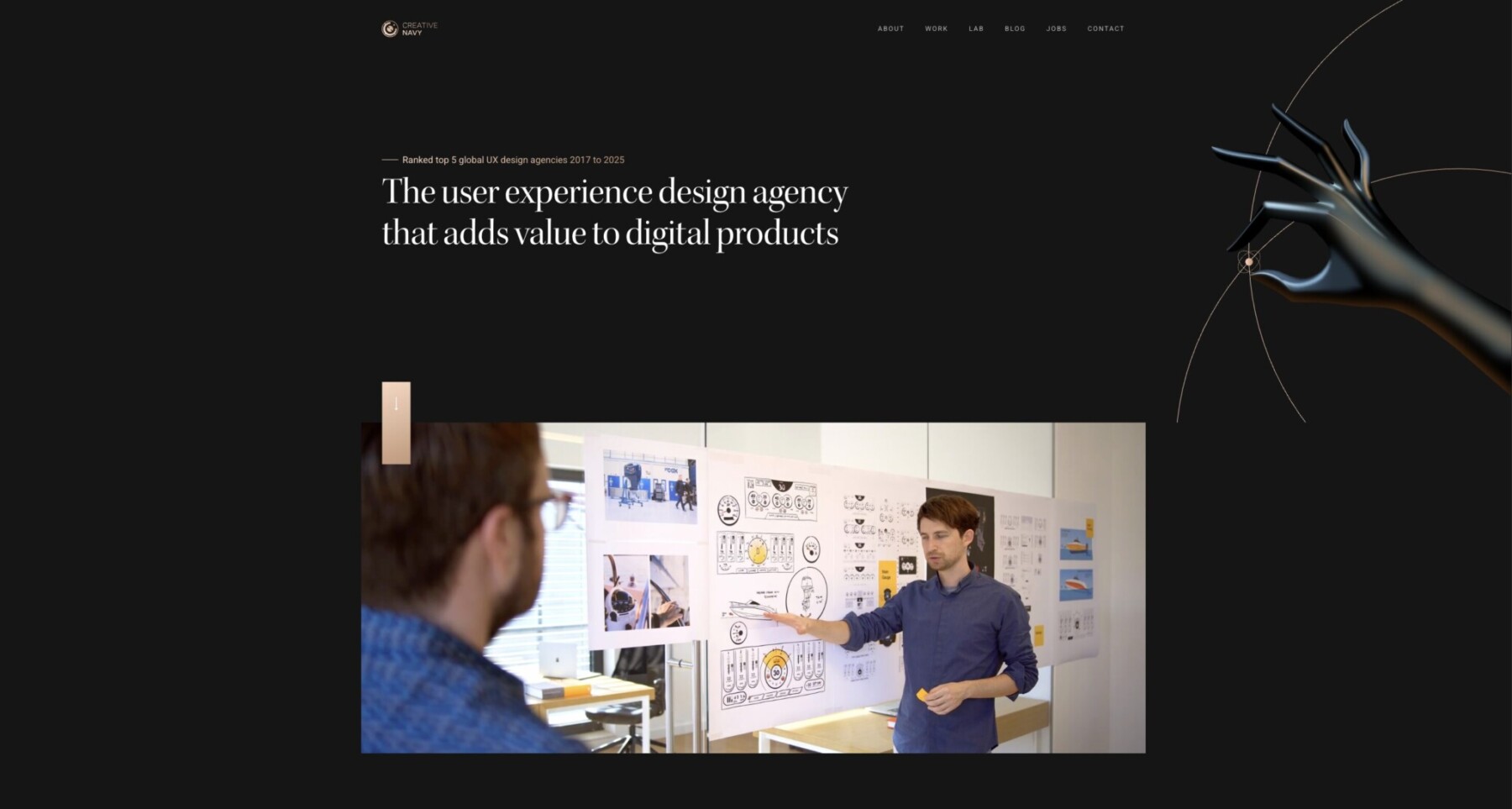
Creative Navy usually works on products where complexity is part of the job, not something to smooth over. Most of their projects sit in B2B or operational software, where requirements aren’t always clean, different stakeholders want different things, and UX decisions have to respect how the product actually works.
Portfolio & examples
- Their portfolio is mostly dashboards, B2B platforms, and internal tools with a lot of information on screen. Instead of trying to simplify everything, the focus is on making dense interfaces usable and consistent.
- The service scope usually spans UX strategy, research, and UI design, with a clear emphasis on understanding workflows before shaping interfaces.
Client / industry feedback
- Clients often describe the delivery as steady and predictable, with a working rhythm that remains consistent throughout the project lifecycle.
- Feedback frequently connects UX changes to concrete business outcomes, rather than treating them as cosmetic improvements.
Notable strengths
They spend enough time upfront to uncover where requirements clash and where workflows break, which makes later decisions easier.
They’re used to working with tight timelines, fixed budgets, and older systems that can’t just be replaced. Improvements tend to focus on making things easier to use without flattening the underlying logic or data.
Best fit
B2B and data-heavy products that need clearer UX without simplifying the product to the point where it loses its core functionality.
Goji Labs
- Location: USA (Los Angeles)
- Website: https://gojilabs.com
Platform ratings
- Clutch: ~5.0 / 5 (84 reviews)
- G2: 5.0 / 5 (2 reviews)
- DesignRush: 5.0 (71 review)
- GoodFirms: 5.0 (48 reviews)
Brief info
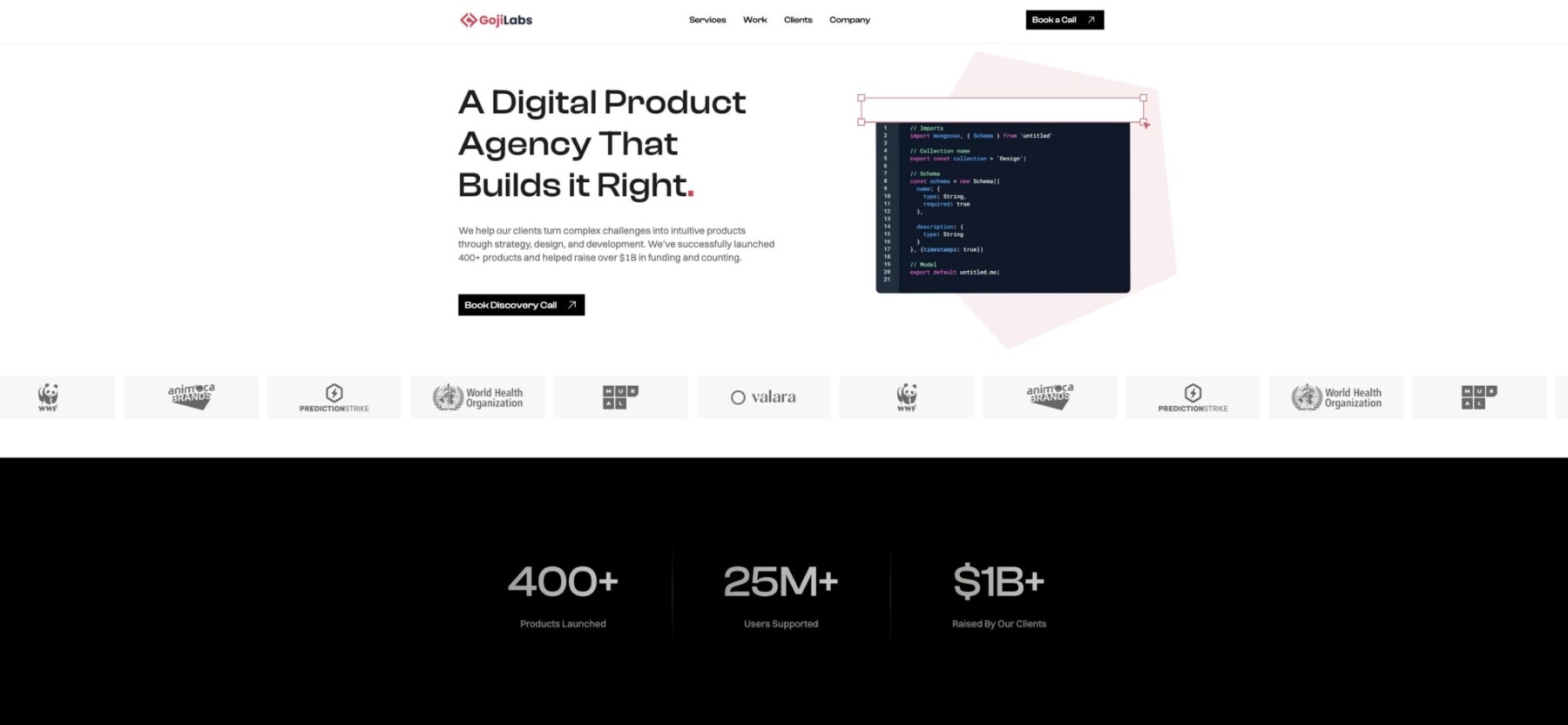
Goji Labs is usually brought in by teams that don’t want to split design and development across different vendors. They handle UX/UI and build work together, which tends to suit startups, nonprofits, and smaller product teams that need things to move without too much coordination overhead.
Portfolio & examples
The portfolio shows full product work across web and mobile, with examples that go past design files and into finished, working products. Most projects are handled by one team covering product thinking, UX/UI, and development.
Client / industry feedback
Clients often mention that responsibility stays clear throughout the project, which helps avoid delays caused by handoffs. G2 feedback points in a similar direction, although the number of reviews there is still small.
Notable strengths
- Design and engineering handled together, reducing friction between concept and implementation.
- Direct communication with stakeholders throughout the project, without layered intermediaries.
- A practical focus on shipping production-ready work rather than polishing concepts indefinitely.
Best fit
Teams that want one partner responsible for both design and build, especially during early stages or fast-moving product phases.
Guidea
- Location: USA (Austin, TX)
- Website: https://guidea.com
Platform ratings
- Clutch: ~5.0 / 5 (43 reviews)
- DesignRush: 5.0 (1 review)
- GoodFirms: not listed
Brief info
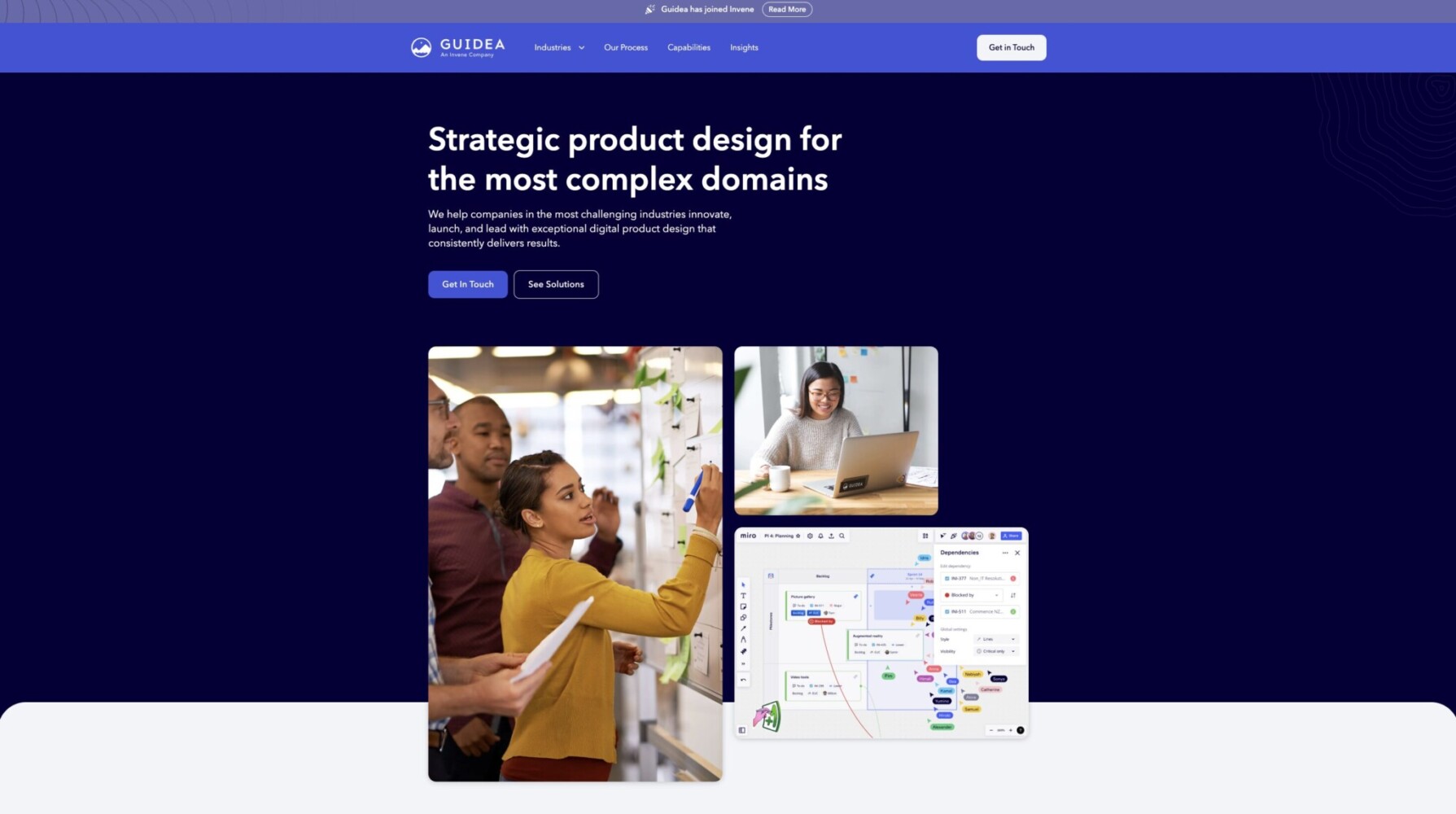
Guidea is usually involved when teams need to pause execution and clarify product direction before committing to interface decisions. Their work leans toward senior UX strategy and research, particularly in situations where internal alignment is missing or the problem space has not yet been clearly defined.
Portfolio & examples
- Case studies span multiple industries and focus on product UX/UI rather than marketing surfaces.
- The work usually focuses on UX strategy, research, and product design, rather than visual production alone.
Client / industry feedback
Clients tend to talk about the work being solid and consistent, especially across longer projects. Pricing is often described as on the higher side, with the expectation that you’re paying for experience and outcomes, not just hours or screens.
Notable strengths
They’re often brought in early, when the product direction is still unclear and decisions haven’t settled yet. There’s a strong focus on lining up business needs, user problems, and what’s actually possible to build. They’re also used to working in setups with many stakeholders and competing opinions.
Best fit
Teams that need clear UX direction and support in decision-making, not just interface execution.
Clay
- Location: USA (San Francisco), global delivery
- Website: https://clay.global
Platform ratings
- Clutch: ~4.8 / 5 (31 reviews)
- DesignRush: 4.9 (37 reviews)
- GoodFirms: listed profile
Brief info
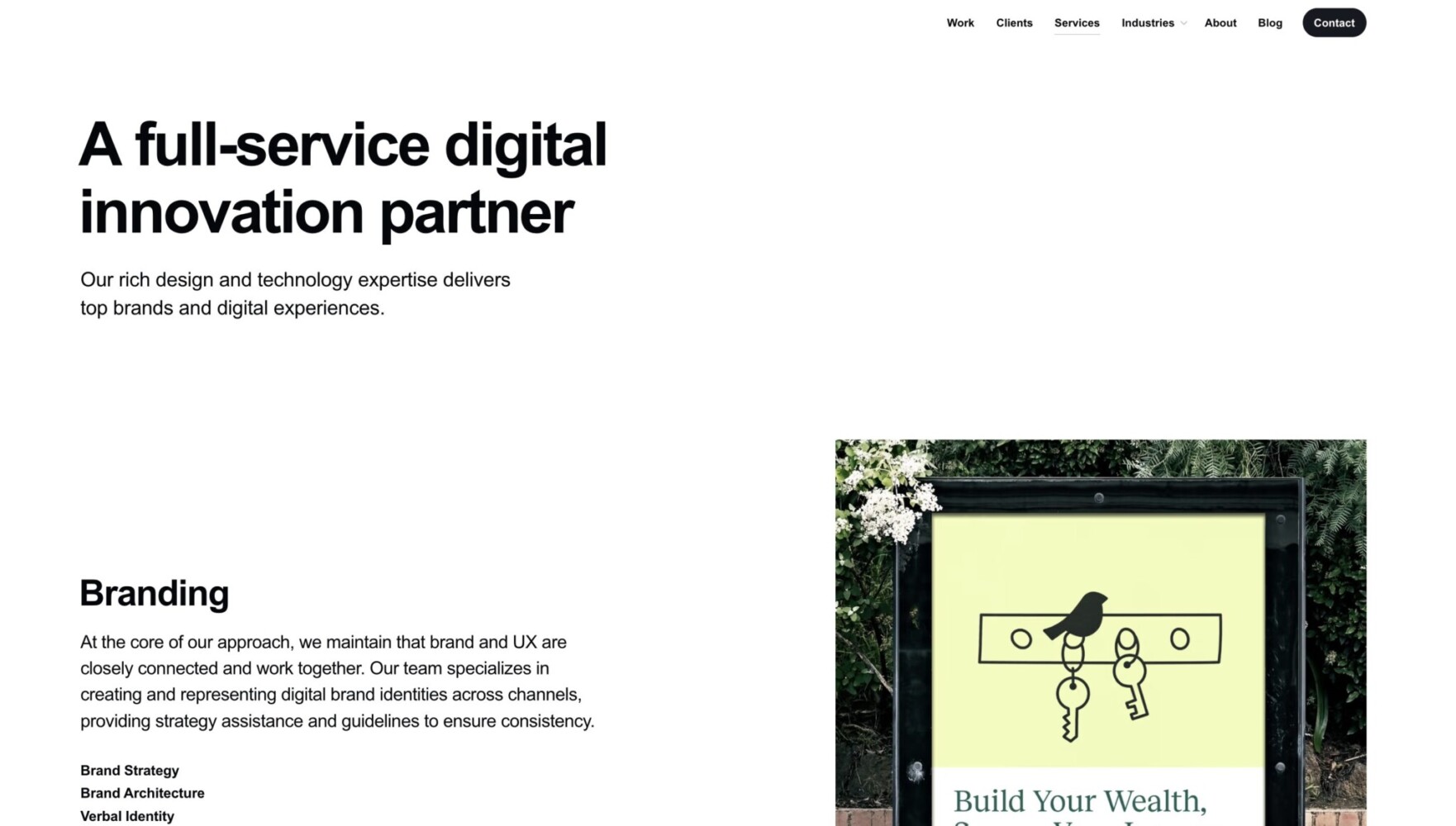
Clay is usually picked when how the product looks actually matters for how it’s perceived. A lot of their work is with tech companies that care about visual quality as part of the product itself, not just as decoration. The focus is clearly on strong interfaces, with UX structure underneath to keep things usable.
Portfolio & examples
The portfolio of this UI design company includes both consumer products and B2B tools, with an emphasis on finished interfaces rather than abstract concepts. Alongside product UX/UI, they also handle brand and experience design.
Client / industry feedback
- Clients tend to mention clear communication and a process that feels controlled, without the sense that things are being rushed.
- Clutch scores suggest quality is rated higher than cost.
Notable strengths
- High-quality UI craft supported by solid UX foundations.
- Clear delivery structure on projects with high visibility.
- An ability to translate complex product ideas into interfaces that remain clear and approachable.
Best fit
Products where UX/UI quality directly affects brand perception and market positioning.
Ramotion
- Location: USA (San Francisco), global delivery
- Website: https://www.ramotion.com
Platform ratings
- Clutch: ~4.9 / 5 (29 reviews)
- DesignRush: 4.9 (23 reviews)
- GoodFirms: listed profile
Brief info
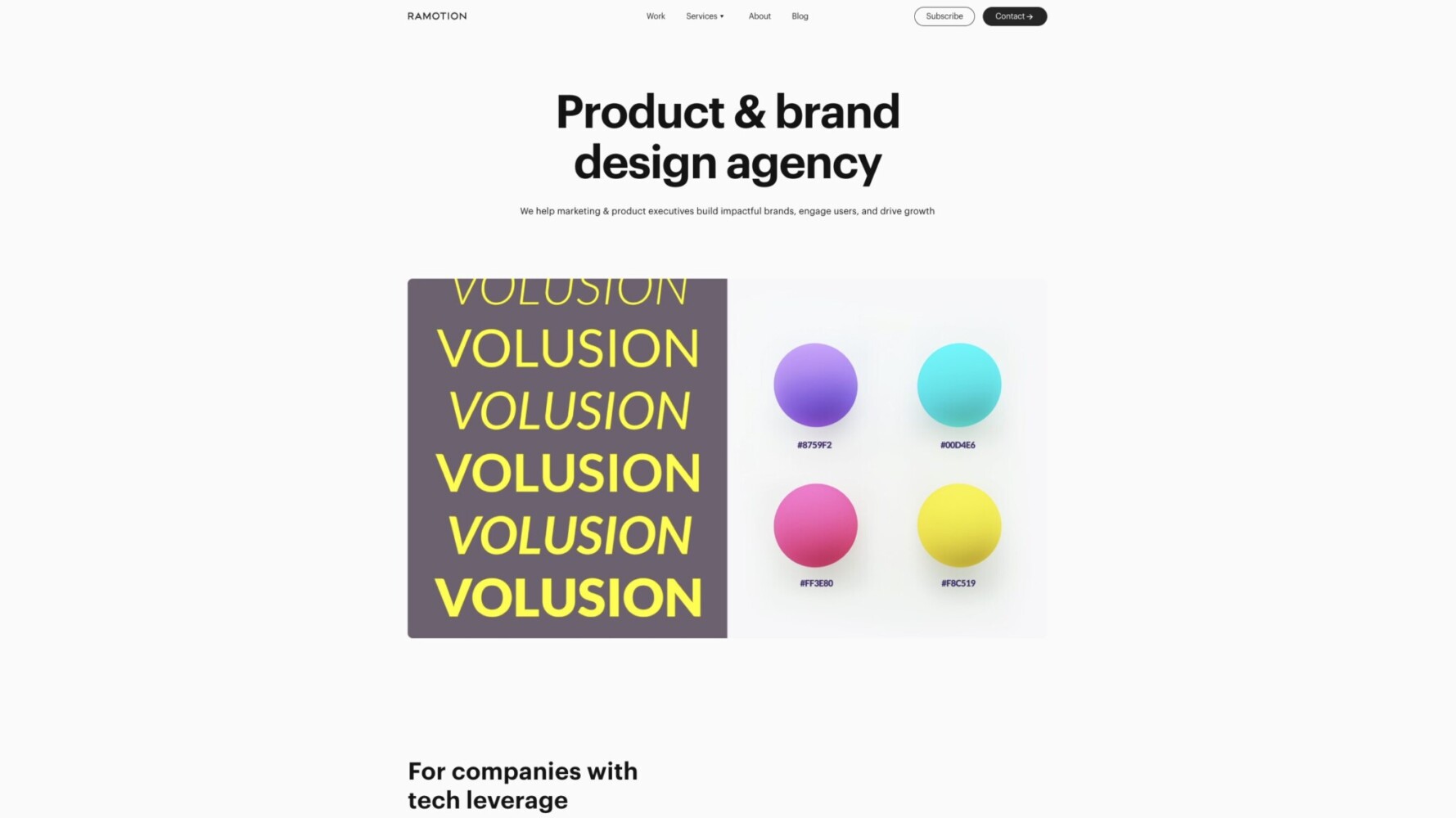
Ramotion is often chosen when a team wants the product, the marketing site, and the mobile app to stop looking like separate pieces. The work is less about individual features and more about making sure everything follows the same visual rules.
Portfolio & examples
- The portfolio includes product UX/UI, branding systems, and mobile/web work.
- Service scope covers both product and brand design.
Client / industry feedback
- Reviews often reference long-term collaboration rather than short, transactional projects.
- Flexibility during evolving requirements is mentioned frequently.
Notable strengths
- A unified approach to brand and product UX.
- Close collaboration with internal teams.
- Design assets prepared with engineering handoff in mind.
Best fit
Startups and product companies that need consistent UX across product, marketing, and mobile channels.
Metalab
- Location: Canada (Victoria / Vancouver)
- Website: https://www.metalab.com
Platform ratings
- Clutch: listed, no public rating
- DesignRush: 4.9 (10 reviews)
- GoodFirms: not listed
Brief info
Metalab’s reputation is driven more by shipped work and portfolio recognition than by review volume on third-party marketplaces. Teams tend to choose them based on taste, execution quality, and familiarity with modern product interfaces rather than process transparency.
Portfolio & examples
- The portfolio shows shipped interfaces across a range of modern software products.
- The DesignRush profile highlights notable clients as listed.
Client / industry feedback
- Feedback is primarily surfaced through directories rather than long-form reviews.
- Metalab’s own site emphasizes shipped outcomes over conceptual explorations.
Notable strengths
- A high level of interface polish on shipped products.
- A product-oriented mindset that favors implementation over conceptual work.
- Often selected for taste and execution rather than visible process.
Best fit
Product teams that prioritize interface quality and are comfortable choosing based on portfolio reputation rather than review volume.
UX/UI Design Agency Buyer’s Guide
When choosing among top UX agencies, most bad decisions come from looking at the wrong signals. Visual polish, brand names, and awards are easy to compare, but they don’t tell you much about how the agency will behave once real product constraints show up.
What’s more useful is to break the choice down into a few concrete questions.
Things to consider before you decide:
- What stage your product is in
Some agencies are strongest at early discovery and shaping direction, others at refining and stabilizing an existing product. Very few are equally good at both. - How much uncertainty you’re dealing with
If requirements are still fuzzy, you’ll need an agency that’s comfortable asking questions and slowing things down early. If the scope is clear, execution and consistency matter more. - Whether the agency has worked on similar products
“Same industry” matters less than “same type of complexity.” A team used to SaaS dashboards will move differently than one focused on marketing sites or consumer apps. - How design decisions are explained
You should be able to understand why something is designed a certain way, what problem it solves, and what trade-offs were made. If explanations stay abstract, expect issues later. - How change is handled
Requirements will shift. Good agencies don’t treat that as a failure or a reset, but as part of normal product work. - How design connects to development
Ask how handoff works, how engineers are involved, and what happens when something turns out to be hard to build. This is where many projects quietly fall apart. - What the engagement looks like after launch
Products rarely stop evolving. Agencies with long-term experience tend to think in systems and patterns, not just screens. - Whether communication feels straightforward
Early conversations are usually a good preview. If things already feel overly polished or vague, that tone often carries into the work.
Choosing the best UI design company is less about finding the “top” name and more about finding a team that fits the reality of your product, your constraints, and how you actually work.
Related reading